NOIRLab/ NSF /AURA
| Type | Galaxy | Constellation | Vir |
|---|---|---|---|
| Magnitude | 9.6 | Size | 5.0′ |
| Distance | 60.0 million light-years | Best Month | May |
| Visibility | Global | Difficulty | Moderate (level 3/4) |
| Min. Aperture | 3in | RA / Dec | 12h 41m 60.0s · +11° 39' 00" |
| Discovered by | Johann Gottfried Koehler, 1779 | ||
NOIRLab/ NSF /AURA
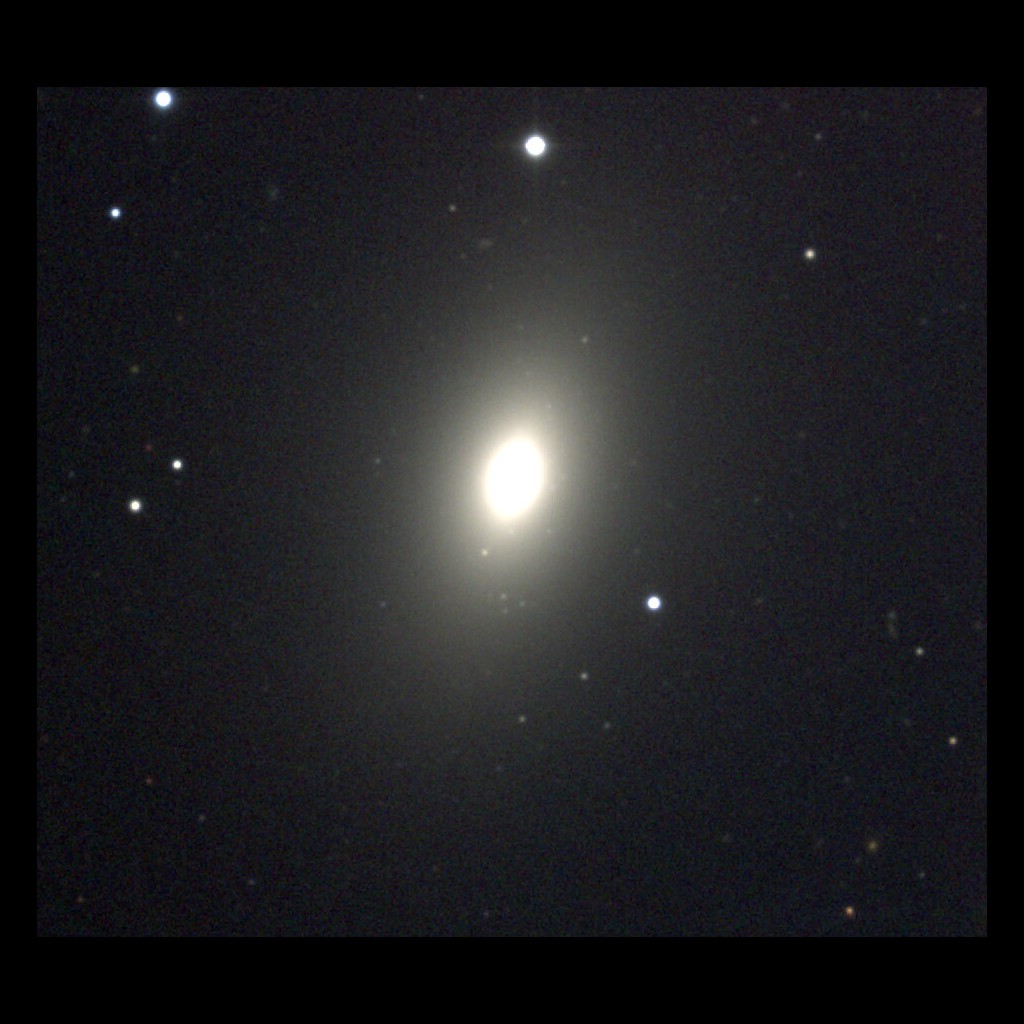
Messier 59 (NGC 4621) is an elliptical galaxy of type E5 in the constellation Virgo, one of many members of the sprawling Virgo Cluster of galaxies approximately 60 million light-years from Earth. It was discovered by Johann Gottfried Koehler on April 11, 1779, just days before Charles Messier independently catalogued it on April 15 of the same year. NGC 4621 is a classic elliptical: smooth, featureless, and oval in shape with no spiral arms, dust lanes, or star-forming regions — just a symmetric, softly glowing sphere of ancient stars fading gradually into the surrounding sky. While smaller than the giant ellipticals M49, M60, and M87, NGC 4621 is by no means negligible, containing hundreds of billions of stars.
Like all large elliptical galaxies, NGC 4621 is dominated by an old, metal-rich stellar population — stars formed billions of years ago in early, intense bursts of star formation that consumed virtually all available gas. Buried at its center is a supermassive black hole of roughly 400 million solar masses. M59 is noteworthy for having one of the fastest known rotation rates among elliptical galaxies of its size, suggesting a complex dynamical history that may include past merger events. A large system of globular clusters — roughly 1,900 — surrounds the galaxy and can be glimpsed as faint point sources in deep images.
In binoculars M59 is a faint smudge; a small telescope shows an oval glow with a brighter nucleus. This image was assembled from B (25 minutes), V (14 minutes), and R (10 minutes) exposures taken at the Kitt Peak National Observatory 0.9-meter telescope in December 1996 and April 1998.
Navigate from Spica toward Virgo. In the Virgo Cluster — near M60, both visible in the same wide field.
| Star | Bayer | Mag | Spectral Type | Distance | Meaning |
|---|---|---|---|---|---|
| Denebola | — | 2.14 | A3 · White main sequence | 36 ly | Arabic Dhanab al-Asad, 'Tail of the Lion' — marks the lion's tail. One of the few stars where infrared excess suggests a debris disk. |
| Mufrid | β Boo | 2.68 | G0 · Yellow subgiant | 37 ly | Arabic Al-Mufrid, 'The Solitary Star of the Lancer' — close companion to brilliant Arcturus in the sky, though not physically related. |
| Vindemiatrix | — | 2.85 | G8 · Yellow giant | 102 ly | Latin for 'The Grape Gatherer' — its heliacal rising in ancient times signaled the grape harvest season in the Mediterranean. |