NOIRLab/ NSF /AURA
| Type | Galaxy | Constellation | Vir |
|---|---|---|---|
| Magnitude | 8.8 | Size | 7.4′ |
| Distance | 55.0 million light-years | Best Month | May |
| Visibility | Global | Difficulty | Easy (level 2/4) |
| Min. Aperture | binoculars | RA / Dec | 12h 43m 37.2s · +11° 33' 00" |
| Discovered by | Johann Gottfried Koehler, 1779 | ||
NOIRLab/ NSF /AURA
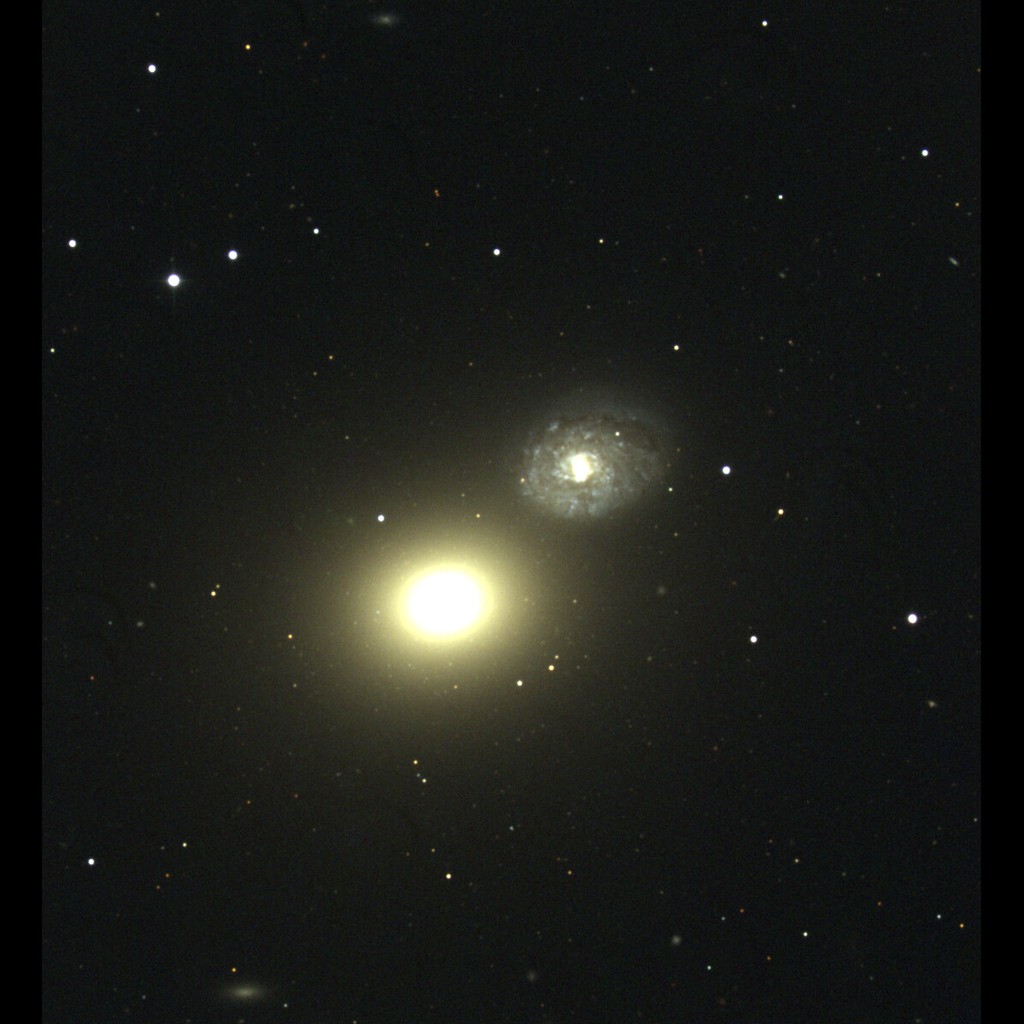
Messier 60 (NGC 4649) is one of the largest and most massive elliptical galaxies in the Virgo Cluster, spanning approximately 120,000 light-years across — larger in physical size than the Milky Way — at a distance of about 60 million light-years in the constellation Virgo. It was discovered by Johann Gottfried Koehler on April 11, 1779, and independently catalogued by Charles Messier on April 15, 1779. NGC 4649 shines at apparent magnitude 8.8, making it the brightest non-active elliptical galaxy in the Virgo Cluster. Its smooth, centrally concentrated profile is immediately recognizable in any telescope, and a striking bonus lies just to the northwest: the late-type spiral NGC 4647, which appears superimposed on M60's outer halo in this image and creates a visually compelling contrast of galaxy types.
NGC 4649 harbors one of the most massive supermassive black holes of any galaxy near us, with a mass estimated at 4.5 to 7 billion solar masses — comparable to the black hole in M87. The galaxy is surrounded by one of the richest known globular cluster systems: thousands of globular clusters have been identified around M60, and many are visible as faint point sources in deep images. Like other giant ellipticals in the Virgo Cluster, NGC 4649 is believed to have grown to its current enormous size through the merging of smaller galaxies over billions of years.
Through binoculars M60 appears as a bright, star-like glow next to a fainter smudge (NGC 4647); a small telescope clearly shows M60's round, concentrated form alongside the elongated companion. This image was taken in April 1998 at the Kitt Peak National Observatory 0.9-meter telescope.
Navigate from Spica toward Virgo. In the Virgo Cluster — forms a pair with M59 just 0.5° west.
| Star | Bayer | Mag | Spectral Type | Distance | Meaning |
|---|---|---|---|---|---|
| Denebola | — | 2.14 | A3 · White main sequence | 36 ly | Arabic Dhanab al-Asad, 'Tail of the Lion' — marks the lion's tail. One of the few stars where infrared excess suggests a debris disk. |
| Mufrid | β Boo | 2.68 | G0 · Yellow subgiant | 37 ly | Arabic Al-Mufrid, 'The Solitary Star of the Lancer' — close companion to brilliant Arcturus in the sky, though not physically related. |
| Vindemiatrix | — | 2.85 | G8 · Yellow giant | 102 ly | Latin for 'The Grape Gatherer' — its heliacal rising in ancient times signaled the grape harvest season in the Mediterranean. |