Hillary Mathis, N.A.Sharp/NOIRLab/ NSF /AURA/
| Type | Galaxy | Constellation | Vir |
|---|---|---|---|
| Magnitude | 9.7 | Size | 6.5′ |
| Distance | 52.0 million light-years | Best Month | May |
| Visibility | Global | Difficulty | Moderate (level 3/4) |
| Min. Aperture | 3in | RA / Dec | 12h 21m 46.8s · +04° 28' 12" |
| Discovered by | Barnaba Oriani, 1779 | ||
Hillary Mathis, N.A.Sharp/NOIRLab/ NSF /AURA/
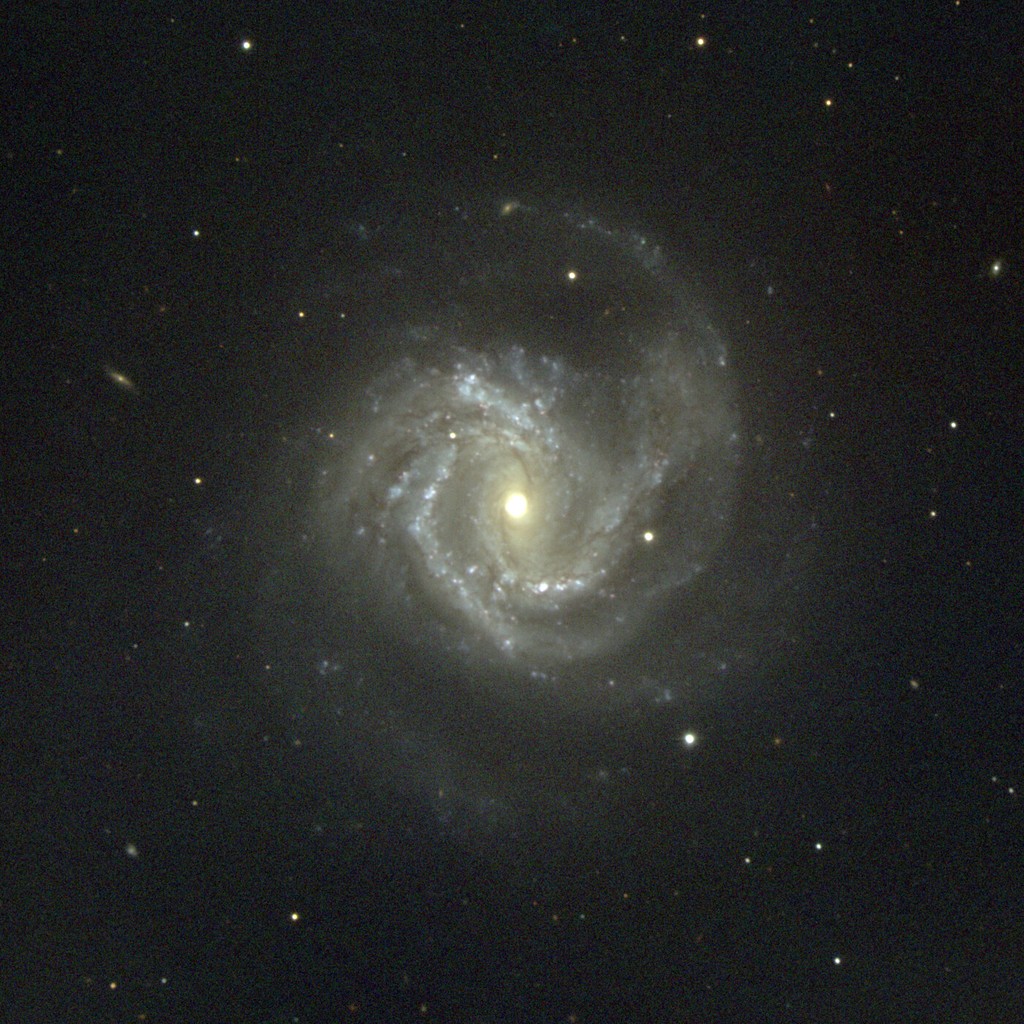
Messier 61 (NGC 4303) is one of the largest and most active spiral galaxies in the Virgo Cluster, lying approximately 52 million light-years away in the constellation Virgo. It was first spotted by Barnaba Oriani on May 5, 1779, and independently found by Charles Messier on the same night — initially misidentified as a comet. When Messier realized it was not moving, he added it to his catalog. NGC 4303 is classified as type SABbc, indicating a weakly barred spiral, and spans roughly 100,000 light-years across its core — comparable in size to our own Milky Way. It is one of the largest spiral galaxies in the Virgo Cluster and one of the nearest examples of a starburst-active spiral.
NGC 4303 is unusually prolific in supernovae: six have been observed in M61 since 1926, more than in almost any other catalogued galaxy. This high rate reflects intense ongoing star formation throughout the galaxy's disk, producing massive short-lived stars that explode frequently. The galaxy's nucleus harbors a Seyfert-type active galactic nucleus — a moderately accreting supermassive black hole — that contributes to its above-average energy output. M61 is one of sixteen Messier galaxies that belong to the Virgo Cluster, the gravitationally dominant structure in our Local Supercluster.
In binoculars M61 is a faint, round smudge; a small telescope shows an oval glow with a brighter nucleus, and larger apertures hint at the spiral structure. This image was taken in February 1996 at the Kitt Peak National Observatory 0.9-meter telescope.
From Spica: In southern Virgo, the southernmost bright Virgo Cluster galaxy.
| Star | Bayer | Mag | Spectral Type | Distance | Meaning |
|---|---|---|---|---|---|
| Spica | α Vir | 0.98 | B1 · Blue-white binary | 250 ly | Latin for 'Ear of Grain' — Virgo holds a sheaf of wheat. One of the four Royal Stars of antiquity, used by Hipparchus to discover the precession of the equinoxes. |
| Denebola | — | 2.14 | A3 · White main sequence | 36 ly | Arabic Dhanab al-Asad, 'Tail of the Lion' — marks the lion's tail. One of the few stars where infrared excess suggests a debris disk. |
| Zosma | β Leo | 2.56 | A4 · White subgiant | 58 ly | Greek for 'Girdle' — marks the hip of Leo the Lion. An aging star beginning to expand into a subgiant, slowly leaving the main sequence. |
| Porrima | — | 2.74 | F0 · Yellow-white binary | 38 ly | Named for Porrima, Roman goddess of prophecy. One of the finest equal double stars in the sky — twin yellow-white stars orbiting each other. |
| Vindemiatrix | — | 2.85 | G8 · Yellow giant | 102 ly | Latin for 'The Grape Gatherer' — its heliacal rising in ancient times signaled the grape harvest season in the Mediterranean. |