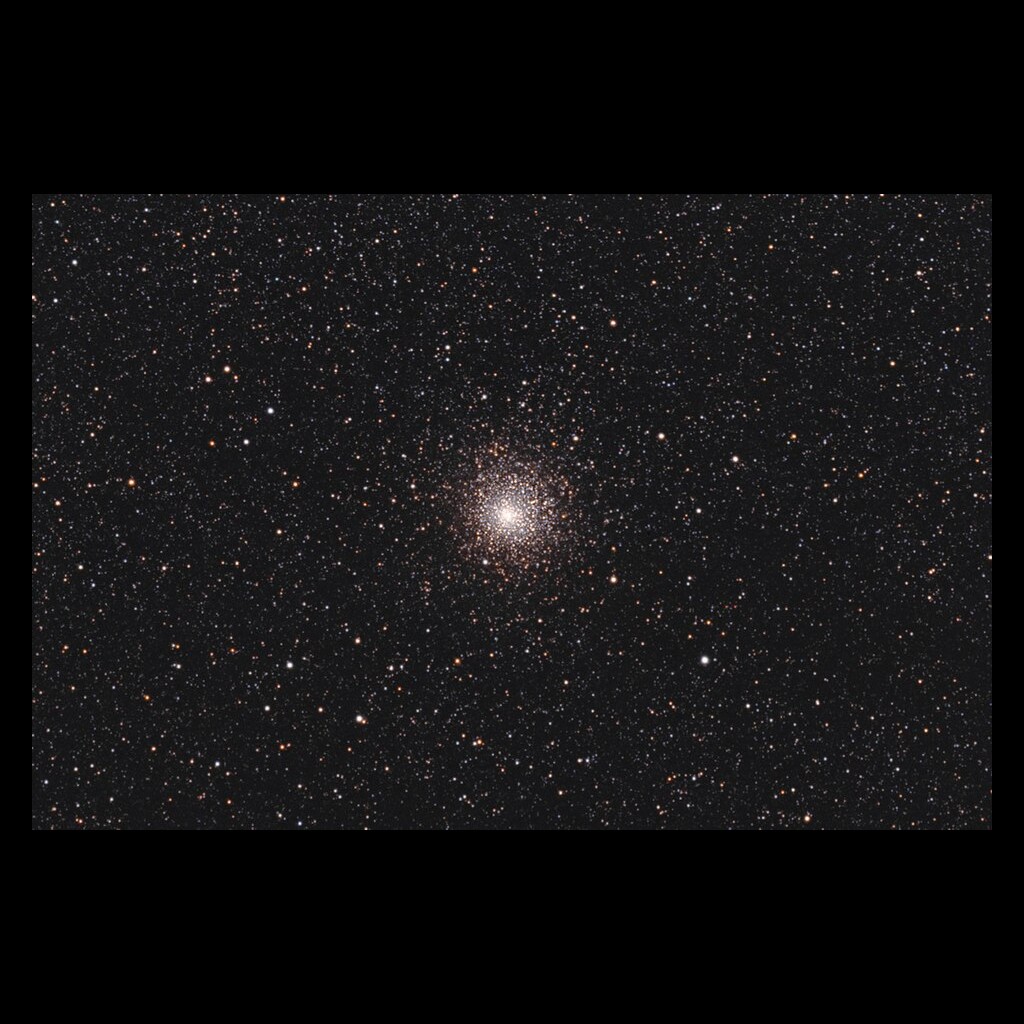
Amateur Astronomer: Hunter Wilson (hewholooks)
| Type | Globular Cluster | Constellation | Oph |
|---|---|---|---|
| Magnitude | 6.5 | Size | 14.1′ |
| Distance | 22,500 light-years | Best Month | July |
| Visibility | Global | Difficulty | Easy (level 2/4) |
| Min. Aperture | binoculars | RA / Dec | 17h 01m 22.8s · -30° 06' 36" |
| Discovered by | Charles Messier, 1771 | ||
Amateur Astronomer: Hunter Wilson (hewholooks)
Messier 62 (NGC 6266) is one of the more unusual globular clusters in the Milky Way, located approximately 22,200 light-years from Earth in the constellation Ophiuchus and positioned remarkably close to the galactic center — only about 6,000 light-years away from the core. Charles Messier discovered it in 1771. At magnitude 6.6, NGC 6266 is bright enough to appear as a hazy patch in binoculars, positioned southeast of the bright star Antares. The cluster is nearly 12 billion years old and contains an extremely dense core of roughly 150,000 stars in a very compact volume, giving it one of the highest central star densities known among Messier's globulars.
The most distinctive feature of NGC 6266 is its asymmetric, irregular shape — its outline is noticeably lopsided, with many stars displaced toward the southeast. This deformation is attributed to the powerful gravitational tidal forces of the galactic center, which are stripping stars preferentially from the side of the cluster facing the Milky Way core. In 2013, astronomers studying archival data from NASA's Chandra X-ray Observatory discovered evidence for a stellar-mass black hole within M62, one of the first such objects identified within a globular cluster. The cluster also contains an unusually large number of X-ray binaries, systems where a compact object accretes material from a companion star, formed through close stellar encounters in the cluster's dense core.
Binoculars show M62 as a round, hazy patch; a small telescope reveals a concentrated core with a slightly asymmetric halo, and larger apertures begin to resolve individual stars at the edges of the cluster.
Navigate from Rigel toward Ophiuchus. In southern Ophiuchus near the Scorpius border.
| Star | Bayer | Mag | Spectral Type | Distance | Meaning |
|---|---|---|---|---|---|
| Antares | α Sco | 1.06 | M1 · Red supergiant | 550 ly | Greek Antares, 'Rival of Mars' — its fiery red color rivals the planet Mars. The blazing heart of Scorpius and one of the largest stars known. |
| Shaula | — | 1.62 | B1 · Blue-white subgiant | 700 ly | Arabic Al-Shawlā', 'The Raised Tail' — the stinger of Scorpius, one of the brightest stars in the southern sky and a navigation star. |
| Kaus Australis | ε Sgr | 1.79 | B9 · Blue-white giant | 143 ly | Hybrid Arabic-Latin, 'Southern Bow' — the brightest star in Sagittarius, at the base of the Archer's bow. Part of the Teapot asterism. |
| Dschubba | λ Sco | 2.29 | B0 · Blue subgiant | 400 ly | Arabic Al-Jabhah, 'The Forehead' — marks the head of Scorpius. A rapidly rotating blue star that has shed a disk of material. |
| Graffias | — | 2.56 | B0 · Blue-white binary | 530 ly | Greek origin meaning 'Claws' — one of several names for the head of Scorpius. A fine double star in small telescopes. |
| Kaus Meridionalis | δ Sgr | 2.72 | K3 · Orange giant | 306 ly | Hybrid Arabic-Latin, 'Middle of the Bow' — the central bow star of Sagittarius, part of the famous Teapot asterism. |
| Nash | — | 2.98 | K0 · Orange giant | 97 ly | Arabic Al-Nasl, 'The Arrowhead' or 'The Point' — marks the tip of the Archer's arrow aimed at the heart of Scorpius. |