N.A.Sharp/NOIRLab/ NSF /AURA/
| Type | Galaxy | Constellation | CVn |
|---|---|---|---|
| Magnitude | 8.6 | Size | 12.6′ |
| Distance | 29.0 million light-years | Best Month | May |
| Visibility | Northern | Difficulty | Easy (level 2/4) |
| Min. Aperture | binoculars | RA / Dec | 13h 15m 50.4s · +42° 01' 48" |
| Discovered by | Pierre Méchain, 1779 | ||
N.A.Sharp/NOIRLab/ NSF /AURA/
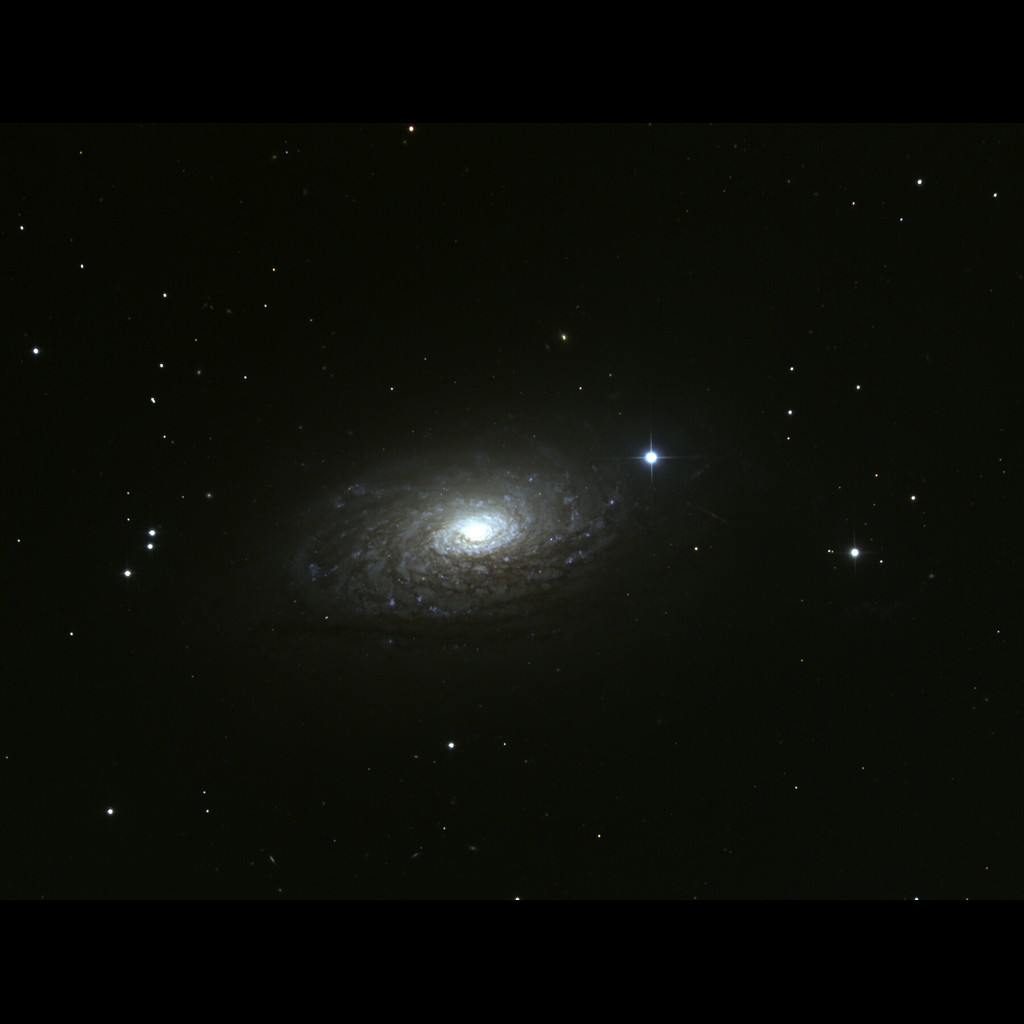
Messier 63 (NGC 5055), popularly known as the Sunflower Galaxy, is a spiral galaxy in the constellation Canes Venatici, lying approximately 29–33 million light-years from Earth. It was discovered by Pierre Méchain on June 14, 1779, and confirmed by Charles Messier shortly thereafter. NGC 5055 is classified as type Sbc, a moderately wound intermediate spiral with a modest central bulge and well-defined, patchy arms rich in star-forming regions. The galaxy spans roughly 98,000 light-years and is one of the larger and brighter members of the M51 Group — a loose physical association of galaxies that also includes the famous Whirlpool Galaxy (M51).
The Sunflower Galaxy gets its nickname from the way its multiple, tightly wound spiral arms and patchy HII regions create a texture reminiscent of a sunflower's face in deep photographs. Its disk shows prominent dust lanes tracing the spiral arms, active star-forming knots glowing pinkish-red in hydrogen-alpha light, and an outer halo that extends far beyond the bright inner disk. Studies with radio telescopes have revealed an enormous extended HI (neutral hydrogen) envelope that stretches to about five times the optical radius of the galaxy — one of the largest known, offering evidence of a massive reservoir of raw material available for future star formation.
In a small telescope M63 appears as an oval glow with a brighter nucleus; moderate apertures (150–200 mm) begin to show the elongated disk and a hint of mottling in the spiral structure. This composite color image was made from CCD observations at the Kitt Peak National Observatory 0.9-meter telescope in May 1998.
From Alkaid: From Alkaid (end of the Big Dipper handle), sweep 6° south-southeast into Canes Venatici.
| Star | Bayer | Mag | Spectral Type | Distance | Meaning |
|---|---|---|---|---|---|
| Alkaid | η UMa | 1.85 | B3 · Blue-white main sequence | 101 ly | Arabic Al-Qa'id, 'The Leader of the Daughters of the Bier' — the tip of the Big Dipper's handle, representing the chief mourner in an Arabic funeral procession. |
| Cor Caroli | — | 2.89 | A0 · White main sequence | 110 ly | Latin for 'Heart of Charles' — named to honor King Charles II of England. The brightest star in Canes Venatici. |