NOIRLab/ NSF /AURA
| Type | Galaxy | Constellation | Com |
|---|---|---|---|
| Magnitude | 8.5 | Size | 9.3′ |
| Distance | 17.0 million light-years | Best Month | May |
| Visibility | Northern | Difficulty | Easy (level 2/4) |
| Min. Aperture | binoculars | RA / Dec | 12h 56m 42.0s · +21° 40' 48" |
| Discovered by | Edward Pigott, 1779 | ||
NOIRLab/ NSF /AURA
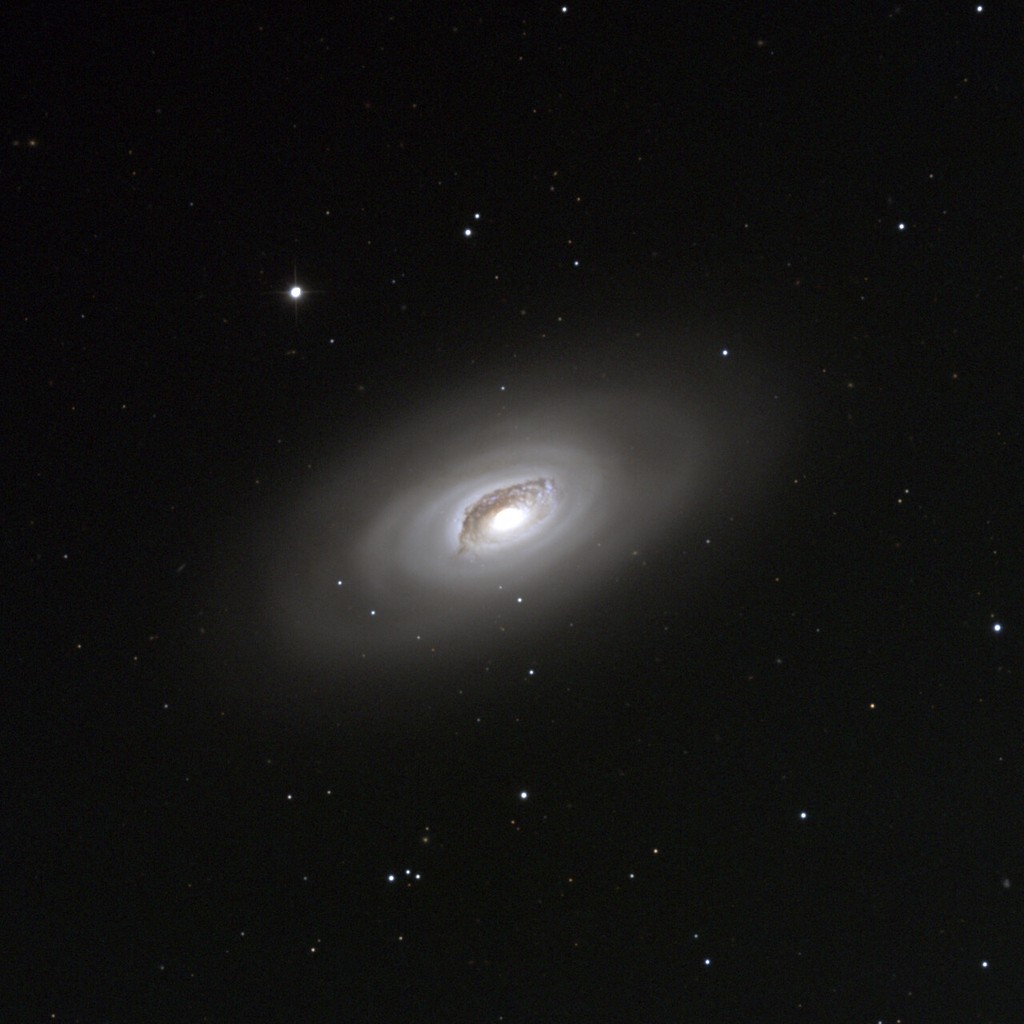
Messier 64 (NGC 4826), known as the Black Eye Galaxy or the Sleeping Beauty Galaxy, is a striking spiral galaxy in the constellation Coma Berenices, approximately 20 million light-years from Earth and spanning about 55,000 light-years across. It was discovered by Edward Pigott on March 23, 1779, and independently found by Johann Elert Bode and Charles Messier shortly after. NGC 4826 is immediately recognizable by the prominent dark dust lane just north of its bright nucleus — the feature that gives it its evocative common name. This dark arc of obscuring dust is far more conspicuous than dust lanes in most galaxies, creating a bold visual contrast visible in modest telescopes.
The dark lane is thought to be the debris of a small companion galaxy that was absorbed by NGC 4826 long ago but has not yet fully settled into the galaxy's orbital plane. Compelling evidence for this past merger comes from one of the galaxy's most remarkable properties: its inner and outer regions rotate in opposite directions. The inner disk — within about 3,000 light-years of the nucleus — rotates in one sense, while the outer disk, halo, and most of the neutral hydrogen rotate in the opposite direction. The boundary between these counter-rotating streams is an active site of collisions between gas clouds, triggering star formation along a ring of young stars. M64 is classified as type Sb.
In a small telescope M64 shows a bright oval nucleus partially flanked by the dark dust lane, visible even at modest apertures; it is one of the easiest examples of a galaxy dust feature to detect visually. This color composite was made from CCD images taken in January 1997 at the Kitt Peak National Observatory 0.9-meter telescope.
From Arcturus: In Coma Berenices, near the star 35 Comae Berenices.
| Star | Bayer | Mag | Spectral Type | Distance | Meaning |
|---|---|---|---|---|---|
| Arcturus | α Boo | -0.05 | K2 · Orange giant | 37 ly | Greek Arktouros, 'Guardian of the Bear' — it follows Ursa Major across the sky. The brightest star in the northern hemisphere. |
| Denebola | — | 2.14 | A3 · White main sequence | 36 ly | Arabic Dhanab al-Asad, 'Tail of the Lion' — marks the lion's tail. One of the few stars where infrared excess suggests a debris disk. |
| Izar | ε Boo | 2.35 | A0 · Orange giant + blue companion | 203 ly | Arabic Al-Izār, 'The Veil' or 'The Loincloth.' One of the finest double stars visible in small telescopes — orange and blue-green. |
| Zosma | β Leo | 2.56 | A4 · White subgiant | 58 ly | Greek for 'Girdle' — marks the hip of Leo the Lion. An aging star beginning to expand into a subgiant, slowly leaving the main sequence. |
| Mufrid | β Boo | 2.68 | G0 · Yellow subgiant | 37 ly | Arabic Al-Mufrid, 'The Solitary Star of the Lancer' — close companion to brilliant Arcturus in the sky, though not physically related. |
| Vindemiatrix | — | 2.85 | G8 · Yellow giant | 102 ly | Latin for 'The Grape Gatherer' — its heliacal rising in ancient times signaled the grape harvest season in the Mediterranean. |