NOIRLab/ NSF /AURA
| Type | Galaxy | Constellation | Leo |
|---|---|---|---|
| Magnitude | 9.3 | Size | 8.7′ |
| Distance | 35.0 million light-years | Best Month | April |
| Visibility | Northern | Difficulty | Moderate (level 3/4) |
| Min. Aperture | 3in | RA / Dec | 11h 18m 46.8s · +13° 05' 60" |
| Discovered by | Charles Messier, 1780 | ||
NOIRLab/ NSF /AURA
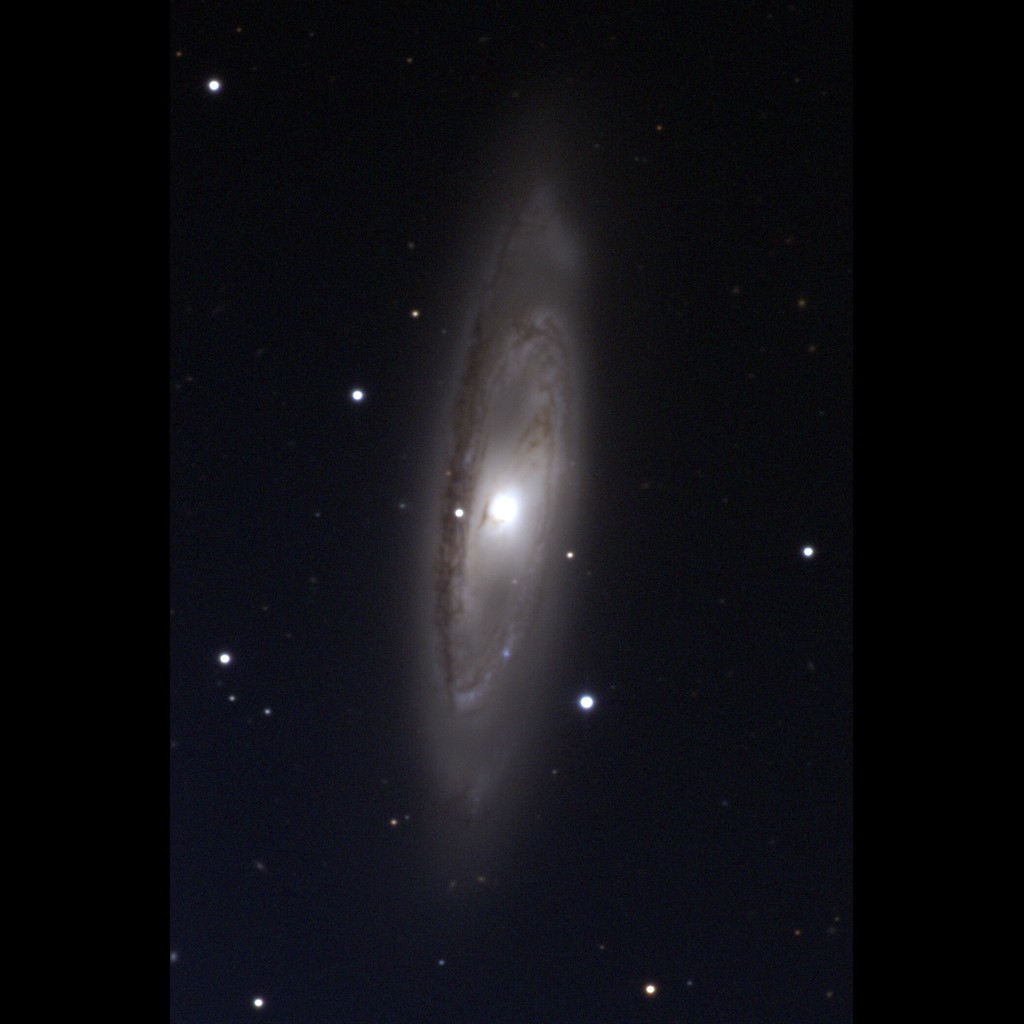
Messier 65 (NGC 3623) is a spiral galaxy of type Sa in the constellation Leo, lying approximately 35 million light-years from Earth. It was discovered by Charles Messier on March 1, 1780. NGC 3623 is one member of the famous Leo Triplet — a visually striking group of three galaxies that can be seen in the same binocular or telescope field: M65 and M66 (NGC 3627) are separated by only about 20 arcminutes on the sky, with the larger and face-on NGC 3628 just half a degree to the north. All three galaxies are physically associated and lie at similar distances, bound in a loose gravitational group.
NGC 3623 is an early-type Sa spiral, meaning it has tightly wound, relatively faint spiral arms and a large, prominent central bulge — the opposite end of the spectrum from the loosely wound, arm-dominated Sc and Sd spirals. It is tilted at a steep angle to our line of sight, presenting an elongated, edge-on-ish view that reveals its prominent dust lane along the disk. M65 appears relatively undisturbed compared with its companion M66, which shows noticeably distorted spiral structure — possibly due to past gravitational interactions with M65 and NGC 3628. M65 has produced no supernovae in the modern observational record, reflecting its relatively quiescent, low-star-formation environment.
In binoculars M65 and M66 appear side by side as two fuzzy ovals in the same field; a small telescope shows both clearly, with M65 appearing more elongated and M66 showing a slightly brighter, more compact nucleus. This image was taken with the WIYN 0.9-meter telescope at Kitt Peak on the night of December 19, 2002.
From Regulus: In Leo, south of the bright star Theta Leonis — M65 and M66 lie less than 0.5° apart.
| Star | Bayer | Mag | Spectral Type | Distance | Meaning |
|---|---|---|---|---|---|
| Regulus | α Leo | 1.36 | B7 · Blue-white main sequence | 79 ly | Latin for 'Little King' — one of the four Royal Stars of antiquity, the heart of Leo the Lion. It spins so fast it is noticeably oblate. |
| Algieba | ζ Leo | 2.01 | K0 · Orange giant binary | 130 ly | Arabic Al-Jabhah, 'The Forehead' or 'The Mane' of the Lion. A beautiful golden double star visible in small telescopes. |
| Denebola | — | 2.14 | A3 · White main sequence | 36 ly | Arabic Dhanab al-Asad, 'Tail of the Lion' — marks the lion's tail. One of the few stars where infrared excess suggests a debris disk. |
| Zosma | β Leo | 2.56 | A4 · White subgiant | 58 ly | Greek for 'Girdle' — marks the hip of Leo the Lion. An aging star beginning to expand into a subgiant, slowly leaving the main sequence. |
| Ras Elased Australis | ε Leo | 2.97 | G0 · Orange giant | 247 ly | Arabic Ra's al-Asad al-Janūbī, 'Southern Head of the Lion' — marks the lion's mane, one of the sickle stars that form Leo's head. |