NOIRLab/ NSF /AURA
| Type | Galaxy | Constellation | Leo |
|---|---|---|---|
| Magnitude | 8.9 | Size | 9.1′ |
| Distance | 36.0 million light-years | Best Month | April |
| Visibility | Northern | Difficulty | Moderate (level 3/4) |
| Min. Aperture | 3in | RA / Dec | 11h 20m 13.2s · +12° 58' 48" |
| Discovered by | Charles Messier, 1780 | ||
NOIRLab/ NSF /AURA
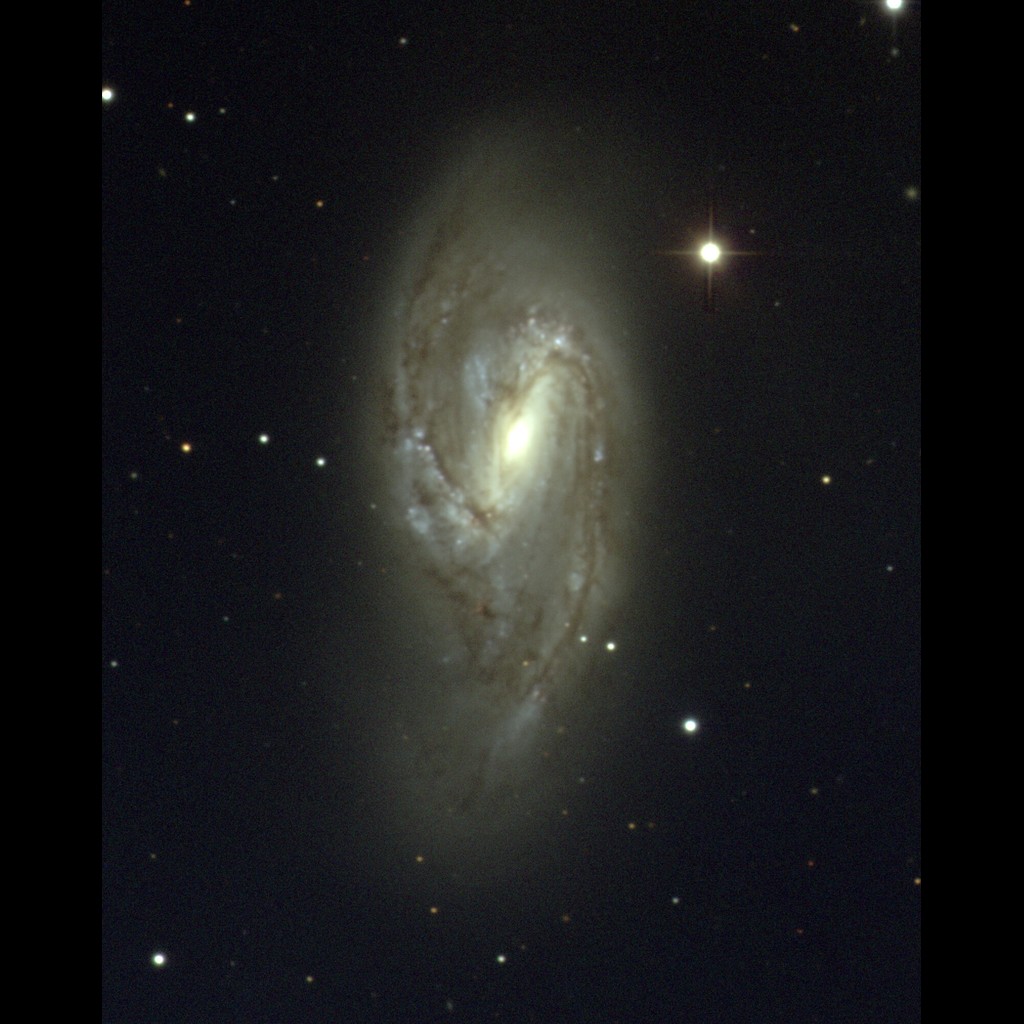
Messier 66 (NGC 3627) is a spiral galaxy of type Sb in the constellation Leo, approximately 35 million light-years from Earth. It was discovered by Charles Messier on March 1, 1780. NGC 3627 is one member of the famous Leo Triplet, a gravitationally interacting group of three galaxies that fit within a single binocular field: M66 and M65 (NGC 3623) lie only 20 arcminutes apart, with the edge-on NGC 3628 completing the trio about half a degree away. Of the three, M66 is the most distorted — its spiral arms are noticeably asymmetric and its dust lanes are more prominent than in the tidally quieter M65, a structural disturbance attributed to past or ongoing gravitational interaction with its companions.
NGC 3627 shows a classic Sb structure: a moderately prominent central bulge, clearly defined spiral arms, and significant dust lanes threading through the disk. The near side of the galaxy is strongly obscured, making the far side's spiral arm more prominent in images. M66 has been prolific in supernovae — four have been observed in historical records — indicating active ongoing star formation in its disk. The galaxy also harbors a low-luminosity active galactic nucleus at its core, a supermassive black hole contributing modestly to the central brightness. At magnitude 8.9, M66 is slightly brighter than its neighbor M65.
In binoculars M65 and M66 appear as a pair of faint ovals; a small telescope shows M66 with a slightly broader, patchier disk than M65 alongside it. This image was taken with the WIYN 0.9-meter telescope at Kitt Peak on the nights of December 19–20, 2002.
From Regulus: Less than 0.5° east of M65 — both visible in the same telescope field.
| Star | Bayer | Mag | Spectral Type | Distance | Meaning |
|---|---|---|---|---|---|
| Regulus | α Leo | 1.36 | B7 · Blue-white main sequence | 79 ly | Latin for 'Little King' — one of the four Royal Stars of antiquity, the heart of Leo the Lion. It spins so fast it is noticeably oblate. |
| Algieba | ζ Leo | 2.01 | K0 · Orange giant binary | 130 ly | Arabic Al-Jabhah, 'The Forehead' or 'The Mane' of the Lion. A beautiful golden double star visible in small telescopes. |
| Denebola | — | 2.14 | A3 · White main sequence | 36 ly | Arabic Dhanab al-Asad, 'Tail of the Lion' — marks the lion's tail. One of the few stars where infrared excess suggests a debris disk. |
| Zosma | β Leo | 2.56 | A4 · White subgiant | 58 ly | Greek for 'Girdle' — marks the hip of Leo the Lion. An aging star beginning to expand into a subgiant, slowly leaving the main sequence. |
| Ras Elased Australis | ε Leo | 2.97 | G0 · Orange giant | 247 ly | Arabic Ra's al-Asad al-Janūbī, 'Southern Head of the Lion' — marks the lion's mane, one of the sickle stars that form Leo's head. |