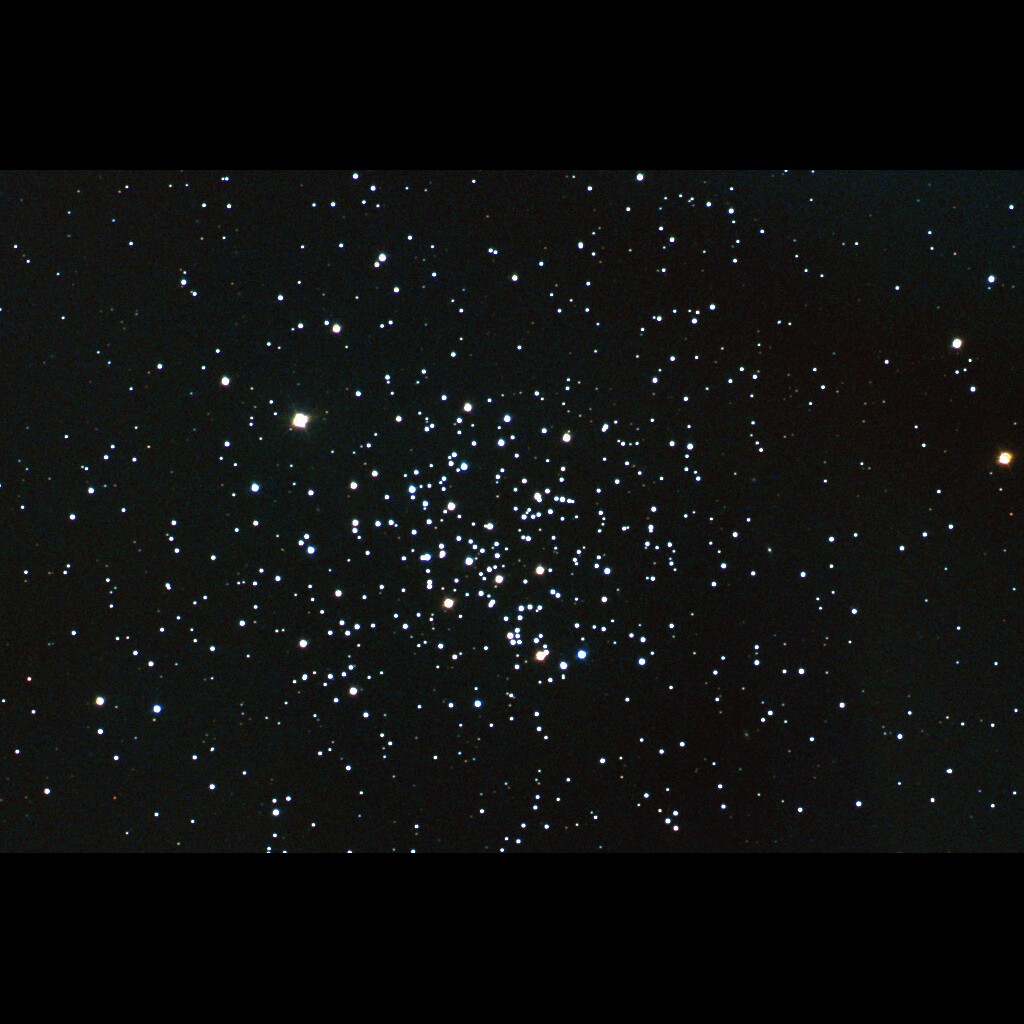
Nigel Sharp, Mark Hanna/NOIRLab/NSF/AURA
| Type | Open Cluster | Constellation | Cnc |
|---|---|---|---|
| Magnitude | 6.1 | Size | 25.0′ |
| Distance | 2,700 light-years | Best Month | March |
| Visibility | Northern | Difficulty | Easy (level 2/4) |
| Min. Aperture | binoculars | RA / Dec | 08h 51m 18.0s · +11° 49' 12" |
| Discovered by | Johann Gottfried Koehler, 1779 | ||
Nigel Sharp, Mark Hanna/NOIRLab/NSF/AURA
Messier 67 (NGC 2682) is one of the oldest and best-studied open star clusters in the sky, located approximately 2,500 light-years away in the constellation Cancer. It was possibly first noted by Johann Gottfried Koehler before 1779; Charles Messier catalogued it on April 6, 1780. NGC 2682 was long celebrated as possibly the oldest known open cluster, with early estimates placing its age at up to 10 billion years; modern measurements have revised this to around 3.5–4 billion years — still remarkably old for an open cluster, most of which dissolve within a few hundred million years. The cluster contains approximately 500 stars within a diameter of about 12 light-years.
NGC 2682's advanced age makes it a uniquely valuable laboratory for stellar evolution. A cluster this old has evolved past the main-sequence turnoff point where solar-mass stars like our Sun have already spent their lives — meaning M67 is populated by red giant stars, sub-giants, and white dwarfs that represent the endpoint of solar-type stellar evolution, all at the same known age and distance. Astronomers have identified blue straggler stars within the cluster — stars that appear unusually blue and luminous for their age, thought to be the rejuvenated products of stellar mergers or mass-transfer in close binary systems. M67 has also been surveyed extensively for exoplanets, with several confirmed around cluster member stars.
Binoculars show M67 as a faint, slightly hazy spot near the stars of Cancer; a small telescope resolves a hundred or more members of mixed brightness spread across a field about the size of the full Moon. This full-color image was assembled from nine BVR exposures taken in January 1997 at the Burrell Schmidt telescope of Case Western Reserve University's Warner and Swasey Observatory on Kitt Peak.
From Regulus: In Cancer, 2° west-southwest of the star Alpha Cancri — between the Beehive (M44) and Regulus.
| Star | Bayer | Mag | Spectral Type | Distance | Meaning |
|---|---|---|---|---|---|
| Procyon | β CMi | 0.40 | F5 · Yellow-white main sequence | 11 ly | Greek for 'Before the Dog' — it rises just before Sirius, the Dog Star. One of the three vertices of the Winter Triangle. |
| Regulus | α Leo | 1.36 | B7 · Blue-white main sequence | 79 ly | Latin for 'Little King' — one of the four Royal Stars of antiquity, the heart of Leo the Lion. It spins so fast it is noticeably oblate. |
| Algieba | ζ Leo | 2.01 | K0 · Orange giant binary | 130 ly | Arabic Al-Jabhah, 'The Forehead' or 'The Mane' of the Lion. A beautiful golden double star visible in small telescopes. |
| Gomeisa | α CMi | 2.89 | B8 · Blue-white main sequence | 170 ly | Arabic Al-Ghumaysā', 'The Weeping One' — in Arabic legend, one of two sisters mourning the death of a great star. The fainter companion to Procyon. |
| Ras Elased Australis | ε Leo | 2.97 | G0 · Orange giant | 247 ly | Arabic Ra's al-Asad al-Janūbī, 'Southern Head of the Lion' — marks the lion's mane, one of the sickle stars that form Leo's head. |