NOIRLab/ NSF /AURA
| Type | Globular Cluster | Constellation | Hya |
|---|---|---|---|
| Magnitude | 9.7 | Size | 11.0′ |
| Distance | 33,300 light-years | Best Month | April |
| Visibility | Global | Difficulty | Moderate (level 3/4) |
| Min. Aperture | 3in | RA / Dec | 12h 39m 25.2s · -26° 45' 00" |
| Discovered by | Charles Messier, 1780 | ||
NOIRLab/ NSF /AURA
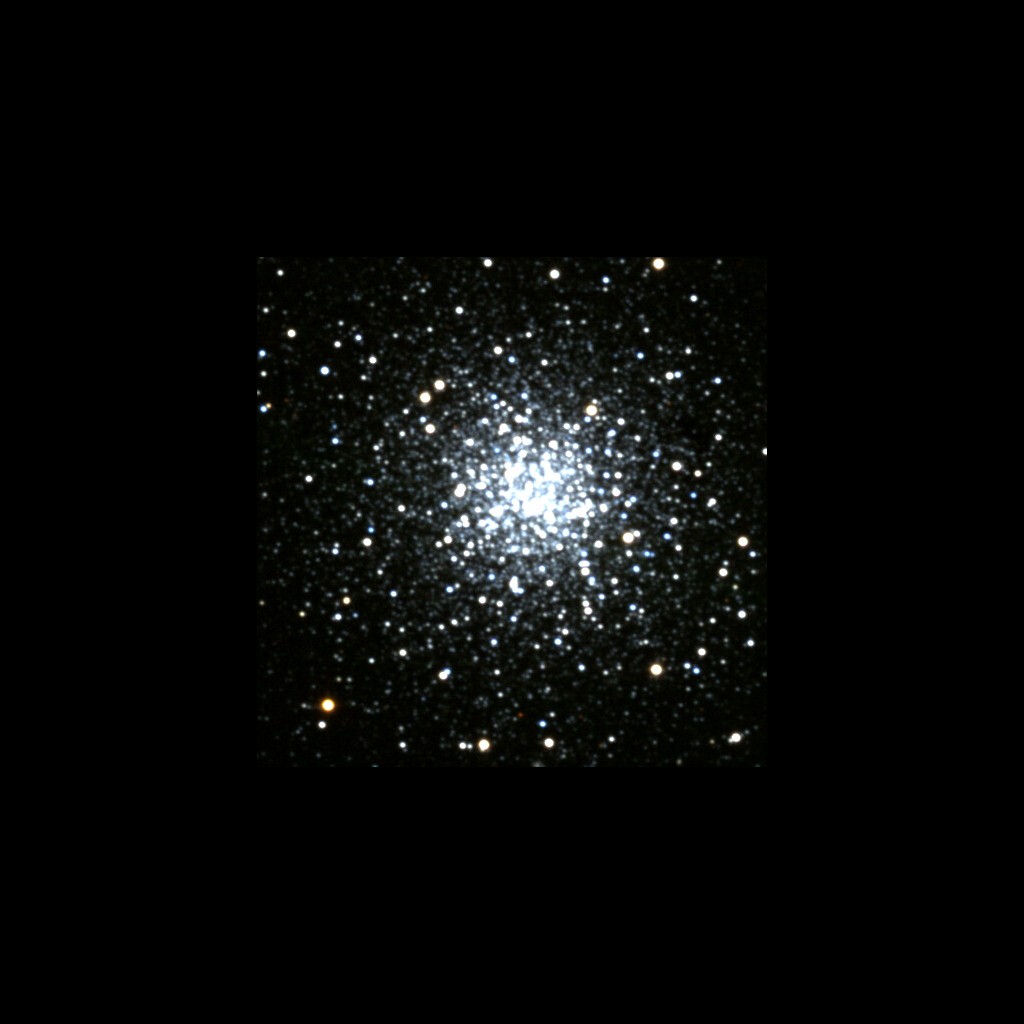
Messier 68 (NGC 4590) is a globular cluster in the constellation Hydra, lying somewhat less than 40,000 light-years from Earth. It was first recorded by Pierre Méchain in 1780 and subsequently catalogued by Charles Messier on April 9, 1780. Despite being one of the more southerly objects in Messier's catalog — Hydra lies well below the celestial equator — NGC 4590 is accessible from mid-northern latitudes with a good southern horizon. Its apparent magnitude of 7.6 puts it within binocular range on a dark, clear night, where it appears as a small, round haze.
NGC 4590 is a moderately loose globular cluster with a low central concentration — stars do not crowd dramatically toward the core the way they do in dense, post-collapse clusters. It is one of the more metal-poor globular clusters in the Milky Way, meaning its stars contain relatively little of the heavier elements forged in stellar interiors — a characteristic of the oldest stellar populations in the galaxy, formed when the Universe's chemical enrichment was still in its earliest stages. One of M68's most distinctive dynamic properties is its motion: the cluster is approaching the Sun at more than 100 kilometers per second, moving rapidly toward us along the line of sight, though this is purely relative motion within the Milky Way's halo.
In a small telescope M68 appears as a round, moderately concentrated glow; 150 mm aperture begins to resolve individual stars across the outer halo. This image was made at the Kitt Peak National Observatory 0.9-meter telescope.
From Spica: In southern Hydra, south of the Corvus-Hydra border.
| Star | Bayer | Mag | Spectral Type | Distance | Meaning |
|---|---|---|---|---|---|
| Spica | α Vir | 0.98 | B1 · Blue-white binary | 250 ly | Latin for 'Ear of Grain' — Virgo holds a sheaf of wheat. One of the four Royal Stars of antiquity, used by Hipparchus to discover the precession of the equinoxes. |
| Menkent | β Cen | 2.06 | K0 · Orange giant | 61 ly | Arabic Mankib Qanṭūris, 'Shoulder of the Centaur' — one of the brightest southern stars, marking the centaur's right shoulder. |
| Gienah Ghurab | γ Crv | 2.58 | B8 · Blue-white giant | 165 ly | Arabic Al-Janāh al-Ghurāb, 'Wing of the Crow' — the brightest star in Corvus, marking the raven's right wing. |
| Kraz | — | 2.65 | G5 · Yellow-white giant | 146 ly | Origin uncertain. Marks the tail of Corvus the Crow, the fainter of the two named stars in this compact southern constellation. |
| Algorab | δ Crv | 2.94 | B9 · Blue-white giant | 87 ly | Arabic Al-Ghurāb, 'The Crow' — named for the constellation itself. A wide double star with a faint optical companion. |