REU program/NOIRLab/ NSF /AURA
| Type | Globular Cluster | Constellation | Sgr |
|---|---|---|---|
| Magnitude | 7.7 | Size | 7.1′ |
| Distance | 29,700 light-years | Best Month | August |
| Visibility | Global | Difficulty | Moderate (level 3/4) |
| Min. Aperture | 3in | RA / Dec | 18h 31m 22.8s · -32° 21' 00" |
| Discovered by | Charles Messier, 1780 | ||
REU program/NOIRLab/ NSF /AURA
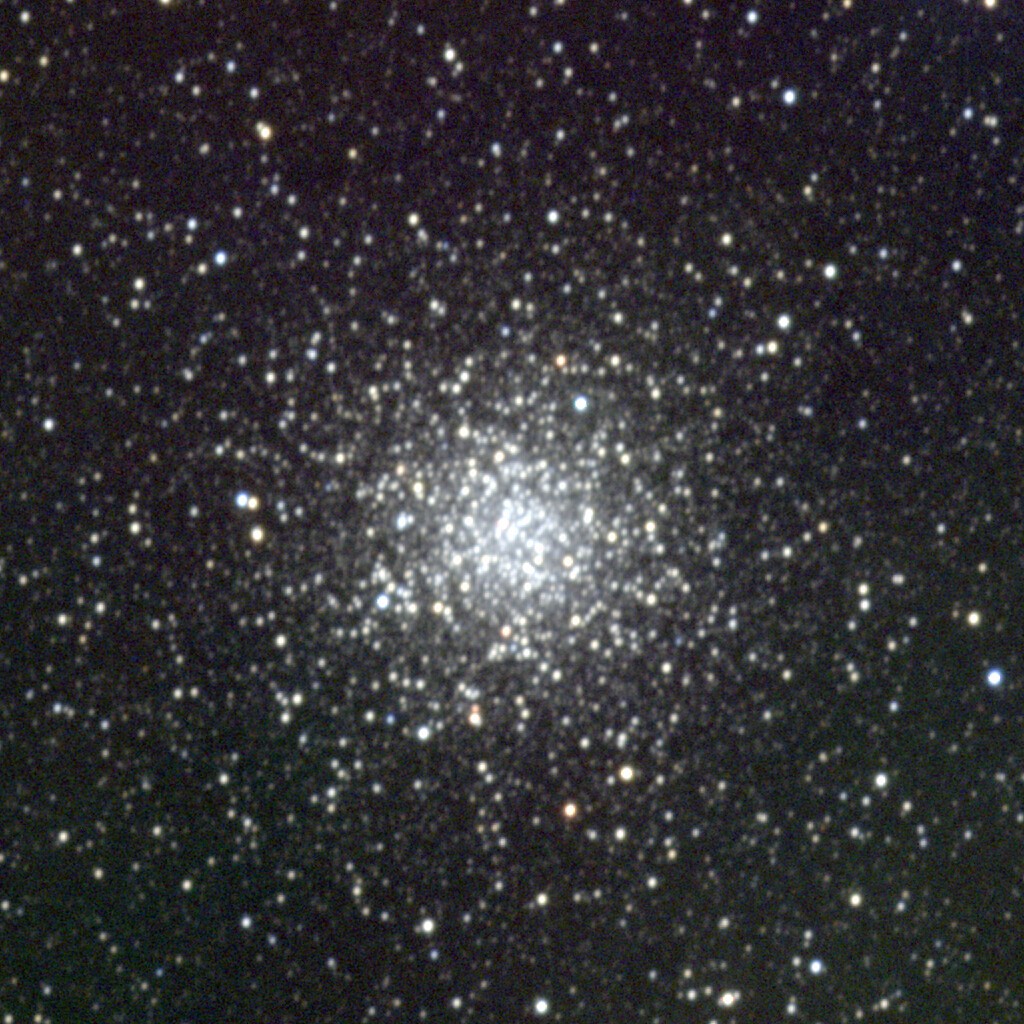
Messier 69 (NGC 6637) is a compact globular cluster in the constellation Sagittarius, located approximately 25,000 light-years from Earth and spanning about 50 light-years across. It was first recorded by Nicolas Louis de Lacaille from the Cape of Good Hope in 1751 and subsequently catalogued by Charles Messier on August 31, 1780. NGC 6637 is one of the closer globulars to the galactic center — lying only about 6,000 light-years from the Milky Way's core — and as a result it sits in a rich, dense starfield of Sagittarius background stars that makes it visually challenging despite its proximity. At apparent magnitude 7.6 it is just within binocular range under dark skies.
NGC 6637 is one of the more metal-rich globular clusters in Messier's catalog — unusual for such an ancient system. Metal-rich globulars are thought to have formed closer to the galactic center, where earlier generations of supernova explosions enriched the available gas with heavy elements before the cluster assembled. M69 is strikingly similar in size, distance, and appearance to its Sagittarian neighbor M70, which lies just 1.8 degrees away — the two clusters form a visual pair that can be swept in a single binocular field. Very few variable stars have been identified in M69, which is consistent with its metal-rich population.
In binoculars M69 is a faint, compact glow in the rich Sagittarius starfields; a 150 mm telescope begins to resolve the outer halo into stars. This composite image was created from observations at the Kitt Peak National Observatory 0.9-meter telescope in May 1998 and July 1998 during the Research Experiences for Undergraduates (REU) program supported by the National Science Foundation.
Navigate from Vega toward Sagittarius. Deep in southern Sagittarius near Epsilon Sagittarii.
| Star | Bayer | Mag | Spectral Type | Distance | Meaning |
|---|---|---|---|---|---|
| Shaula | — | 1.62 | B1 · Blue-white subgiant | 700 ly | Arabic Al-Shawlā', 'The Raised Tail' — the stinger of Scorpius, one of the brightest stars in the southern sky and a navigation star. |
| Kaus Australis | ε Sgr | 1.79 | B9 · Blue-white giant | 143 ly | Hybrid Arabic-Latin, 'Southern Bow' — the brightest star in Sagittarius, at the base of the Archer's bow. Part of the Teapot asterism. |
| Sargas | η Sco | 1.86 | F1 · White supergiant | 272 ly | Sumerian origin of uncertain meaning — one of the oldest star names. Marks the upper tail of Scorpius, a rare white supergiant. |
| Nunki | ζ Sgr | 2.05 | B2 · Blue-white main sequence | 228 ly | Babylonian origin — one of the oldest known star names, from the Babylonian star catalogue. Associated with the sacred city of Eridu. |
| Kaus Meridionalis | δ Sgr | 2.72 | K3 · Orange giant | 306 ly | Hybrid Arabic-Latin, 'Middle of the Bow' — the central bow star of Sagittarius, part of the famous Teapot asterism. |
| Kaus Borealis | — | 2.82 | K1 · Orange giant | 78 ly | Hybrid Arabic-Latin, 'Northern Bow' — marks the top of the Archer's bow in Sagittarius. Part of the Teapot asterism. |
| Nash | — | 2.98 | K0 · Orange giant | 97 ly | Arabic Al-Nasl, 'The Arrowhead' or 'The Point' — marks the tip of the Archer's arrow aimed at the heart of Scorpius. |