REU program/NOIRLab/ NSF /AURA
| Type | Globular Cluster | Constellation | Sgr |
|---|---|---|---|
| Magnitude | 8.1 | Size | 7.8′ |
| Distance | 29,400 light-years | Best Month | August |
| Visibility | Global | Difficulty | Moderate (level 3/4) |
| Min. Aperture | 3in | RA / Dec | 18h 43m 37.2s · -32° 17' 60" |
| Discovered by | Charles Messier, 1780 | ||
REU program/NOIRLab/ NSF /AURA
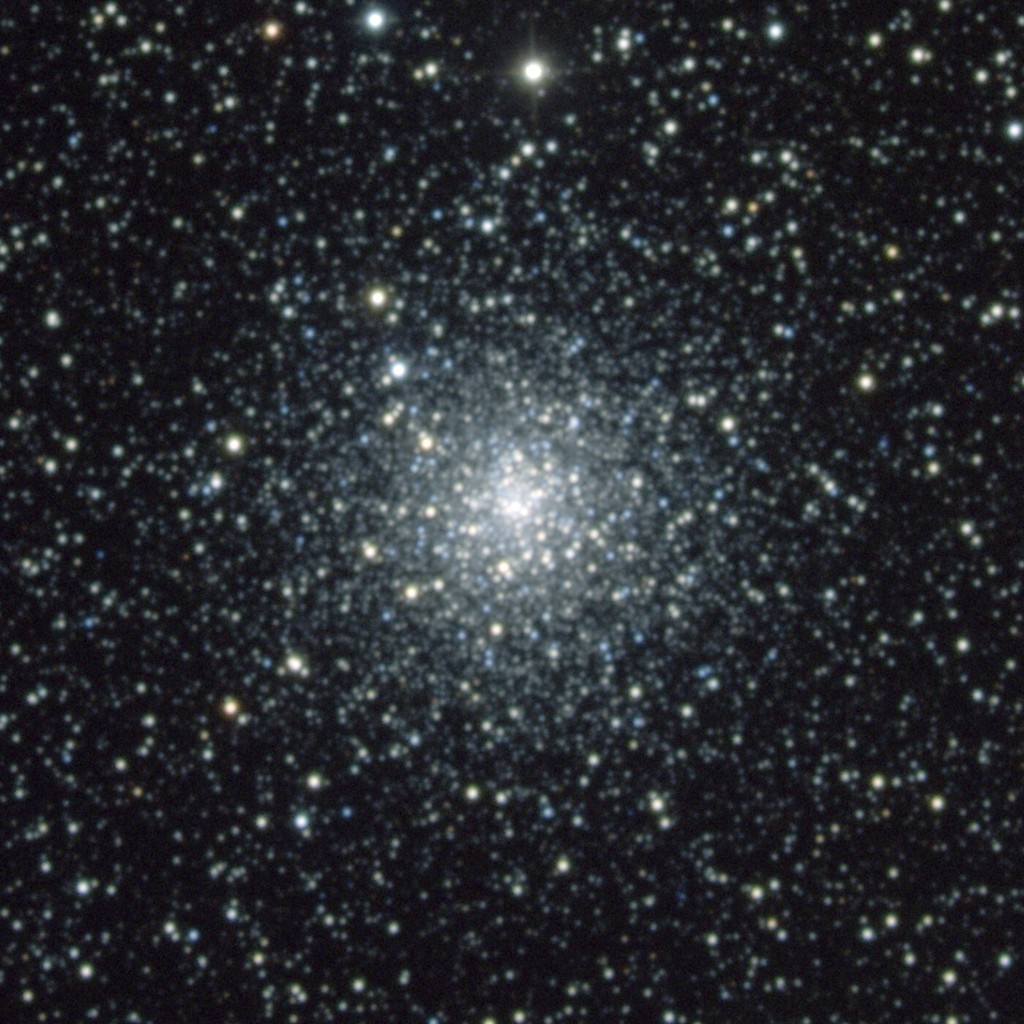
Messier 70 (NGC 6681) is a globular cluster in the constellation Sagittarius, approximately 30,000 light-years from Earth and spanning about 65 light-years across. Charles Messier discovered it on August 31, 1780, the same night he found M69. NGC 6681 has a very dense, highly concentrated core — one of the hallmarks of a post-core-collapse globular cluster, where gravitational interactions have driven stars to sink toward the center over billions of years, creating an extraordinarily compact stellar nucleus. In 1995, M70 gained a brief brush with fame when Comet Hale-Bopp was discovered in photographs of its immediate vicinity, though the comet and cluster are entirely unrelated.
NGC 6681's extreme central concentration distinguishes it visually from the slightly looser M69 nearby. Like M69, it is relatively metal-rich for a globular cluster and sits in a similar direction toward the inner galaxy, embedded in rich Sagittarius starfields that make both clusters slightly challenging to locate despite their moderate brightness (magnitude 7.9). The cluster contains a modest number of variable stars, and its proximity to the galactic center means that tidal forces from the Milky Way's massive bulge play an ongoing role in shaping its dynamics and orbital evolution.
A small telescope shows M70 as a compact, concentrated glow; the dense core gives it a star-like appearance at low power that only a moderate aperture can resolve into individual stars at the edges. This composite image was made from exposures taken at the Kitt Peak National Observatory 0.9-meter telescope in July 1998 during the Research Experiences for Undergraduates (REU) program and again in October 1998. Dynamic range was carefully stretched to reveal both the crowded inner core and the sparser outer regions.
Navigate from Vega toward Sagittarius. About 2° east of M69 in southern Sagittarius — both in the same binocular field.
| Star | Bayer | Mag | Spectral Type | Distance | Meaning |
|---|---|---|---|---|---|
| Shaula | — | 1.62 | B1 · Blue-white subgiant | 700 ly | Arabic Al-Shawlā', 'The Raised Tail' — the stinger of Scorpius, one of the brightest stars in the southern sky and a navigation star. |
| Kaus Australis | ε Sgr | 1.79 | B9 · Blue-white giant | 143 ly | Hybrid Arabic-Latin, 'Southern Bow' — the brightest star in Sagittarius, at the base of the Archer's bow. Part of the Teapot asterism. |
| Sargas | η Sco | 1.86 | F1 · White supergiant | 272 ly | Sumerian origin of uncertain meaning — one of the oldest star names. Marks the upper tail of Scorpius, a rare white supergiant. |
| Nunki | ζ Sgr | 2.05 | B2 · Blue-white main sequence | 228 ly | Babylonian origin — one of the oldest known star names, from the Babylonian star catalogue. Associated with the sacred city of Eridu. |
| Kaus Meridionalis | δ Sgr | 2.72 | K3 · Orange giant | 306 ly | Hybrid Arabic-Latin, 'Middle of the Bow' — the central bow star of Sagittarius, part of the famous Teapot asterism. |
| Kaus Borealis | — | 2.82 | K1 · Orange giant | 78 ly | Hybrid Arabic-Latin, 'Northern Bow' — marks the top of the Archer's bow in Sagittarius. Part of the Teapot asterism. |
| Nash | — | 2.98 | K0 · Orange giant | 97 ly | Arabic Al-Nasl, 'The Arrowhead' or 'The Point' — marks the tip of the Archer's arrow aimed at the heart of Scorpius. |