REU program/NOIRLab/ NSF /AURA
| Type | Globular Cluster | Constellation | Sge |
|---|---|---|---|
| Magnitude | 8.3 | Size | 7.2′ |
| Distance | 13,000 light-years | Best Month | August |
| Visibility | Northern | Difficulty | Moderate (level 3/4) |
| Min. Aperture | 3in | RA / Dec | 19h 53m 49.2s · +18° 46' 48" |
| Discovered by | Philippe Loys de Chéseaux, 1745 | ||
REU program/NOIRLab/ NSF /AURA
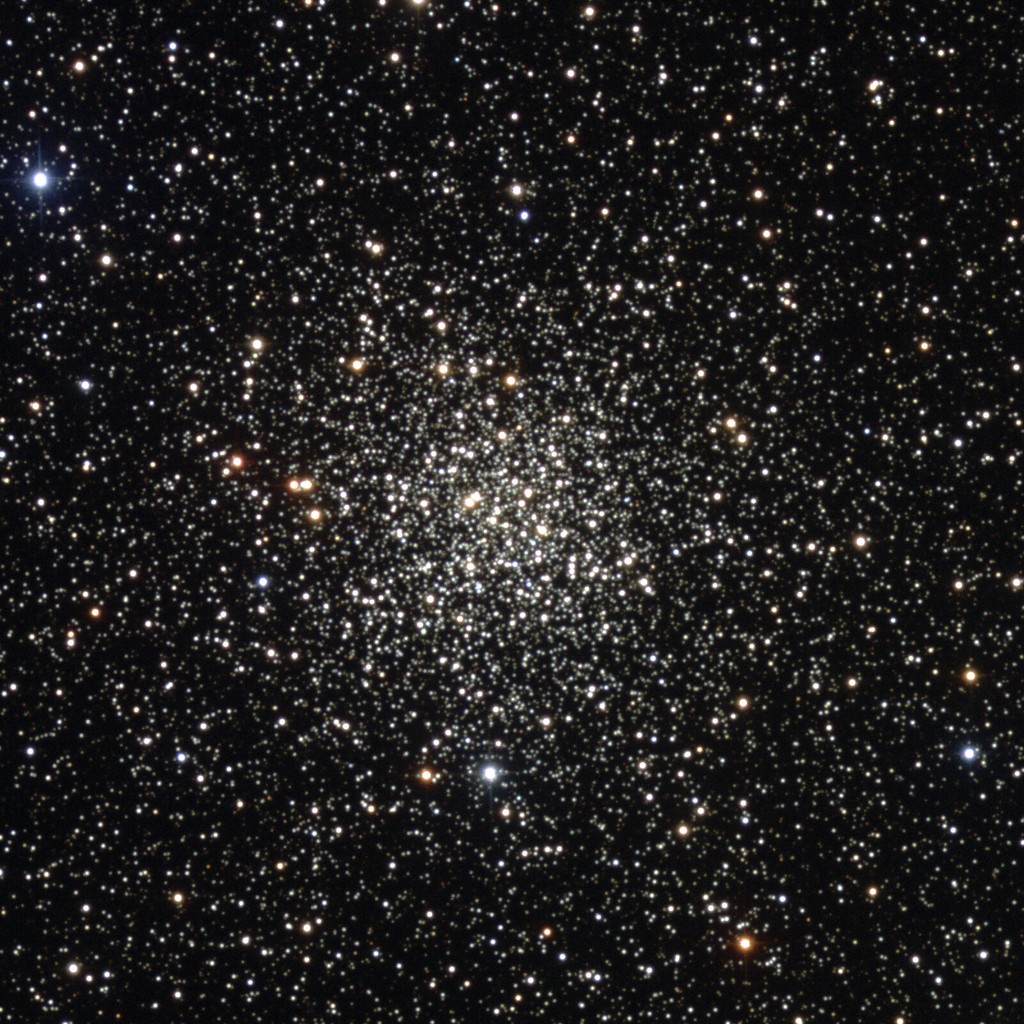
Messier 71 (NGC 6838) is a star cluster in the small constellation Sagitta, the Arrow, located approximately 12,000 light-years from Earth and spanning about 30 light-years across. It was possibly first observed by Philippe Loys de Chéseaux around 1745 and catalogued by Charles Messier on October 4, 1780. NGC 6838 occupies a fascinating middle ground in the classification of star clusters: some astronomers consider it a loose, sparsely populated globular cluster; others maintain it is simply a very condensed open cluster. The boundary between the two types is genuinely blurred, and M71 illustrates the spectrum connecting them — it lacks the dramatic central concentration of a classical globular yet contains too many stars in too small a volume to be a typical open cluster.
NGC 6838 contains a few thousand stars and is estimated to be between 9 and 10 billion years old, ancient enough to qualify as a genuine Population II globular by age, though its low central concentration and modest membership distinguish it from more canonical examples. The cluster contains several red giant stars visible in color images, along with a handful of variable stars including RR Lyrae types that support the globular classification. Its relatively modest brightness (magnitude 6.1) and loose structure make it a beautiful but understated binocular object, sitting neatly between the two bright stars that mark the Sagitta asterism — Gamma and Delta Sagittae.
In binoculars M71 appears as a faint, softly glowing patch in a Milky Way starfield; a small telescope reveals a scattered, loosely concentrated gathering of stars that rewards relaxed low-power observation. This composite was made from images taken in July 1998 at the Kitt Peak National Observatory 0.9-meter telescope during the Research Experiences for Undergraduates (REU) program supported by the National Science Foundation.
Navigate from Vega toward Sagitta. In the tiny constellation Sagitta (the Arrow) — midway along the arrow's shaft.
| Star | Bayer | Mag | Spectral Type | Distance | Meaning |
|---|---|---|---|---|---|
| Altair | α Aql | 0.76 | A7 · White main sequence | 17 ly | Arabic Al-Nasr al-Tā'ir, 'The Flying Eagle.' One of the three stars of the Summer Triangle, it spins so fast it is noticeably flattened at the poles. |
| Tarazed | γ Aql | 2.72 | K3 · Orange giant | 460 ly | Persian Tarāzad, possibly 'The Beam of the Scales' — flanks Altair in Aquila, the bright orange counterpart to the white eagle star. |
| Albireo | β Cyg | 3.05 | K3 · Orange giant + blue companion | 430 ly | Origin uncertain, possibly corrupted Latin or Arabic. Famous as one of the most beautiful double stars in the sky — gold and blue. |
| Alshain | θ Aql | 3.71 | G8 · Yellow subgiant | 45 ly | Persian Shahīn, 'The Peregrine Falcon' — flanks Altair in Aquila, part of the trio of stars that make the eagle's body. |