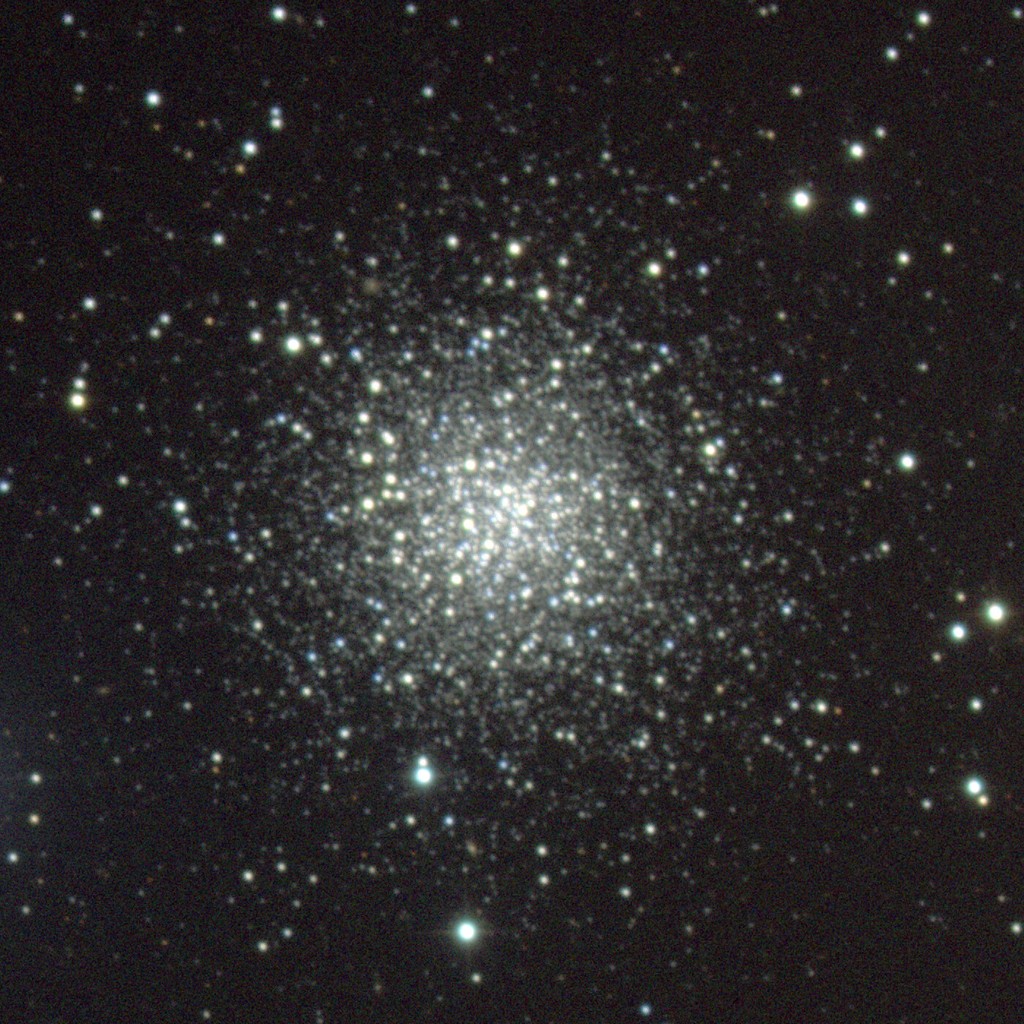
REU program/NOIRLab/ NSF /AURA
| Type | Globular Cluster | Constellation | Aqr |
|---|---|---|---|
| Magnitude | 9.3 | Size | 5.9′ |
| Distance | 55,400 light-years | Best Month | September |
| Visibility | Global | Difficulty | Challenging (level 4/4) |
| Min. Aperture | 6in | RA / Dec | 20h 53m 24.0s · -12° 31' 48" |
| Discovered by | Pierre Méchain, 1780 | ||
REU program/NOIRLab/ NSF /AURA
Messier 72 (NGC 6981) is a globular cluster in the constellation Aquarius, one of the more remote of the Messier globulars at approximately 53,000 light-years from Earth. It was discovered by Pierre Méchain in August 1780 and catalogued by Charles Messier shortly after. Spanning somewhat over 90 light-years, NGC 6981 is physically a large and intrinsically brilliant system — despite its faintness in telescopes, M72 is actually one of the most intrinsically luminous globular clusters known, its absolute magnitude placing it among the dozen or so brightest in the Milky Way. Its apparent faintness (magnitude 9.4) is purely a consequence of its extraordinary distance.
NGC 6981 has a relatively open, diffuse structure with a moderately compressed core — not as tightly concentrated as globulars like M15 or M70, giving it a looser, more gradual appearance. The cluster contains hundreds of variable stars, mostly RR Lyrae pulsators that have been extensively studied to refine its distance and age (estimated around 9.5 billion years). At its distance, M72 lies well out in the galactic halo, far from the tidal disruption of the inner Milky Way. It sits in a rich area of the sky alongside two of the catalog's most unusual entries: M73, a tiny asterism of just four stars just 1.5 degrees to the east.
In binoculars M72 is barely visible as a faint, star-like haze; a small telescope shows it as a small, diffuse disk, and 200 mm aperture begins to resolve individual stars in the outer regions. This composite was created from images taken at the Kitt Peak National Observatory 0.9-meter telescope in July 1998 during the Research Experiences for Undergraduates (REU) program and again in October 1998.
Navigate from Enif toward Aquarius. In Aquarius, south of the main water-jar asterism.
| Star | Bayer | Mag | Spectral Type | Distance | Meaning |
|---|---|---|---|---|---|
| Sadalsuud | α Aqr | 2.90 | G0 · Yellow supergiant | 610 ly | Arabic Sa'd al-Su'ūd, 'Luckiest of the Lucky' — the brightest star in Aquarius, heralding the spring season in ancient Babylonian and Arabian astronomy. |