REU program/NOIRLab/ NSF /AURA
| Type | Open Cluster | Constellation | Aqr |
|---|---|---|---|
| Magnitude | 9.0 | Size | 2.8′ |
| Distance | 2,000 light-years | Best Month | September |
| Visibility | Global | Difficulty | Challenging (level 4/4) |
| Min. Aperture | 6in | RA / Dec | 20h 58m 37.2s · -12° 37' 48" |
| Discovered by | Charles Messier, 1780 | ||
REU program/NOIRLab/ NSF /AURA
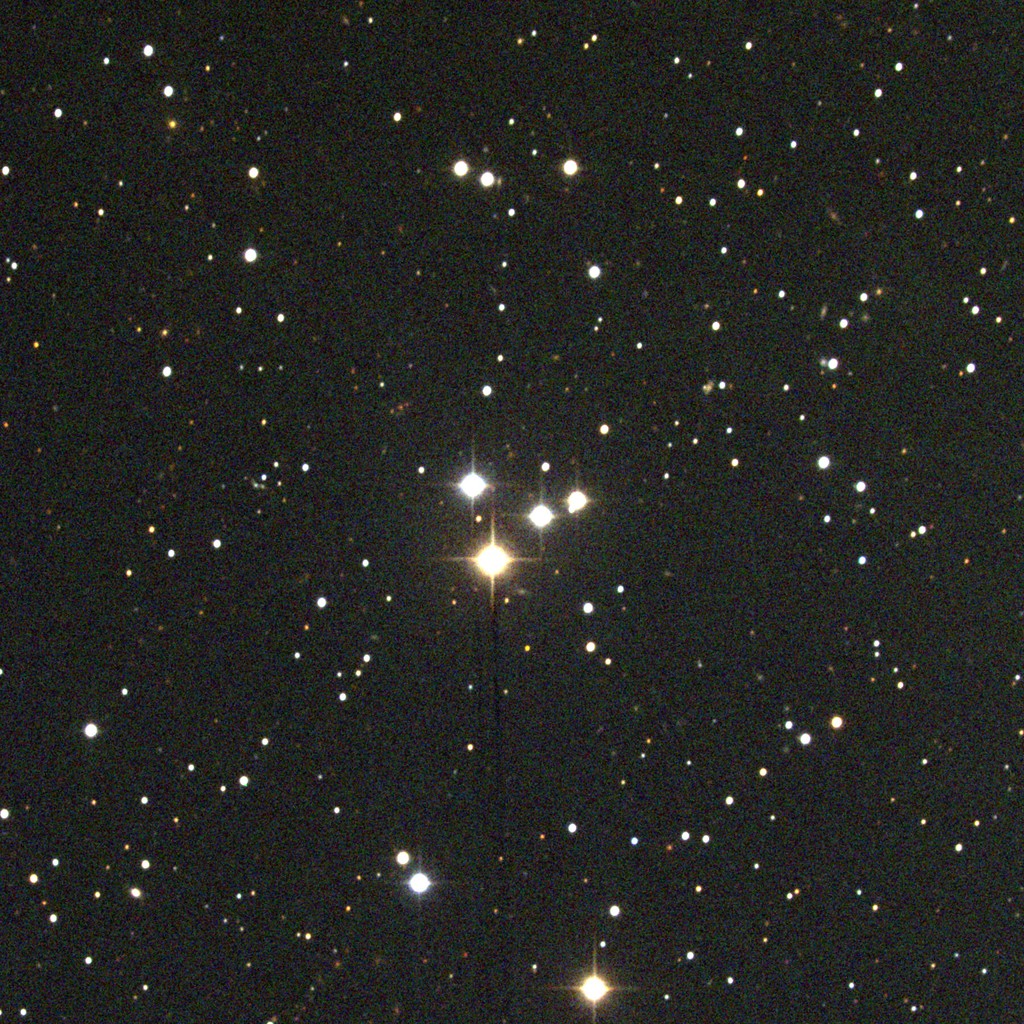
Messier 73 (NGC 6994) is one of the most unusual entries in Messier's catalog — not a nebula, galaxy, or true cluster, but a compact grouping of just four faint stars in the constellation Aquarius. Charles Messier catalogued it on October 4, 1780, the same night he found M72, describing it as a "cluster of three or four small stars, which resembles a nebula." For most of astronomical history M73 was considered either a sparse open cluster or an optical asterism — a chance alignment of unrelated foreground stars. Modern proper motion and radial velocity measurements indicate the four stars are almost certainly not physically associated; they appear close together merely because they happen to lie along the same line of sight from Earth.
The four stars range from magnitude 10.5 to 12.7 and span only about 2.8 arcminutes on the sky. Despite the lack of physical association, M73 retains its Messier number and its formal NGC designation, and it remains a valid observational target for those completing a full Messier marathon. It is sometimes included in lists of "spurious" Messier objects alongside M40 (a double star) and M24 (a star cloud), reflecting the reality that Messier's catalog was a practical tool for comet hunters rather than a rigorous classification of deep-sky object types. M73 serves as an interesting historical footnote: even careful observers with early telescopes had difficulty distinguishing compact star groupings from unresolved nebulosity.
Through any small telescope M73 is quickly identified as four faint stars in a Y or arrowhead pattern — a satisfying observation for those completing the catalog, even if the object is anti-climactic. This image was taken at the Kitt Peak National Observatory 0.9-meter telescope in July 1997 during the Research Experiences for Undergraduates (REU) program supported by the National Science Foundation.
Navigate from Enif toward Aquarius. About 1.5° east of M72 — the four stars are visible in the same field.
| Star | Bayer | Mag | Spectral Type | Distance | Meaning |
|---|---|---|---|---|---|
| Sadalsuud | α Aqr | 2.90 | G0 · Yellow supergiant | 610 ly | Arabic Sa'd al-Su'ūd, 'Luckiest of the Lucky' — the brightest star in Aquarius, heralding the spring season in ancient Babylonian and Arabian astronomy. |
| Sadalmelik | β Aqr | 2.95 | G2 · Yellow supergiant | 520 ly | Arabic Sa'd al-Malik, 'Lucky Stars of the King' — one of several 'lucky star' names in Aquarius, associated with the spring rains in ancient Arabia. |