Todd Boroson/NOIRLab/ NSF /AURA/
| Type | Galaxy | Constellation | Psc |
|---|---|---|---|
| Magnitude | 9.4 | Size | 10.5′ |
| Distance | 32.0 million light-years | Best Month | November |
| Visibility | Northern | Difficulty | Challenging (level 4/4) |
| Min. Aperture | 6in | RA / Dec | 01h 36m 43.2s · +15° 46' 48" |
| Discovered by | Pierre Méchain, 1780 | ||
Todd Boroson/NOIRLab/ NSF /AURA/
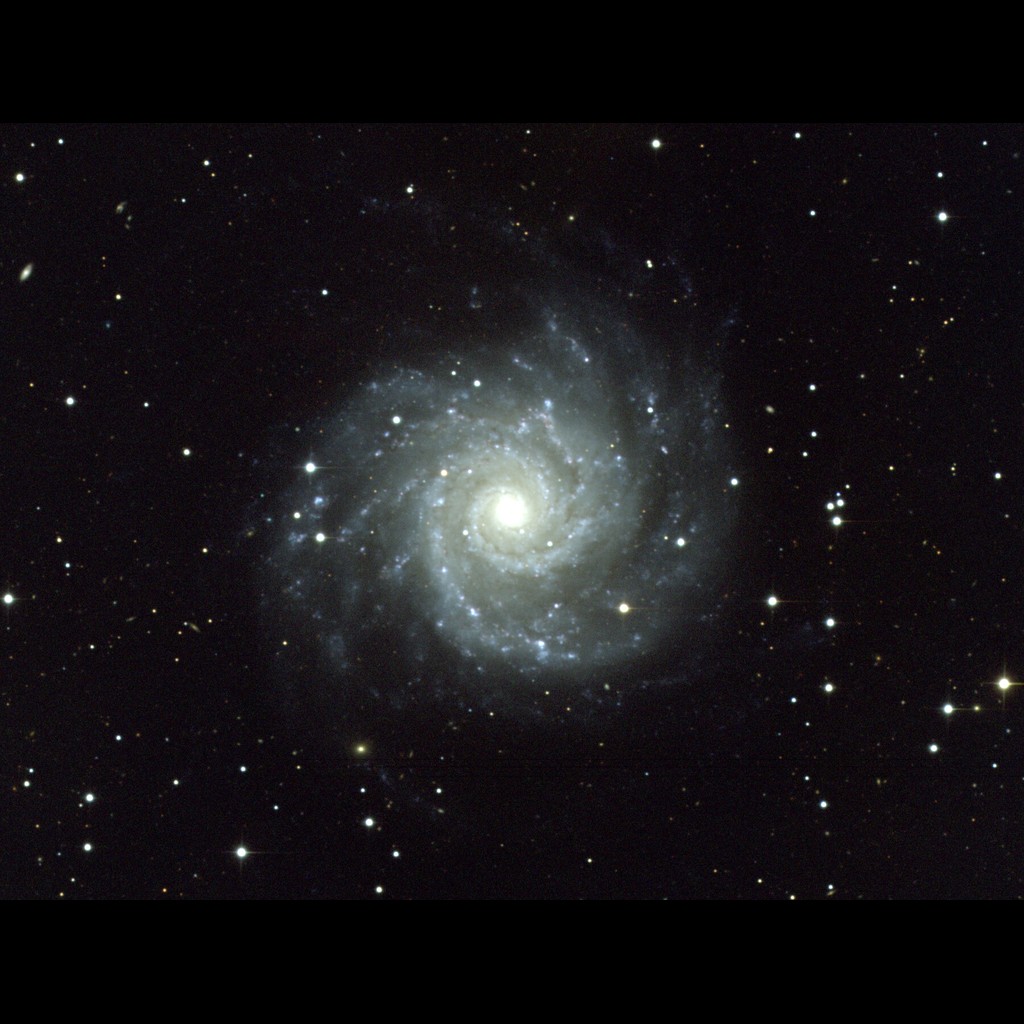
Messier 74 (NGC 628) is a grand, face-on spiral galaxy in the constellation Pisces, lying approximately 30 million light-years from Earth and spanning about 80,000 light-years across. It was discovered by Pierre Méchain in September 1780 and catalogued by Charles Messier on October 18 of that year. NGC 628 is a classic Sc-type spiral: loosely wound, nearly perfectly circular as seen from Earth (because it faces us nearly directly), and rich with well-defined spiral arms that trace arcs of blue star-forming regions and pinkish HII emission nebulae across its disk. Despite these photogenic qualities, M74 is notoriously difficult to observe because its enormous apparent size spreads its light thinly across the sky, giving it the lowest surface brightness of any object in Messier's catalog.
NGC 628 has an extraordinarily symmetric, textbook-perfect spiral structure, making it a frequent subject of extragalactic studies. Its two main spiral arms are sharply defined and studded with knots of active star formation, young blue star clusters, and HII regions that glow red in hydrogen-alpha light. The galaxy's disk shows relatively little dust obscuration — being nearly face-on, its dust lanes are distributed across the face rather than concentrated into dramatic edge-on lanes. M74 has produced several supernovae in recent decades, reflecting the vigorous ongoing star formation throughout its disk. It may be the brightest member of a small galaxy group.
M74's low surface brightness makes it one of the most challenging Messier objects; dark skies and a wide-field, low-power eyepiece are essential — it rewards patience and acclimatized eyes far more than aperture. This image was made at the Kitt Peak National Observatory 0.9-meter telescope in 1991.
Navigate from Alnilam toward Pisces. In Pisces, 1.3° east-northeast of the star Eta Piscium.
| Star | Bayer | Mag | Spectral Type | Distance | Meaning |
|---|---|---|---|---|---|
| Hamal | α Ari | 2.01 | K2 · Orange giant | 66 ly | Arabic Al-Hamal, 'The Head of the Ram' — the brightest star in Aries. Marked the vernal equinox around 2000 BCE. |
| Sheratan | β Ari | 2.64 | A5 · White binary | 60 ly | Arabic Al-Sharatain, 'The Two Signs' — once marked the vernal equinox alongside Hamal. A spectroscopic binary star. |