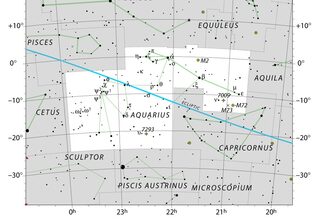
 IAU Chart
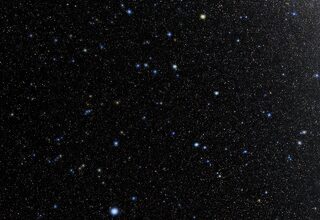 NOIRLab Images
 Stellarium Images
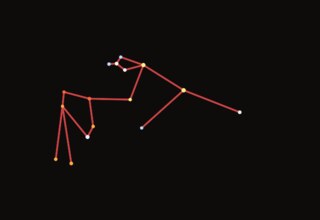 Stars and Sticks
| Abbreviation | Aqr |
|---|---|
| Meaning | Water Bearer |
| Pronunciation Guide is based on “Pronouncing Astronomical Names,” published in 1943 by the American Astronomical Society. | uh-QUAIR-ee-us |
| Genitive The genitive is the Latin possessive form used in star names. For example, Alpha Orionis means “the Alpha of Orion.” | uh-KWAIR-ee-eye |
| Best Month | October |
| Visibility | Global |
| Origin | AncientThese figures are rooted in the classical Greek and Mesopotamian traditions cataloged by Ptolemy in the 2nd century AD. |
| Author | PtolemyPtolemy, a 2nd-century Greco-Egyptian astronomer, cataloged the 48 classical constellations in his landmark work, the Almagest. These form the core of the 88 modern constellations recognized today. |
| Type | constellation |
| Difficulty | Moderate |
| Description | One of the oldest constellations, Aquarius appears in Babylonian star catalogs as 'the great one' pouring water. The Greeks identified him as Ganymede, the beautiful youth from Troy whom Zeus — disguised as an eagle — abducted to Olympus to serve as cupbearer to the gods, granting him immortality. The stream he pours flows into the mouth of the Southern Fish (Piscis Austrinus). Aquarius is the source of two major meteor showers — the Eta Aquariids in May and the Delta Aquariids in July, both from debris from Halley's Comet. Its brightest star, Sadalsuud (Beta Aquarii), is a yellow supergiant about 610 light-years away whose Arabic name means 'the luckiest of the lucky.' |
| Meteor Shower | Eta Aquariids |
| Peak Month | May |
Click a thumbnail to view full-size. Plain and Annotated versions available on the image page.
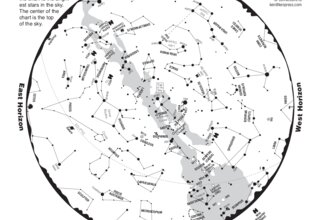
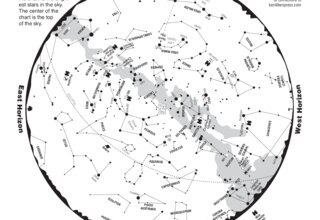
Monthly sky charts courtesy of What's Out Tonight? — Copyright ©2026 Ken Graun. Star charts are optimized for mid-latitudes of the Northern Hemisphere. Click a chart to view or download the PDF. For guidance on using the chart, or to purchase a planisphere and astronomy books, visit kenpress.com.
Images: NOIRLab/NSF/AURA/E. Slawik · IAU and Sky & Telescope · Stellarium — Full credits →