NOIRLab/NSF/AURA
| Type | Globular Cluster | Constellation | Lyn |
|---|---|---|---|
| Magnitude | 10.4 | Size | 4.1′ |
| Distance | 300,000 light-years | Best Month | February |
| Visibility | Northern | Difficulty | Challenging (level 4/4) |
| Min. Aperture | 6-inch | RA / Dec | 07h 38m 08.2s · +38° 52' 55" |
| Discovered by | William Herschel, 1788 | ||
NOIRLab/NSF/AURA
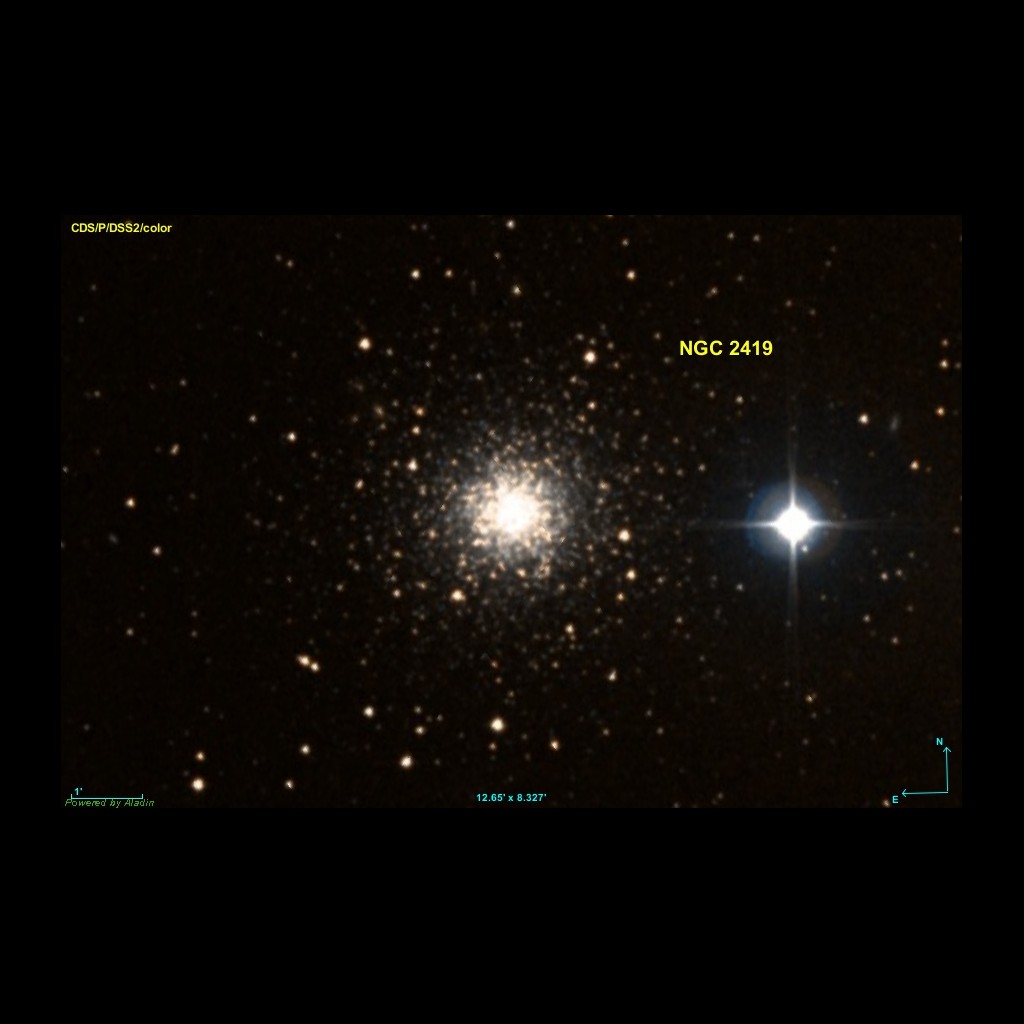
Caldwell 25, NGC 2419, is a remote and remarkably luminous globular cluster located in the constellation Lynx, approximately 300,000 light-years from Earth. Discovered by William Herschel in 1788, it is one of the most distant globular clusters associated with the Milky Way — so remote that it was long debated whether it was truly gravitationally bound to our galaxy at all, earning it the nickname "the Intergalactic Wanderer." Despite its vast distance, NGC 2419 shines at magnitude 10.4 and spans about 4 arcminutes, placing it within reach of a 6-inch telescope under dark skies, though it appears as an unresolved, slightly fuzzy glow rather than a resolved swarm of stars.
What makes NGC 2419 particularly remarkable is its intrinsic luminosity. It is one of the most luminous globular clusters in the Milky Way system — if placed at the same distance as the famous Omega Centauri (C80), it would appear comparable in size and brilliance. Its highly elongated, retrograde orbit carries it deep into the outer galactic halo, largely shielded from the tidal disruption that gradually strips stars from clusters on tighter orbits. This means NGC 2419 may be a nearly pristine fossil from the earliest epoch of galaxy assembly.
This image was obtained using the 4-meter Nicholas U. Mayall telescope at Kitt Peak National Observatory, providing sufficient depth to reveal the cluster's dense, concentrated core against the sparse stellar field of Lynx. Modern studies using the Hubble Space Telescope have resolved individual stars in the cluster's outer regions, uncovering an unusual chemical enrichment pattern — with significant star-to-star variations in elements like helium and potassium — that distinguishes NGC 2419 from typical Milky Way globulars and has fueled speculation about its possible origin as the stripped nucleus of a dwarf galaxy.
| Star | Bayer | Mag | Spectral Type | Distance | Meaning |
|---|---|---|---|---|---|
| Pollux | β Gem | 1.16 | K0 · Orange giant | 34 ly | Named for the immortal twin of Greek myth, son of Zeus. The brightest star in Gemini has a confirmed planet — Pollux b — orbiting it. |
| Castor | α Gem | 1.58 | A2 · White sextuple system | 52 ly | Named for one of the divine twins of Greek myth, son of Zeus and brother of Pollux. Actually a sextuple star system — six stars in one. |
| Menkalinan | β Aur | 1.90 | A2 · Yellow giant binary | 82 ly | Arabic Mankib dhī al-'Inān, 'Shoulder of the Rein-Holder' — marks Auriga the Charioteer's shoulder. An eclipsing binary pair. |