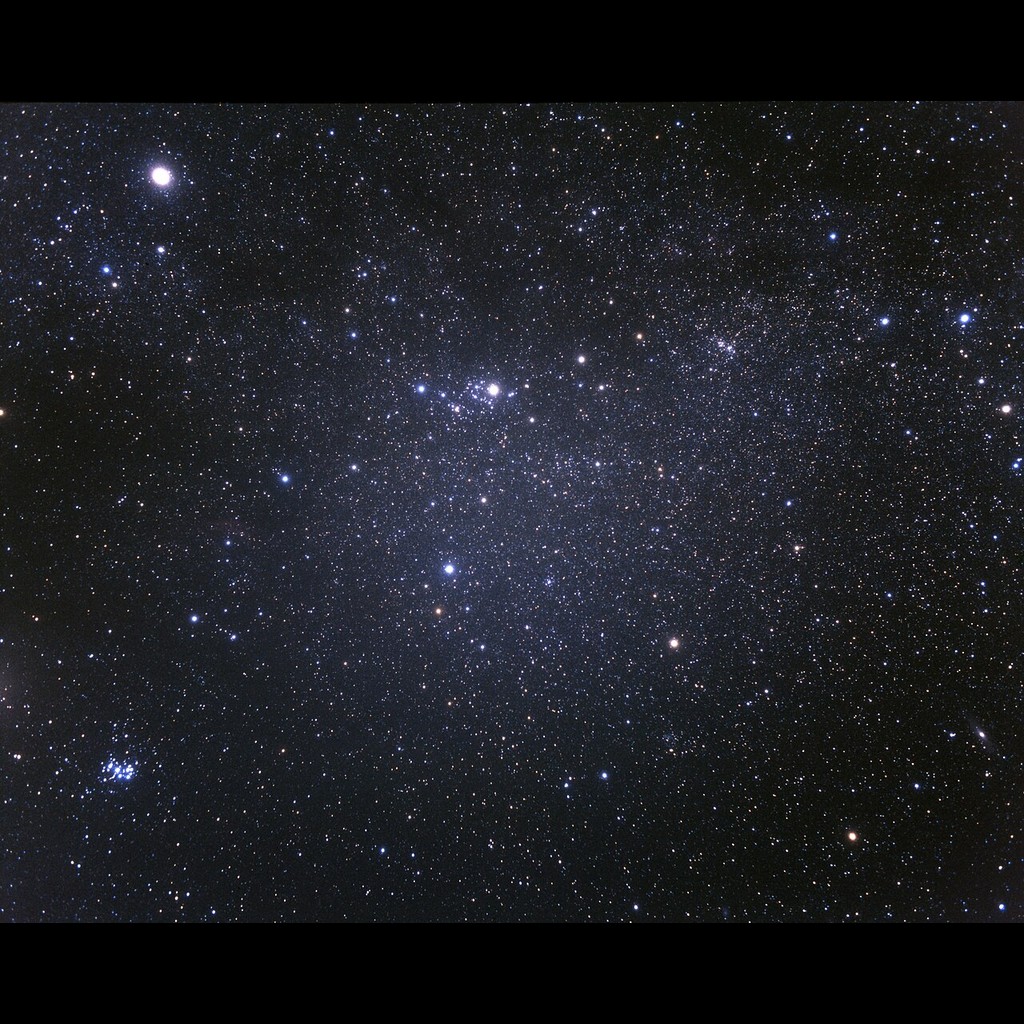
A. Fujii
| Type | Galaxy | Constellation | Per |
|---|---|---|---|
| Magnitude | 11.6 | Size | 2.6′ |
| Distance | 237.0 million light-years | Best Month | November |
| Visibility | Northern | Difficulty | Challenging (level 4/4) |
| Min. Aperture | 10in | RA / Dec | 03h 19m 44.4s · +41° 31' 12" |
| Discovered by | William Herschel, 1786 | ||
A. Fujii
Caldwell 24 is centered on NGC 1275, a fascinating and violent active galaxy located in the heart of the Perseus Cluster within the constellation Perseus. Renowned for its energetic nature — a result of the immense activity and intense radio emissions emanating from its central supermassive black hole — NGC 1275 stands out as the dominant member of one of the most massive galaxy clusters in the known universe. While resolving the intricate details of this distant system typically demands professional instrumentation, wider fields often capture additional context such as the concentration of faint galaxy glows belonging to the Perseus Cluster itself, visible as a scattering of small smudges surrounding the bright central object.
NGC 1275 sits at the center of the Perseus galaxy cluster, located roughly 240 million light-years from Earth. Its central supermassive black hole — estimated at several hundred million solar masses — powers active jets of relativistic plasma that punch outward into the surrounding hot intracluster gas. X-ray observations by the Chandra Space Telescope have revealed enormous cavities in the intracluster medium carved by these jets, surrounded by filaments of cool gas cascading inward toward the galaxy like enormous cooling curtains. These filaments, detected in hydrogen-alpha emission and molecular line emission, extend tens of thousands of light-years from the galaxy's core and represent one of the most dramatic examples of feedback between an active galactic nucleus and its host cluster.
For amateur observers, C24 presents a challenging but rewarding target. NGC 1275 itself shines at magnitude 11.6, placing it within reach of 6-inch and larger telescopes under dark skies. The cluster is best observed during autumn from northern latitudes when Perseus rides high in the sky, and wide-field views at moderate magnification reveal the subtle concentration of faint galaxy glows that betray this remarkable supercluster environment. The brightest cluster members can be detected as faint, slightly extended objects surrounding the dominant galaxy.
From Algol: From Algol (Beta Persei), move 5° north into the heart of the Perseus Cluster region.
| Star | Bayer | Mag | Spectral Type | Distance | Meaning |
|---|---|---|---|---|---|
| Mirphak | ε Per | 1.79 | F5 · Yellow-white supergiant | 590 ly | Arabic Mirfaq al-Thurayya, 'Elbow near the Pleiades' — the brightest star in Perseus, embedded in a beautiful star cluster visible in binoculars. |
| Algol | β Per | 2.09 | B8 · Eclipsing binary | 93 ly | Arabic Ra's al-Ghūl, 'Head of the Demon' — named for the severed Medusa head held by Perseus. It dims every 2.87 days as a companion eclipses it. |
| Almaak | γ And | 2.10 | B8 · Orange giant + blue companion | 355 ly | Arabic Al-'Anāq al-Ard, 'The Desert Lynx.' One of the finest double stars in the sky — vivid gold and blue-green pair. |