KPNO/NOIRLab/NSF/AURA/Dale Cupp/Flynn Haase
| Type | Galaxy | Constellation | And |
|---|---|---|---|
| Magnitude | 9.9 | Size | 13.5′ |
| Distance | 30.0 million light-years | Best Month | October |
| Visibility | Northern | Difficulty | Moderate (level 3/4) |
| Min. Aperture | 3in | RA / Dec | 02h 22m 22.8s · +42° 21' 00" |
| Discovered by | William Herschel, 1784 | ||
KPNO/NOIRLab/NSF/AURA/Dale Cupp/Flynn Haase
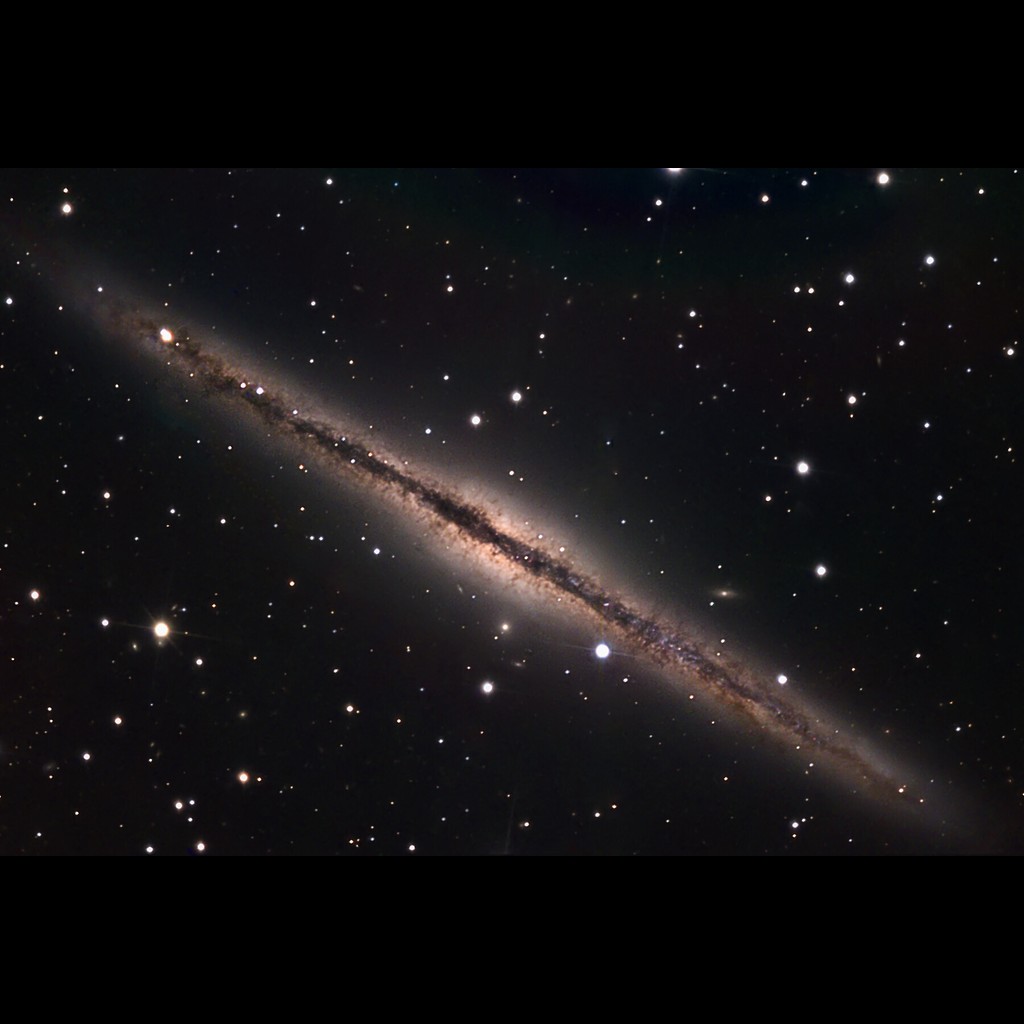
Caldwell 23, also known as NGC 891 (the Silver Sliver Galaxy), is arguably one of the most beautiful and frequently studied examples of a nearby spiral galaxy viewed perfectly edge-on. Located approximately 30 million light-years away in the constellation Andromeda, this galaxy offers astronomers a unique cross-sectional view of galactic structure, complete with small companion galaxies visible above and below its main disk in this image. It is a primary subject for research into the dynamics of material within galactic planes, particularly because of the mysterious sprays of gas and dust being accelerated perpendicular to the disk — an enigmatic phenomenon that remains a topic of active investigation. This image was captured during the 2014 Advanced Observing Program at the Kitt Peak Visitor Center.
The defining feature of NGC 891 is its pronounced dark equatorial dust lane, a narrow band of absorbing material that bisects the galaxy's disk with remarkable precision — visible even in modest amateur telescopes. What makes the galaxy especially intriguing for researchers is the observation that dust extends far above and below the midplane in filamentary structures, driven outward by the combined pressure of supernovae and stellar winds from active star-forming regions beneath. Infrared imaging has traced these extraplanar dust features to heights of several kiloparsecs above the disk, providing a nearby and well-resolved analog for studying the circulation of material between a galaxy's disk and its surrounding halo.
For visual observers, NGC 891 is one of the sky's most satisfying edge-on galaxies, easily located in Andromeda near the bright star Almach. In a 6-inch telescope it appears as a long, slender streak of light; apertures of 10 inches and above begin to reveal the dust lane as a subtle darkening along the midplane under excellent seeing conditions. The sharp, needle-like profile has made NGC 891 a benchmark target for testing telescope optics and observer technique, and its two small companion galaxies offer a bonus for those scanning the surrounding field.
Navigate from Almach toward Andromeda. From Almach, move 3.5° north — NGC 891 lies just west of a faint chain of stars.
| Star | Bayer | Mag | Spectral Type | Distance | Meaning |
|---|---|---|---|---|---|
| Mirphak | ε Per | 1.79 | F5 · Yellow-white supergiant | 590 ly | Arabic Mirfaq al-Thurayya, 'Elbow near the Pleiades' — the brightest star in Perseus, embedded in a beautiful star cluster visible in binoculars. |
| Mirach | β And | 2.07 | M0 · Red giant | 197 ly | Arabic Al-Mirāq, 'The Girdle' or 'The Loin' — marks the hip of Andromeda. Nearby sits M31, the Andromeda Galaxy, visible to the naked eye. |
| Algol | β Per | 2.09 | B8 · Eclipsing binary | 93 ly | Arabic Ra's al-Ghūl, 'Head of the Demon' — named for the severed Medusa head held by Perseus. It dims every 2.87 days as a companion eclipses it. |
| Almaak | γ And | 2.10 | B8 · Orange giant + blue companion | 355 ly | Arabic Al-'Anāq al-Ard, 'The Desert Lynx.' One of the finest double stars in the sky — vivid gold and blue-green pair. |