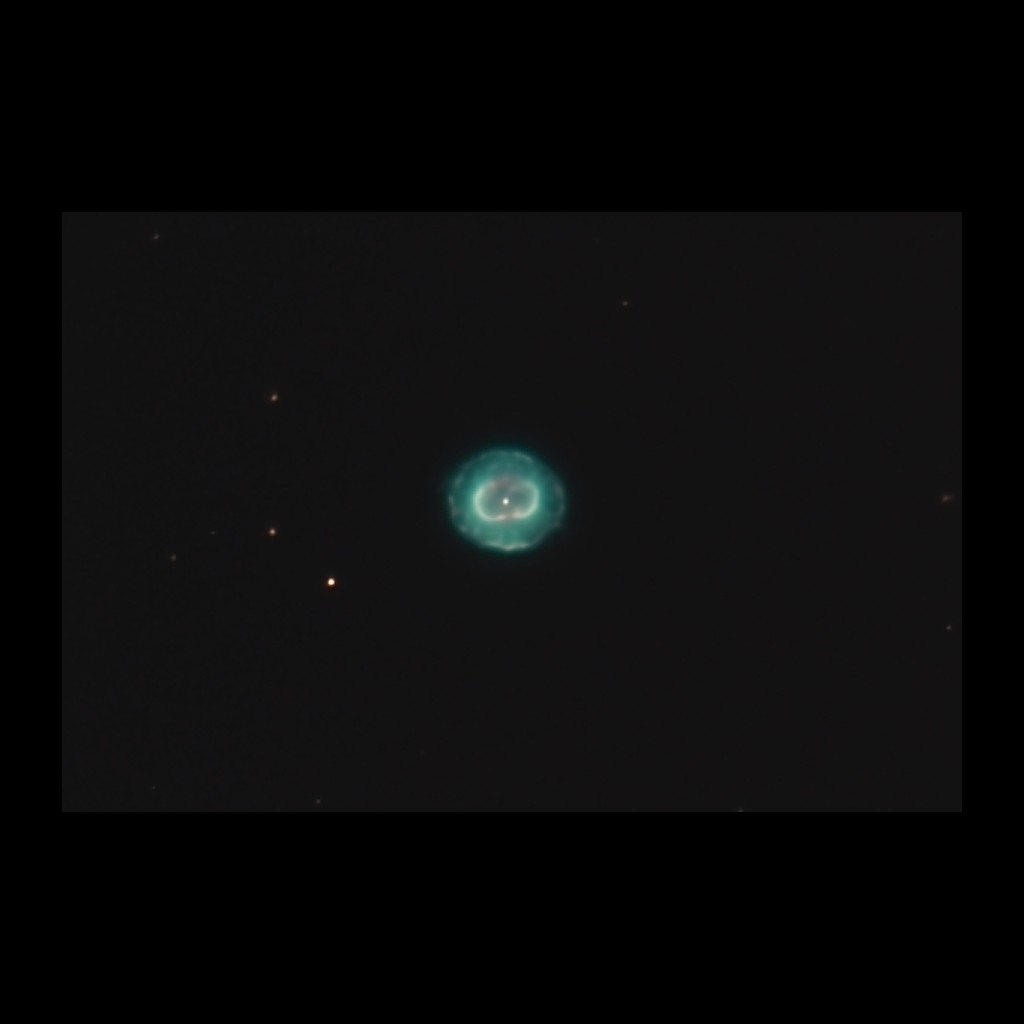
Amateur astronomer, Gianluca Pollastri
| Type | Planetary Nebula | Constellation | And |
|---|---|---|---|
| Magnitude | 8.3 | Size | 0.5′ |
| Distance | 5,600 light-years | Best Month | October |
| Visibility | Northern | Difficulty | Moderate (level 3/4) |
| Min. Aperture | 3in | RA / Dec | 23h 26m 16.8s · +42° 32' 60" |
| Discovered by | William Herschel, 1784 | ||
Amateur astronomer, Gianluca Pollastri
Caldwell 22, widely known as the Blue Snowball Nebula, is a bright and compact planetary nebula located in the constellation Andromeda, cataloged as NGC 7662. Residing approximately 1,800 light-years from Earth, it shines at magnitude 8.3 — bright enough to spot in binoculars as a star-like point — and resolves into a vivid blue-green disk of ionized gas in even a small telescope. The color comes primarily from doubly ionized oxygen ([O III]) excited by ultraviolet radiation from the hot central white dwarf. The progenitor star shed its outer layers thousands of years ago, and the resulting shell has been expanding outward ever since, producing the smooth, rounded appearance that gives the nebula its popular name.
At higher magnification, NGC 7662 reveals a layered structure: a bright inner ring surrounded by a slightly dimmer outer shell, with the central star (around magnitude 13) detectable in apertures of 8 inches or more under good seeing. The inner ring shows subtle variations in brightness around its circumference, and the transition between the bright disk and the fainter outer halo is one of the cleanest examples of a double-shell planetary nebula structure accessible in a modest instrument. Unlike many planetary nebulae whose structure only emerges in long-exposure narrowband photographs, the Blue Snowball reveals considerable detail visually, making it a favorite for high-magnification planetary observing.
This image demonstrates the impressive results achievable with dedicated tracking and patience, consisting of 1 hour and 23 minutes of total exposure time captured from a backyard in suburban Dublin. Utilizing a 9.25-inch telescope at f/10, the capture brings out the nested ring structure and the vibrant blue coloration that give this nebula its iconic name. NGC 7662 is well placed for northern observers throughout autumn and early winter, and its high surface brightness makes it relatively forgiving of light pollution — one of the most accessible planetary nebulae in the Caldwell catalog.
Navigate from Almach toward Andromeda. From Almach (Gamma Andromedae), sweep 4° west along the southern edge of Andromeda.
| Star | Bayer | Mag | Spectral Type | Distance | Meaning |
|---|---|---|---|---|---|
| Matar | ε Peg | 2.93 | G2 · Yellow giant binary | 167 ly | Arabic Al-Maṭar, 'Lucky Stars of Rain' — marks the horse's knee in Pegasus, associated with the rainy season in ancient Arabian astronomy. |