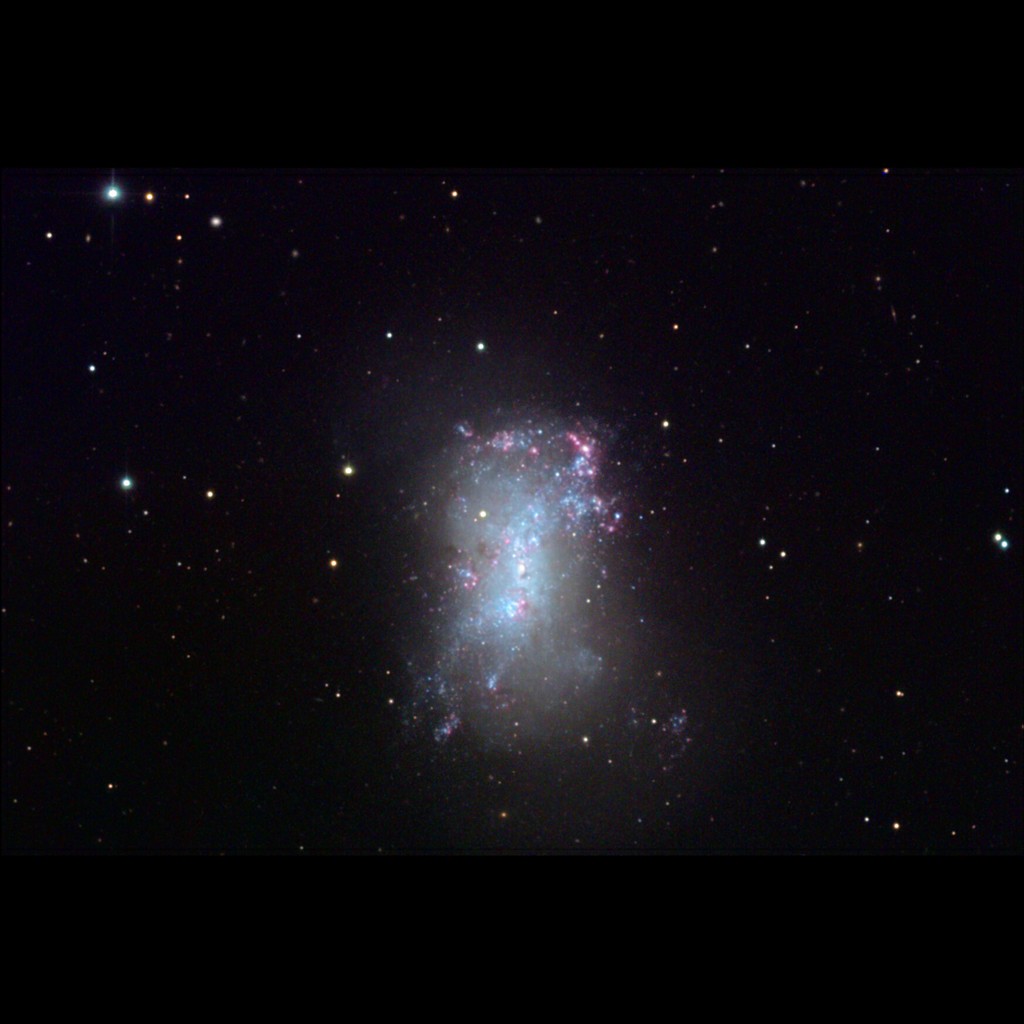
KPNO/NOIRLab/NSF/AURA/John and Christie Connors/Adam Block
| Type | Galaxy | Constellation | CVn |
|---|---|---|---|
| Magnitude | 9.4 | Size | 5.1′ |
| Distance | 12.5 million light-years | Best Month | April |
| Visibility | Northern | Difficulty | Moderate (level 3/4) |
| Min. Aperture | 3in | RA / Dec | 12h 28m 04.8s · +44° 05' 24" |
| Discovered by | William Herschel, 1788 | ||
KPNO/NOIRLab/NSF/AURA/John and Christie Connors/Adam Block
Caldwell 21, cataloged as NGC 4449, is a vibrant irregular dwarf galaxy located approximately 12 million light-years away in the Canes Venaticorum group. It is strikingly similar to our own Large Magellanic Cloud in both size and structural complexity, making it one of the best-studied starburst dwarfs in the local universe. The galaxy's core is defined by a central bar of extremely young stars, estimated at only about 5 million years old. This view reveals numerous red HII regions — vibrant nurseries of ongoing star formation — as well as massive dark clouds of gas and dust that hold the potential for future stellar generations. Bright chains of blue stars highlight a galaxy-wide baby boom of stellar development. This image was captured as part of the Advanced Observing Program at the Kitt Peak Visitor Center during 2014.
NGC 4449 is classified as a starburst galaxy in which the current rate of star formation is dramatically elevated compared to any long-term average. Studies suggest the galaxy has been forming stars at its current furious pace for at least the last billion years, possibly sustained by tidal interactions with nearby systems. Deep photometric surveys have revealed a faint stellar stream surrounding the galaxy — the remnant of a smaller companion that NGC 4449 has been in the process of absorbing — a process remarkably similar to what the Milky Way is doing to several of its own satellite galaxies today.
In amateur telescopes, NGC 4449 appears as a bright, elongated patch of light about 5 arcminutes long, easily visible in instruments of 4 inches or more. Larger apertures begin to reveal the uneven, mottled texture of its stellar populations and the elongated bar at its core. The galaxy's irregular outline and high surface brightness distinguish it from more symmetrical elliptical and spiral galaxies in the same field, marking it immediately as something unusual — a small galaxy punching well above its weight in the production of new stars.
Navigate from Arcturus toward Canes Venatici. From Arcturus, sweep 18° north-northwest into Canes Venatici.
| Star | Bayer | Mag | Spectral Type | Distance | Meaning |
|---|---|---|---|---|---|
| Alioth | — | 1.76 | A0 · White giant | 83 ly | Arabic origin uncertain, possibly from 'fat tail of a sheep.' The brightest star in Ursa Major and the handle of the Big Dipper. |
| Alkaid | η UMa | 1.85 | B3 · Blue-white main sequence | 101 ly | Arabic Al-Qa'id, 'The Leader of the Daughters of the Bier' — the tip of the Big Dipper's handle, representing the chief mourner in an Arabic funeral procession. |
| Mizar | ζ UMa | 2.23 | A2 · White binary | 83 ly | Arabic Al-Marāq, 'The Groin' — the middle star of the Big Dipper's handle. The first double star discovered through a telescope (1617). |
| Phad | γ UMa | 2.41 | A0 · White main sequence | 84 ly | Arabic Al-Fakhdhah, 'The Thigh of the Bear' — marks the hip of Ursa Major, one of the four bowl stars of the Big Dipper. |
| Cor Caroli | — | 2.89 | A0 · White main sequence | 110 ly | Latin for 'Heart of Charles' — named to honor King Charles II of England. The brightest star in Canes Venatici. |