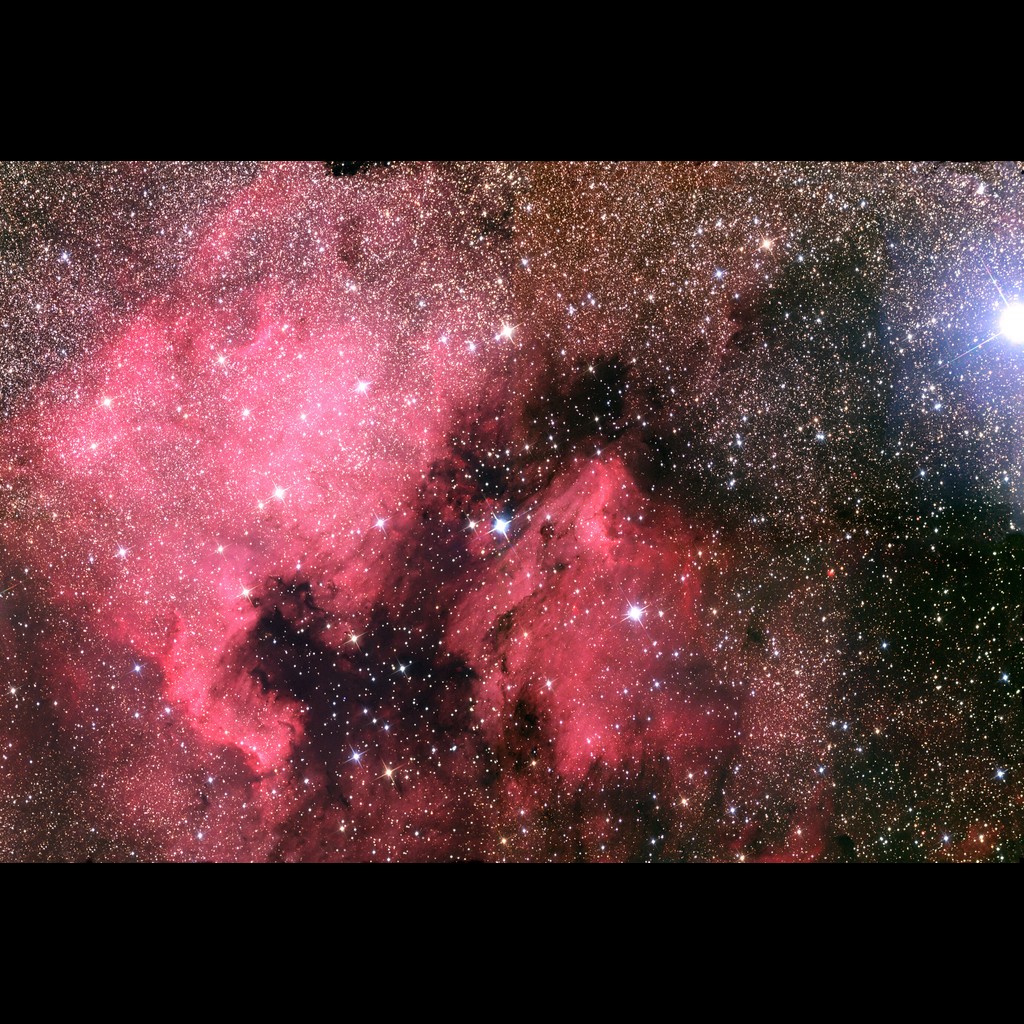
KPNO/NOIRLab/NSF/AURA/Adam Block
| Type | Emission Nebula | Constellation | Cyg |
|---|---|---|---|
| Magnitude | 4.0 | Size | 120.0′ |
| Distance | 1,600 light-years | Best Month | August |
| Visibility | Northern | Difficulty | Easy (level 2/4) |
| Min. Aperture | binoculars | RA / Dec | 20h 58m 01.2s · +44° 31' 48" |
| Discovered by | William Herschel, 1786 | ||
KPNO/NOIRLab/NSF/AURA/Adam Block
Caldwell 20, the North America Nebula (NGC 7000), is a striking emission nebula in the constellation Cygnus, famous for its distinct resemblance to the North American continent. Often observed alongside its neighbor the Pelican Nebula (IC 5070), this region is a massive HII complex superimposed against the dense star fields of the Milky Way. While the bright star Deneb appears prominently in the field, it is not associated with the nebula; at over 1,500 light-years away it is a foreground object relative to the nebula's distance of roughly 1,600 light-years. For years the true ionizing source of NGC 7000 remained a mystery, until astronomers Fernando Comeron and Anna Pasquali identified a secretive, massive OB star hidden behind thick dust clouds located just off the coast of Florida in the nebula's distinctive outline. Had this star been 50 times closer, it would rival Venus in brightness.
The dark rift that appears to separate the North America Nebula from the Pelican Nebula is caused by foreground dust rather than any genuine gap in the glowing gas — deep hydrogen-alpha imaging confirms that both nebulae are connected parts of the same enormous star-forming complex. The nebula glows predominantly in the red light of ionized hydrogen energized by that hidden OB star, and narrowband imaging reveals intricate pillars, arcs, and filaments of gas sculpted by the stellar winds and radiation of the embedded young stellar population. This four-frame mosaic spans more than 4 degrees of sky, captured during the 2014 Advanced Observing Program at the Kitt Peak Visitor Center.
The North America Nebula is one of the finest targets in the sky for binoculars and wide-field telescopes from dark locations. Under truly exceptional conditions it can even be glimpsed with the naked eye as a subtle brightening of the Milky Way alongside Deneb. Long-exposure narrowband photography brings out the intricate gas structures in spectacular detail, and observers with hydrogen-alpha or OIII filters can trace the continental shape across the field. Patrick Moore placed it as the twentieth entry in his Caldwell catalog in recognition of its sheer visual size and dramatic structure.
From Deneb: From Deneb, sweep 3° east — the nebula's brightest regions lie just east of this brilliant star.
| Star | Bayer | Mag | Spectral Type | Distance | Meaning |
|---|---|---|---|---|---|
| Deneb | α Cyg | 1.25 | A2 · Blue-white supergiant | 2600 ly | Arabic Dhanab al-Dajājah, 'Tail of the Hen' — the tail of Cygnus the Swan and one of the three stars of the Summer Triangle. |
| Sadr | γ Cyg | 2.23 | F8 · Yellow-white supergiant | 1800 ly | Arabic Al-Sadr, 'The Breast' — marks the center of Cygnus the Swan, where the Northern Cross intersects. Surrounded by the North America Nebula. |
| Gienah | — | 2.48 | K0 · Blue-white giant | 1520 ly | Arabic Al-Janāh, 'The Wing' — marks the wing of Cygnus the Swan, one of several stars sharing this name across different constellations. |