The Dark Side Observatory
| Type | Emission Nebula | Constellation | Cyg |
|---|---|---|---|
| Magnitude | 7.2 | Size | 12.0′ |
| Distance | 4,000 light-years | Best Month | August |
| Visibility | Northern | Difficulty | Challenging (level 4/4) |
| Min. Aperture | 6in | RA / Dec | 21h 53m 42.0s · +47° 16' 12" |
| Discovered by | Thomas Anderson, 1893 | ||
The Dark Side Observatory
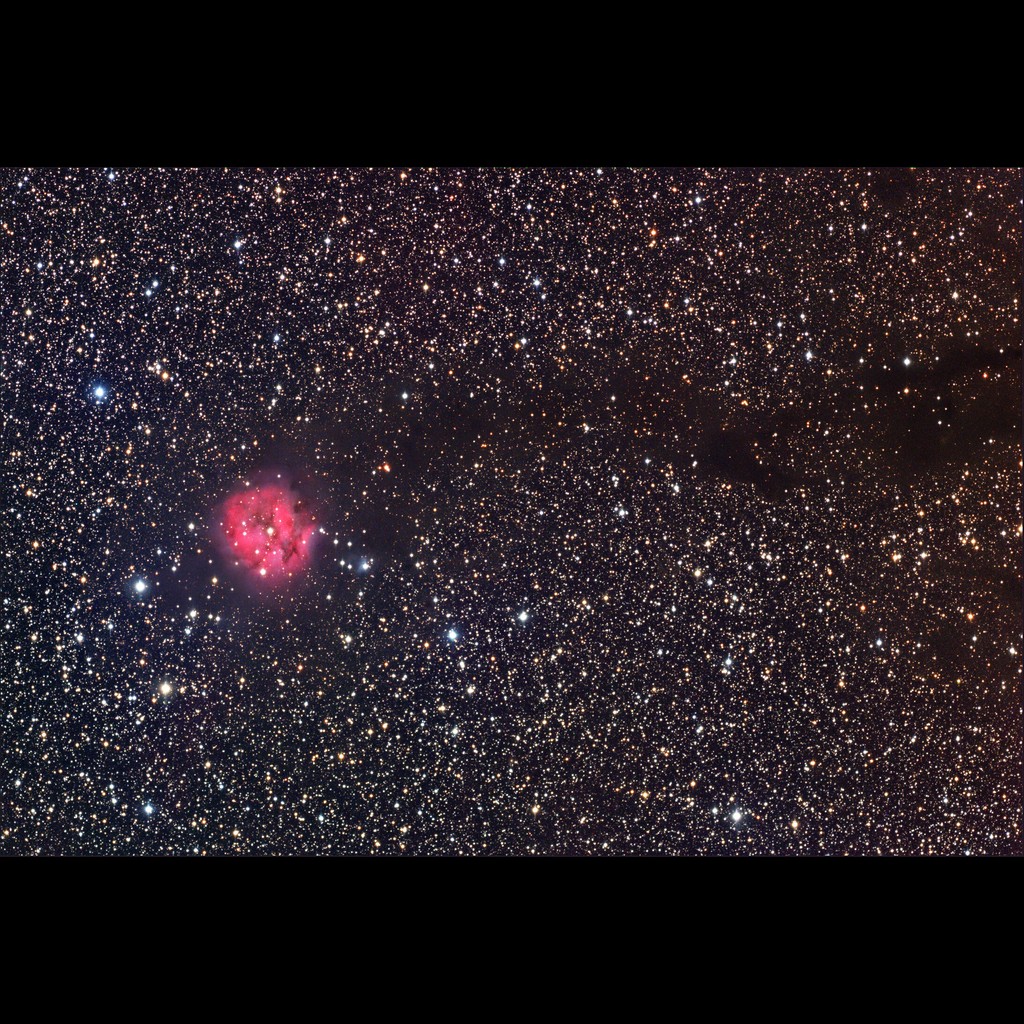
Caldwell 19, popularly known as the Cocoon Nebula (IC 5146), is a striking star-forming region located approximately 4,000 light-years away in the constellation Cygnus. Measuring about 15 light-years across, this emission nebula glows with a distinct red hue caused by hydrogen gas being ionized and illuminated by the intense radiation of young, massive stars nestled within its interior. At the heart of the cocoon lies a very young open cluster, Collinder 470, whose brightest members are less than 100,000 years old — making this one of the most actively forming stellar nurseries accessible in a moderate telescope. This image was captured as part of the Advanced Observing Program (AOP) at the Kitt Peak Visitor Center in 2014.
What gives the Cocoon Nebula its distinctive appearance is the dramatic interplay between the glowing emission nebula at its core and the dark nebula — cataloged as Barnard 168 — that trails away from it to the west like a long, opaque tentacle. This dark lane is a dense column of cold molecular gas and dust that absorbs background starlight and channels material inward toward the active star-forming core. It is one of the clearest examples in the sky of a dark nebula serving as the feeder reservoir for an adjacent emission nebula, with star formation proceeding along the length of the filament over time.
In visual observation, IC 5146 is a moderately challenging object, best detected with a wide-field eyepiece under dark skies. A nebula filter significantly improves contrast against the bright Milky Way background of Cygnus. Long-exposure photographs in hydrogen-alpha light reveal the full extent of the nebula's structure — the bright circular glow of the emission region embedded in the darkness of Barnard 168 — making it one of the most rewarding targets for narrowband astrophotography in the summer sky.
From Deneb: From Deneb, sweep 6° east-southeast following the edge of the Milky Way into eastern Cygnus.
| Star | Bayer | Mag | Spectral Type | Distance | Meaning |
|---|---|---|---|---|---|
| Deneb | α Cyg | 1.25 | A2 · Blue-white supergiant | 2600 ly | Arabic Dhanab al-Dajājah, 'Tail of the Hen' — the tail of Cygnus the Swan and one of the three stars of the Summer Triangle. |
| Sadr | γ Cyg | 2.23 | F8 · Yellow-white supergiant | 1800 ly | Arabic Al-Sadr, 'The Breast' — marks the center of Cygnus the Swan, where the Northern Cross intersects. Surrounded by the North America Nebula. |
| Gienah | — | 2.48 | K0 · Blue-white giant | 1520 ly | Arabic Al-Janāh, 'The Wing' — marks the wing of Cygnus the Swan, one of several stars sharing this name across different constellations. |