The Dark Side Observatory
| Type | Galaxy | Constellation | Cas |
|---|---|---|---|
| Magnitude | 9.2 | Size | 11.7′ |
| Distance | 2.08 million light-years | Best Month | October |
| Visibility | Northern | Difficulty | Moderate (level 3/4) |
| Min. Aperture | 3in | RA / Dec | 00h 38m 49.2s · +48° 19' 48" |
| Discovered by | William Herschel, 1787 | ||
The Dark Side Observatory
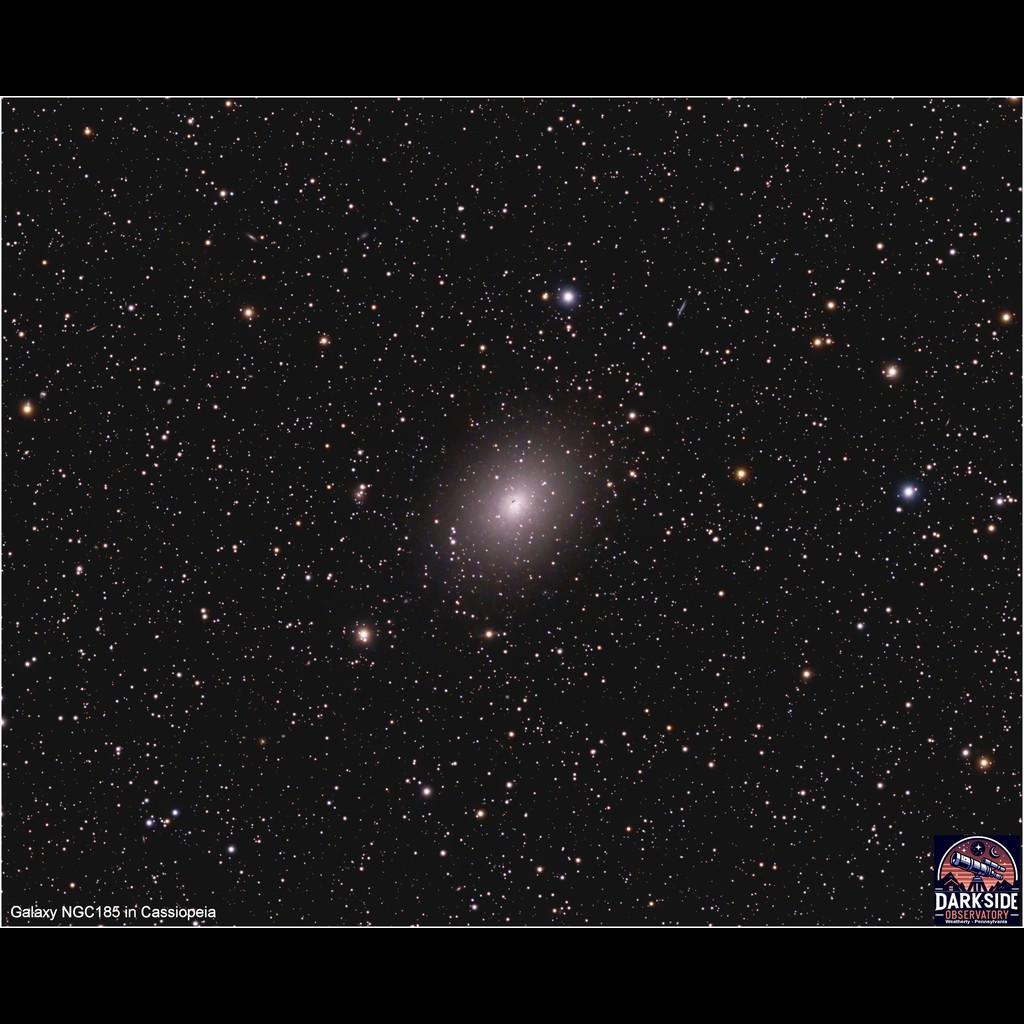
Caldwell 18, cataloged as NGC 185, is a dwarf spheroidal galaxy located approximately 2 million light-years away in the constellation Cassiopeia. Like its neighbor, Caldwell 17 (NGC 147), it is a satellite galaxy of the Andromeda Galaxy (M31) and a member of our Local Group. NGC 185 is particularly interesting to astronomers because, unlike most dwarf elliptical galaxies, it possesses an active galactic nucleus and shows evidence of star formation in its recent history, making it a unique laboratory for studying stellar evolution in small-scale galaxies. This image was captured on September 8, 2024, at The Dark Side Observatory (W59) in Weatherly, PA, under Bortle Class 4 skies, revealing the soft, diffuse structure of this elusive deep-sky object.
What makes NGC 185 scientifically unusual among dwarf spheroidals is the presence of distinct dark dust patches visible in high-resolution images near its center — a feature rarely seen in this class of galaxy. Spectroscopic evidence confirms stars younger than 100 million years mixed in with the dominant older population, indicating at least one recent episode of star formation fueled by gas that somehow persisted or was reacquired from the intergalactic environment. Carbon stars have also been identified in its outer regions, tracers of an intermediate-age stellar population that bridges the galaxy's ancient halo and its younger central stars.
Visually, NGC 185 is marginally easier to observe than its sibling NGC 147 (Caldwell 17), having a slightly brighter and more condensed core that helps the eye anchor on it under dark skies. In a 6-inch telescope it appears as a round, softly glowing patch roughly 8 arcminutes in extent, with a very subtle brightening toward the center. The pair NGC 147 and NGC 185 can often be swept into the same wide-field view, and together they offer a compelling glimpse into the varied architecture of the dwarf galaxies orbiting our galactic neighbor Andromeda.
Navigate from Schedar toward Cassiopeia. From Schedar, sweep 7° south — C17 and C18 lie within 1° of each other and can be seen in the same wide-field view.
| Star | Bayer | Mag | Spectral Type | Distance | Meaning |
|---|---|---|---|---|---|
| Mirach | β And | 2.07 | M0 · Red giant | 197 ly | Arabic Al-Mirāq, 'The Girdle' or 'The Loin' — marks the hip of Andromeda. Nearby sits M31, the Andromeda Galaxy, visible to the naked eye. |
| Almaak | γ And | 2.10 | B8 · Orange giant + blue companion | 355 ly | Arabic Al-'Anāq al-Ard, 'The Desert Lynx.' One of the finest double stars in the sky — vivid gold and blue-green pair. |
| Cih | α Cas | 2.15 | B0 · Blue-white supergiant | 550 ly | Chinese name meaning 'The Whip' — the middle star of Cassiopeia's W, marking the queen's waist. A luminous blue variable. |
| Shedir | γ Cas | 2.24 | K0 · Orange giant | 229 ly | Arabic Al-Sadr, 'The Breast' — marks the heart of Cassiopeia the Queen on her throne. A slowly varying orange giant. |
| Caph | β Cas | 2.28 | F2 · White giant | 54 ly | Arabic Al-Kaff, 'The Hand' or 'The Palm' — marks the tip of the W-shape of Cassiopeia. A pulsating variable star. |
| Ruchbah | δ Cas | 2.66 | A5 · White giant binary | 99 ly | Arabic Al-Rukbah, 'The Knee' of Cassiopeia — one of the W-shaped stars of the queen, an eclipsing binary that dips in brightness periodically. |