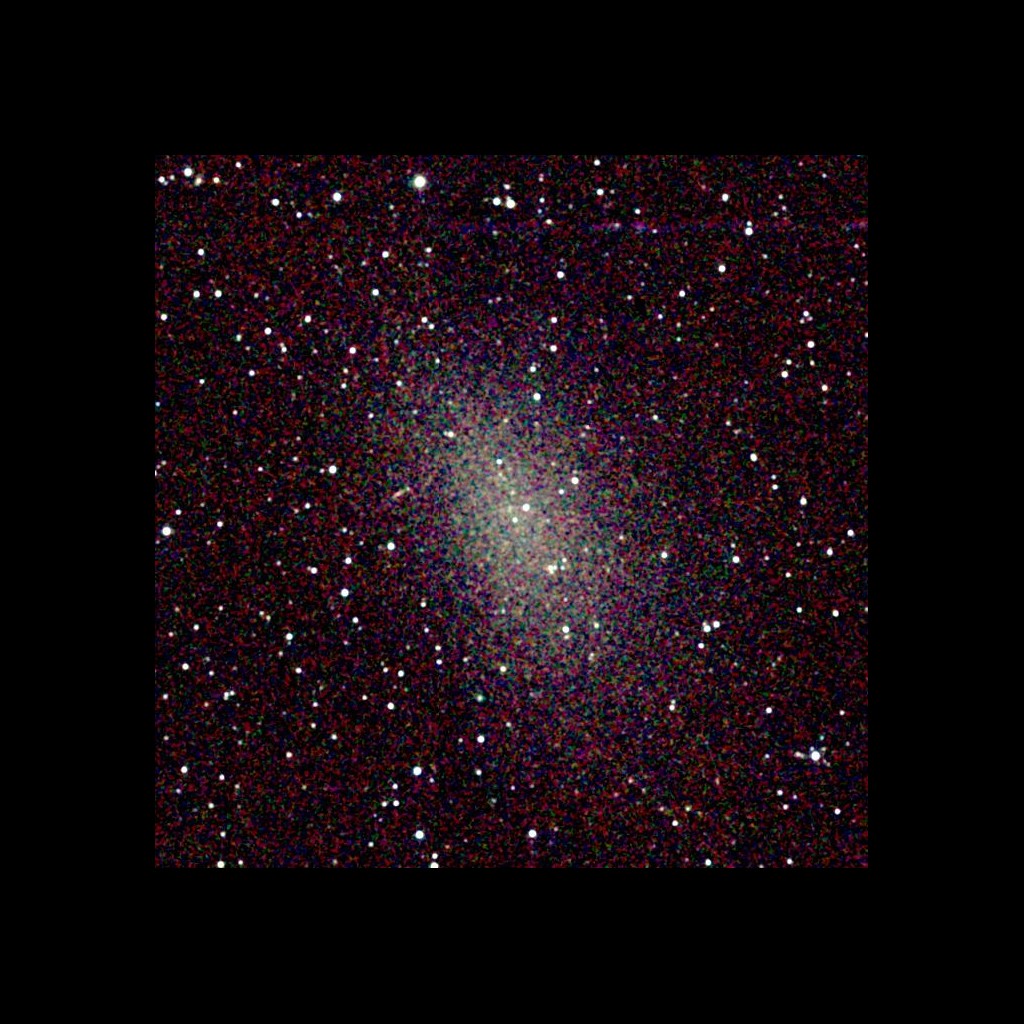
2MASS/NASA/ESA, Public domain, via Wikimedia Commons
| Type | Galaxy | Constellation | Cas |
|---|---|---|---|
| Magnitude | 9.5 | Size | 13.2′ |
| Distance | 2.53 million light-years | Best Month | October |
| Visibility | Northern | Difficulty | Moderate (level 3/4) |
| Min. Aperture | 3in | RA / Dec | 00h 33m 10.8s · +48° 31' 12" |
| Discovered by | John Herschel, 1829 | ||
2MASS/NASA/ESA, Public domain, via Wikimedia Commons
Caldwell 17, also known as NGC 147, is a dwarf spheroidal galaxy located in the constellation Cassiopeia. As a satellite galaxy of the Andromeda Galaxy (M31), it is a distant member of our Local Group, residing approximately 2.5 million light-years away. Unlike the massive, gas-rich spiral galaxies that dominate the sky, NGC 147 is composed primarily of older, evolved stars and contains very little interstellar gas or dust, leading to its faint and diffuse appearance. It is a subtle, challenging target for amateur astronomers, requiring dark skies and careful observation to detect. Its physical connection to the Andromeda subgroup makes it a fascinating study in the diverse population of small galaxies that orbit and interact with the major giants of our local universe.
In long-exposure photographs, NGC 147 appears as a faint, nearly circular haze with no obvious nucleus, spanning roughly 13 by 8 arcminutes on the sky. High-resolution imaging by Hubble has resolved individual red giant stars in its outer regions, confirming a uniformly old stellar population with little or no ongoing star formation. It is closely paired on the sky — and gravitationally — with the nearby dwarf galaxy NGC 185 (Caldwell 18), and both are believed to orbit M31 at a projected separation of roughly 300 kiloparsecs from the Andromeda system.
For visual observers, NGC 147 is a demanding object requiring a dark sky, clean optics, and patience. A 6-inch or larger telescope will reveal a faint elliptical glow under good conditions, but the galaxy blends readily into the sky background if transparency is compromised. It rewards observers who have committed to seeking out all the known satellite galaxies of Andromeda — a diverse zoo of dwarf systems that trace the gravitational reach of our larger galactic neighbor. The 2MASS infrared survey image used here cuts through the foreground dust of Cassiopeia more effectively than visible light, revealing the full extent of this elusive galaxy.
Navigate from Schedar toward Cassiopeia. From Schedar, sweep 7° south toward the Andromeda border.
| Star | Bayer | Mag | Spectral Type | Distance | Meaning |
|---|---|---|---|---|---|
| Mirach | β And | 2.07 | M0 · Red giant | 197 ly | Arabic Al-Mirāq, 'The Girdle' or 'The Loin' — marks the hip of Andromeda. Nearby sits M31, the Andromeda Galaxy, visible to the naked eye. |
| Almaak | γ And | 2.10 | B8 · Orange giant + blue companion | 355 ly | Arabic Al-'Anāq al-Ard, 'The Desert Lynx.' One of the finest double stars in the sky — vivid gold and blue-green pair. |
| Cih | α Cas | 2.15 | B0 · Blue-white supergiant | 550 ly | Chinese name meaning 'The Whip' — the middle star of Cassiopeia's W, marking the queen's waist. A luminous blue variable. |
| Shedir | γ Cas | 2.24 | K0 · Orange giant | 229 ly | Arabic Al-Sadr, 'The Breast' — marks the heart of Cassiopeia the Queen on her throne. A slowly varying orange giant. |
| Caph | β Cas | 2.28 | F2 · White giant | 54 ly | Arabic Al-Kaff, 'The Hand' or 'The Palm' — marks the tip of the W-shape of Cassiopeia. A pulsating variable star. |
| Ruchbah | δ Cas | 2.66 | A5 · White giant binary | 99 ly | Arabic Al-Rukbah, 'The Knee' of Cassiopeia — one of the W-shaped stars of the queen, an eclipsing binary that dips in brightness periodically. |