Professor of Physics, Donald Pelletier
| Type | Open Cluster | Constellation | Lac |
|---|---|---|---|
| Magnitude | 6.4 | Size | 21.0′ |
| Distance | 2,600 light-years | Best Month | September |
| Visibility | Northern | Difficulty | Easy (level 2/4) |
| Min. Aperture | binoculars | RA / Dec | 22h 14m 52.8s · +49° 52' 48" |
| Discovered by | William Herschel, 1788 | ||
Professor of Physics, Donald Pelletier
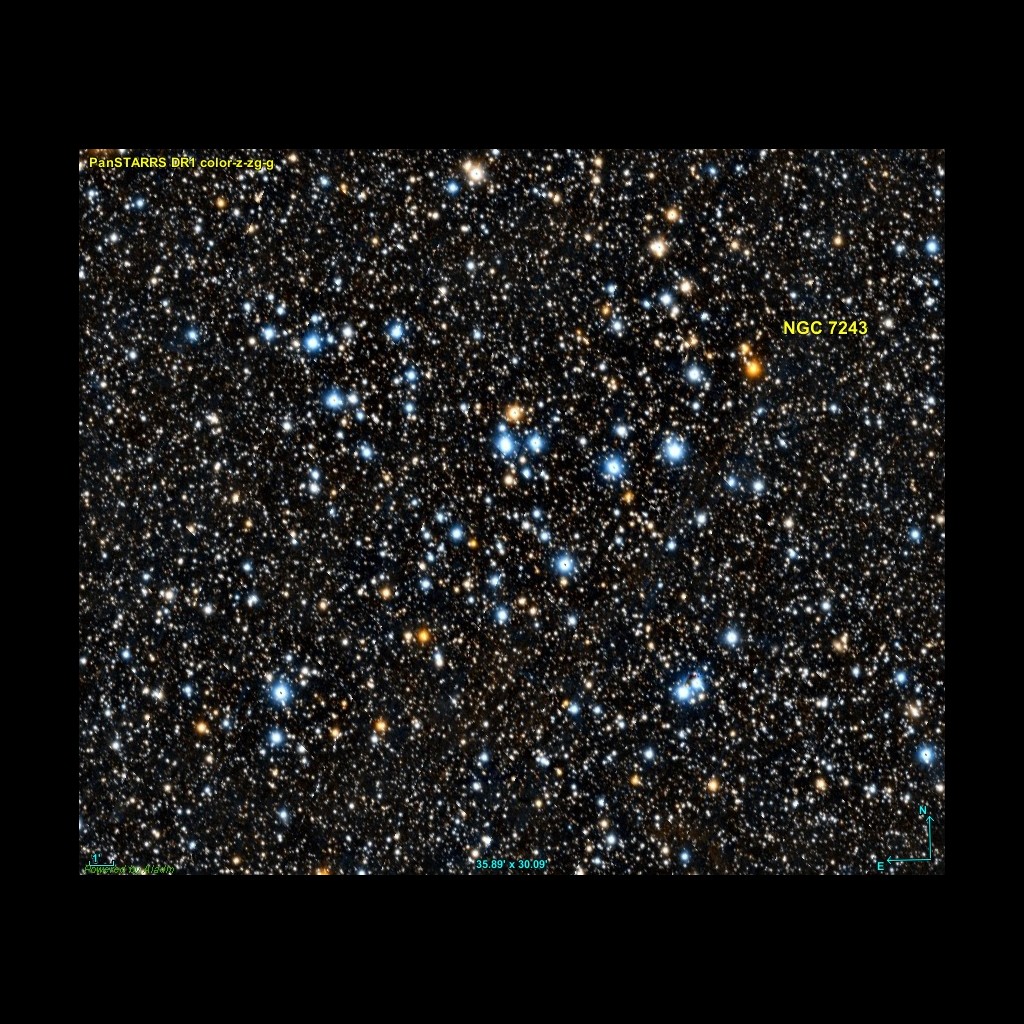
Caldwell 16, also known as NGC 7243, is a large, sprawling open cluster located in the small, understated constellation of Lacerta. Situated approximately 2,800 light-years from Earth, this cluster features a loose and somewhat irregular arrangement of stars that creates a distinct, coarse appearance often described as scattered. Spanning about 21 arcminutes — roughly two-thirds the diameter of the full Moon — it is bright enough to be seen with binoculars or small telescopes under moderately dark skies. Its young population of blue and white stars stands out against the backdrop of the Milky Way, making it a rewarding target for observers who enjoy star-hopping through less-populated regions of the night sky.
NGC 7243 is estimated to be approximately 60 to 100 million years old — young enough to retain a complement of luminous blue-white B-type stars, but old enough that the most massive members have already evolved away from the main sequence. Studies of the cluster have identified a small number of red giant members, suggesting that the upper main sequence has begun to peel away with age. The cluster contains roughly 40 confirmed members, with the brighter stars arranged in a loose, elongated pattern that spans the full angular extent of the grouping.
Because NGC 7243 lacks a dramatic core concentration, it is best appreciated in binoculars or a finderscope at low magnification, where the loose scatter of blue-white stars stands out against the moderately rich Milky Way field in Lacerta. Higher magnifications tend to dissolve the cluster into the surrounding star field, making it harder to isolate as a distinct grouping. Lacerta is one of the sky's less-visited constellations, but observers who take the time to explore it will find NGC 7243 a pleasant reward — a wide, sparkling grouping that exemplifies the youthful open clusters scattered along the Milky Way's disk.
Navigate from Scheat toward Lacerta. From Scheat (Beta Pegasi), sweep 12° north into Lacerta.
| Star | Bayer | Mag | Spectral Type | Distance | Meaning |
|---|---|---|---|---|---|
| Deneb | α Cyg | 1.25 | A2 · Blue-white supergiant | 2600 ly | Arabic Dhanab al-Dajājah, 'Tail of the Hen' — the tail of Cygnus the Swan and one of the three stars of the Summer Triangle. |