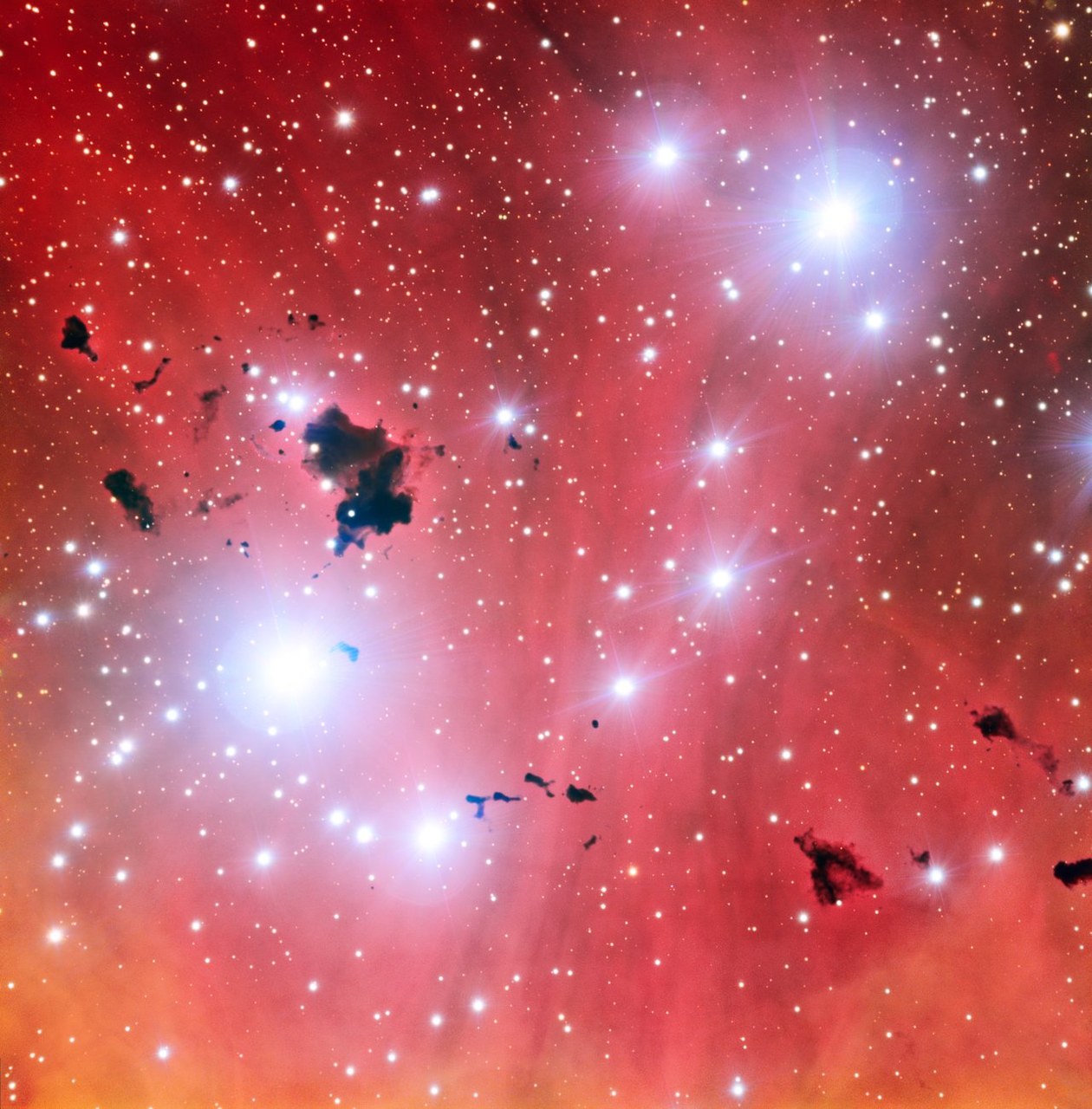
DSS2/STScI/NASA (public domain)
| Type | Planetary Nebula | Constellation | Cyg |
|---|---|---|---|
| Magnitude | 8.8 | Size | 0.5′ |
| Distance | 2,200 light-years | Best Month | August |
| Visibility | Northern | Difficulty | Easy (level 2/4) |
| Min. Aperture | 3-inch | RA / Dec | 19h 44m 48.1s · +50° 31' 30" |
| Discovered by | William Herschel, 1793 | ||
DSS2/STScI/NASA (public domain)
NGC 6826, known as the Blinking Planetary Nebula, is a fine planetary nebula located about 2,200 light-years away in the constellation Cygnus. Discovered by William Herschel in 1793, it spans roughly half an arcminute and glows at magnitude 8.8, making it easily resolved into its distinctive blue-green disk in a small telescope. Its central star shines at magnitude 10.4 — unusually luminous for a planetary nebula's white-dwarf remnant — and is the source of the intense ultraviolet radiation that energizes the surrounding shell of expelled gas.
The "blinking" effect that gives NGC 6826 its popular name is a classic demonstration of averted vision: when you look directly at the nebula, the eye is drawn to the brilliant central star and the surrounding disk seems to vanish. Look slightly away, and the glowing shell blinks back into view. This behavior makes it a perennial favorite for public observing nights and a satisfying demonstration object in any telescope.
In high-resolution images, NGC 6826 reveals a layered structure: a bright inner disk of [O III] emission is wrapped in a fainter outer halo, with two bright patches — known as FLIERs (fast, low-ionization emission regions) — flanking the central star on either side. These knots of denser material are moving outward at high velocity relative to the nebular shell, and their origin remains an active area of research. The entire assembly is the remains of a solar-type star that shed its outer layers several thousand years ago, leaving behind the hot stellar core that will cool over billions of years into a cold white dwarf.
| Star | Bayer | Mag | Spectral Type | Distance | Meaning |
|---|---|---|---|---|---|
| Vega | α Lyr | 0.03 | A0 · Blue-white main sequence | 25 ly | Arabic Wāqi', 'The Swooping Eagle' — the fifth brightest star and anchor of the Summer Triangle. Will become the North Star around 13,727 CE. |
| Deneb | α Cyg | 1.25 | A2 · Blue-white supergiant | 2600 ly | Arabic Dhanab al-Dajājah, 'Tail of the Hen' — the tail of Cygnus the Swan and one of the three stars of the Summer Triangle. |
| Sadr | γ Cyg | 2.23 | F8 · Yellow-white supergiant | 1800 ly | Arabic Al-Sadr, 'The Breast' — marks the center of Cygnus the Swan, where the Northern Cross intersects. Surrounded by the North America Nebula. |
| Etamin | α Dra | 2.24 | K5 · Orange giant | 148 ly | Arabic Al-Tinnīn, 'The Dragon' — the brightest star in Draco, marking the dragon's head. The North Star around 4000 BCE. |