N.A.Sharp/NOIRLab/NSF/AURA
| Type | Open Cluster | Constellation | Per |
|---|---|---|---|
| Magnitude | 4.3 | Size | 30.0′ |
| Distance | 7,500 light-years | Best Month | November |
| Visibility | Northern | Difficulty | Easiest (level 1/4) |
| Min. Aperture | naked eye | RA / Dec | 02h 19m 12.0s · +57° 07' 48" |
| Discovered by | Hipparchus, -130 | ||
N.A.Sharp/NOIRLab/NSF/AURA
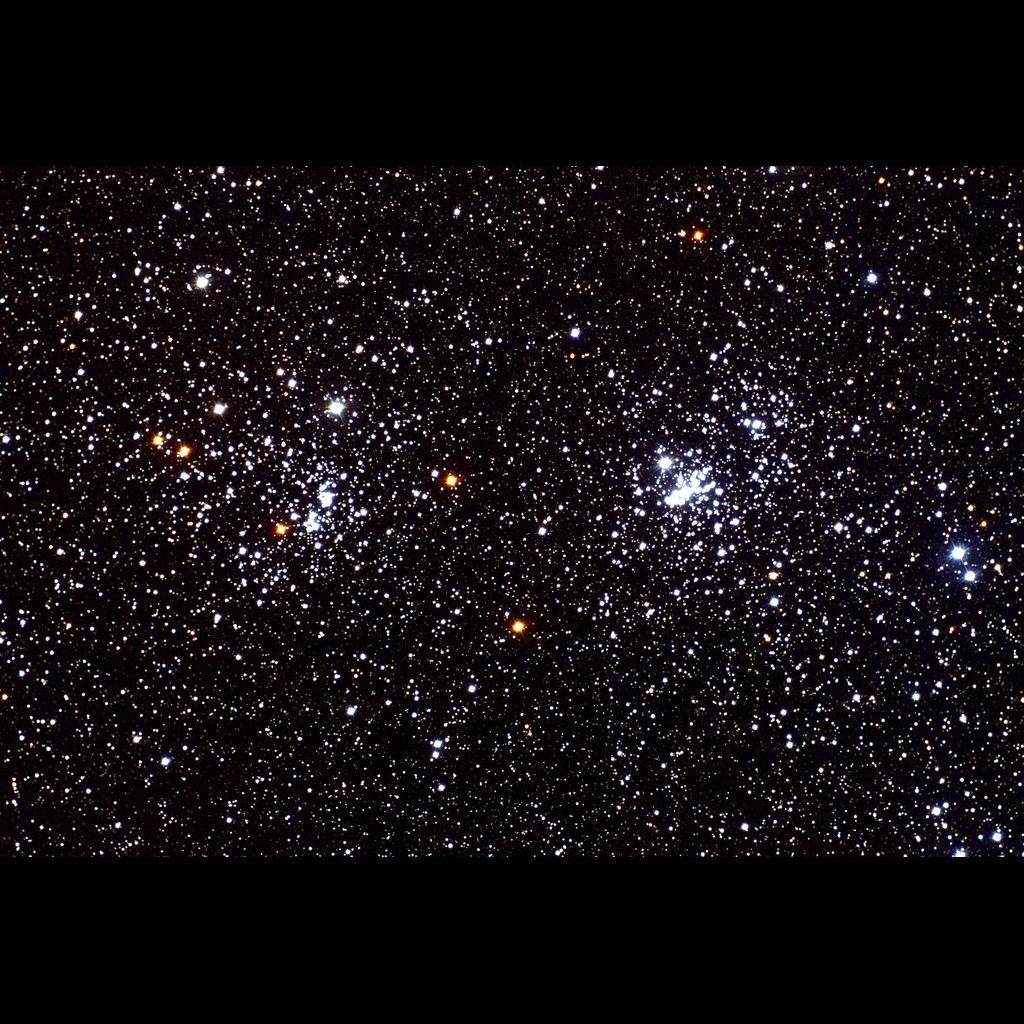
Caldwell 14, known as NGC 869 or h Persei, is the western member of the famous Double Cluster in the constellation Perseus. Situated about 7,000 light-years away, it is an exceptional grouping of young, brilliant O and B-type stars, many of them supergiants. It forms a breathtaking pair with its companion NGC 884 (Chi Persei, Caldwell 15), which lies just to its east. The two clusters are separated by only about 100 light-years in space — genuinely neighboring clusters formed from the same giant molecular cloud — making this pairing one of the finest examples of a physical double cluster in the sky. This image features data captured in September 1997 at the Burrell Schmidt telescope of the Warner and Swasey Observatory on Kitt Peak.
NGC 869 and NGC 884 are among the youngest and most spectacular open clusters visible to northern observers. At roughly 12.8 million years old, their hot blue supergiant members burn furiously and will exhaust their fuel in a cosmically brief time — some will end their lives as supernovae within the next few million years. The clusters are members of the Perseus OB1 stellar association, a vast region of active star formation that spans much of the constellation. Under dark skies, the Double Cluster is visible to the naked eye as a misty double patch midway between Perseus and Cassiopeia.
In photographs, the contrast between the two clusters is striking: NGC 869 is slightly richer and appears more concentrated, while NGC 884 shows a warmer color palette due to a greater proportion of orange supergiant members. Together they span nearly a full degree of sky, making them one of the few deep-sky showpieces better suited to binoculars or a rich-field telescope than to high magnification. Few objects in the Caldwell or Messier catalogs rival them for sheer visual impact on a clear night.
Navigate from Mirfak toward Perseus. From Mirfak (Alpha Persei), sweep 5° northwest — the Double Cluster is immediately apparent as a bright Milky Way condensation.
| Star | Bayer | Mag | Spectral Type | Distance | Meaning |
|---|---|---|---|---|---|
| Mirphak | ε Per | 1.79 | F5 · Yellow-white supergiant | 590 ly | Arabic Mirfaq al-Thurayya, 'Elbow near the Pleiades' — the brightest star in Perseus, embedded in a beautiful star cluster visible in binoculars. |
| Cih | α Cas | 2.15 | B0 · Blue-white supergiant | 550 ly | Chinese name meaning 'The Whip' — the middle star of Cassiopeia's W, marking the queen's waist. A luminous blue variable. |
| Shedir | γ Cas | 2.24 | K0 · Orange giant | 229 ly | Arabic Al-Sadr, 'The Breast' — marks the heart of Cassiopeia the Queen on her throne. A slowly varying orange giant. |
| Caph | β Cas | 2.28 | F2 · White giant | 54 ly | Arabic Al-Kaff, 'The Hand' or 'The Palm' — marks the tip of the W-shape of Cassiopeia. A pulsating variable star. |
| Ruchbah | δ Cas | 2.66 | A5 · White giant binary | 99 ly | Arabic Al-Rukbah, 'The Knee' of Cassiopeia — one of the W-shaped stars of the queen, an eclipsing binary that dips in brightness periodically. |