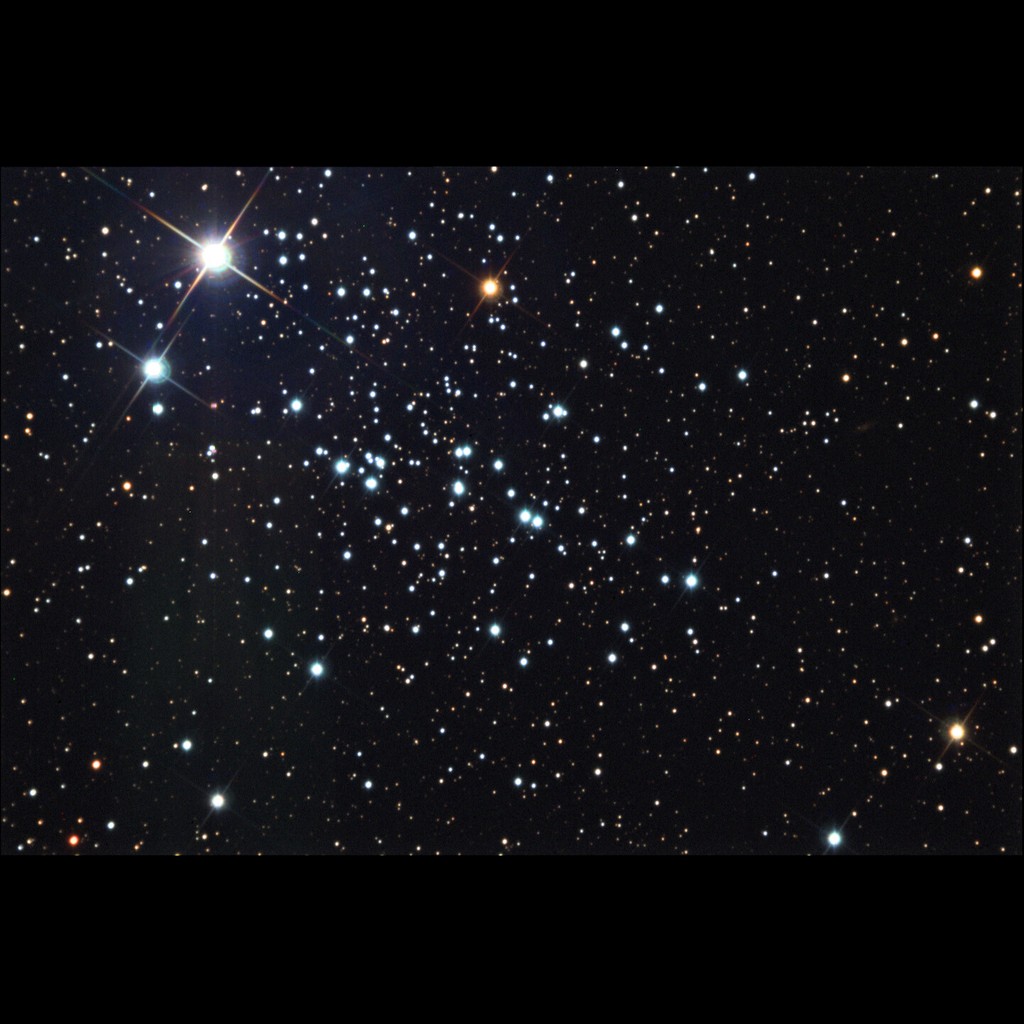
KPNO/NOIRLab/NSF/AURA/Ken and Emilie Siarkiewicz/Adam Block
| Type | Open Cluster | Constellation | Cas |
|---|---|---|---|
| Magnitude | 6.4 | Size | 13.0′ |
| Distance | 7,900 light-years | Best Month | October |
| Visibility | Northern | Difficulty | Easy (level 2/4) |
| Min. Aperture | binoculars | RA / Dec | 01h 19m 22.8s · +58° 16' 12" |
| Discovered by | William Herschel, 1787 | ||
KPNO/NOIRLab/NSF/AURA/Ken and Emilie Siarkiewicz/Adam Block
Caldwell 13, also known as NGC 457, is a vibrant open cluster situated in the constellation Cassiopeia. It is a perennial favorite among amateur astronomers, thanks to its accessibility in small telescopes and a distinct, recognizable arrangement of stars that sparks the imagination. Many observers see the shape of an owl or — as it is often affectionately called — the E.T. Cluster, with two prominent, bright stars at the top forming the figure's eyes while chains of fainter stars extend outward as arms. Captured here as part of the 2014 Advanced Observing Program at the Kitt Peak Visitor Center, this image highlights the cluster's striking structure and serves as an excellent reference for those beginning their journey into deep-sky observation.
The two bright eye-stars are Phi Cassiopeiae (magnitude 5.0) and HD 7902 (magnitude 7.0), though neither is a confirmed cluster member — both are likely foreground stars that happen to lie along the same line of sight and lend the figure its most recognizable feature. The true cluster members, located approximately 7,900 light-years away, are predominantly hot B-type supergiants and main-sequence stars that formed together roughly 21 million years ago. NGC 457 spans about 20 arcminutes on the sky — roughly two-thirds the apparent diameter of the full Moon — and contains an estimated 150 to 200 stellar members.
NGC 457 is a superb target for binoculars and small telescopes at low magnification, where the distinctive outstretched arms figure becomes immediately apparent. Dark skies bring out the fainter members of the body, while the brilliant eye-stars anchor the view with a pleasing color contrast against the blue-white cluster stars. The cluster responds best to magnifications of 30 to 60 power, where it fills the eyepiece with a satisfying mix of stars set against the rich Cassiopeia Milky Way background.
Navigate from Schedar toward Cassiopeia. From Schedar (Alpha Cassiopeiae), move 2.5° northeast — the two bright 'eye' stars are immediately obvious.
| Star | Bayer | Mag | Spectral Type | Distance | Meaning |
|---|---|---|---|---|---|
| Cih | α Cas | 2.15 | B0 · Blue-white supergiant | 550 ly | Chinese name meaning 'The Whip' — the middle star of Cassiopeia's W, marking the queen's waist. A luminous blue variable. |
| Shedir | γ Cas | 2.24 | K0 · Orange giant | 229 ly | Arabic Al-Sadr, 'The Breast' — marks the heart of Cassiopeia the Queen on her throne. A slowly varying orange giant. |
| Caph | β Cas | 2.28 | F2 · White giant | 54 ly | Arabic Al-Kaff, 'The Hand' or 'The Palm' — marks the tip of the W-shape of Cassiopeia. A pulsating variable star. |
| Ruchbah | δ Cas | 2.66 | A5 · White giant binary | 99 ly | Arabic Al-Rukbah, 'The Knee' of Cassiopeia — one of the W-shaped stars of the queen, an eclipsing binary that dips in brightness periodically. |