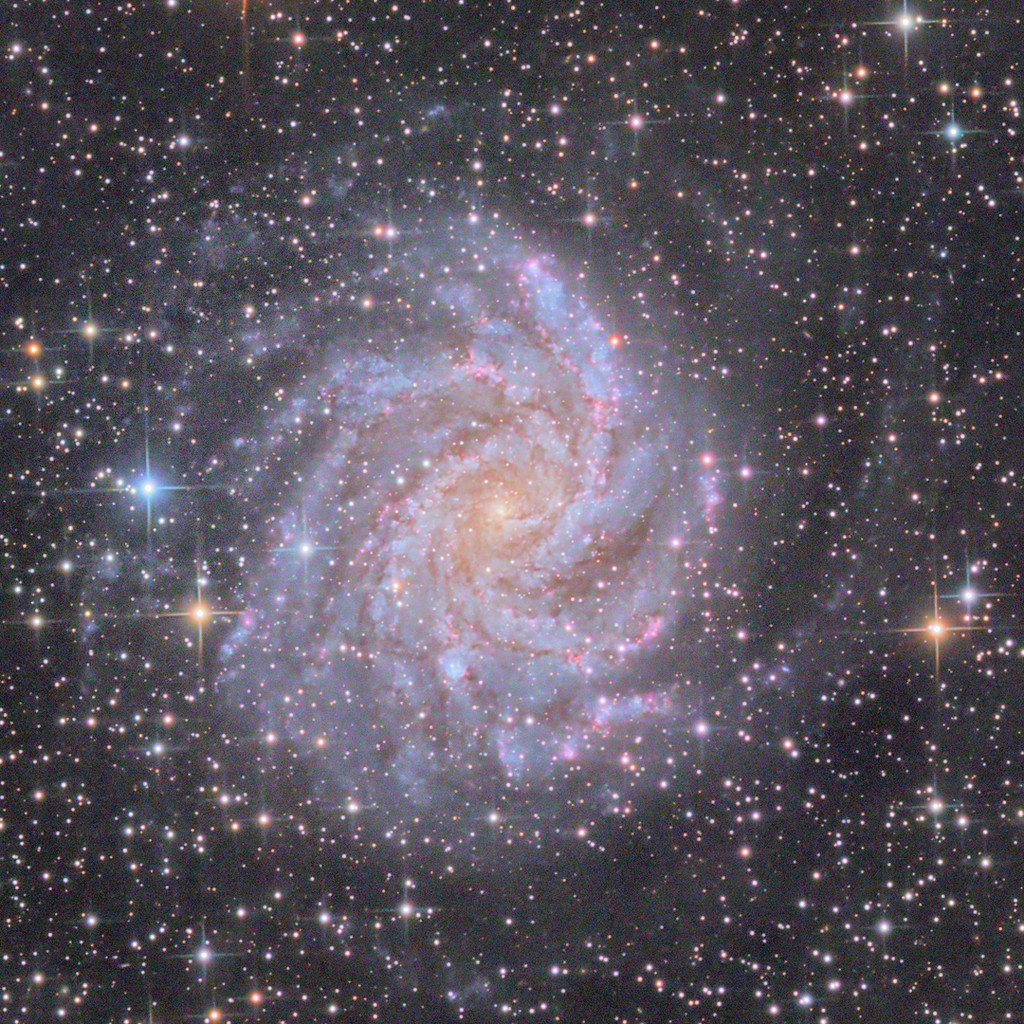
amateur astrophotographer Andrei Gusan
| Type | Galaxy | Constellation | Cep |
|---|---|---|---|
| Magnitude | 8.8 | Size | 11.5′ |
| Distance | 22.0 million light-years | Best Month | August |
| Visibility | Northern | Difficulty | Moderate (level 3/4) |
| Min. Aperture | 3in | RA / Dec | 20h 35m 06.0s · +60° 08' 60" |
| Discovered by | William Herschel, 1798 | ||
amateur astrophotographer Andrei Gusan
Caldwell 12, famously known as the Fireworks Galaxy (NGC 6946), is a beautiful face-on spiral galaxy located on the border between the constellations Cepheus and Cygnus. It earns its nickname from its remarkably high rate of supernova activity — ten confirmed supernovae have been observed in this galaxy since 1917, far more than the average for a galaxy of its size, and a rate that speaks directly to the furious pace of star formation ongoing within its arms. This capture by amateur astrophotographer Andrei Gusan, utilizing a 10-inch Newtonian reflector, illustrates the impressive level of detail achievable by dedicated observers under dark skies.
NGC 6946's extraordinary supernova rate reflects spiral arms packed with HII regions and young stellar associations constantly producing massive stars that end their lives quickly and violently. Infrared surveys suggest the actual star formation rate is significantly higher than optical observations reveal, as much of the activity is buried beneath thick dust lanes. The galaxy lies just 11 degrees above the galactic plane, and the foreground dust of the Milky Way causes significant extinction that dims and reddens its apparent magnitude — otherwise this 22-million-light-year-distant spiral would appear even brighter in the sky.
Despite the foreground dust, NGC 6946 is accessible to amateur telescopes of 6 inches or more from a reasonably dark location, where it appears as a large, low-surface-brightness glow with a brighter core. Larger instruments begin to reveal hints of the spiral structure and the brightest HII regions scattered through the arms. The image showcases the galaxy's grand spiral architecture and the star-forming knots distributed throughout the outer arms, serving as a testament to why NGC 6946 is prized among observers studying the dynamic and evolving nature of galaxies like our own.
From Deneb: From Deneb, sweep 8° north-northeast along the Cygnus-Cepheus border.
| Star | Bayer | Mag | Spectral Type | Distance | Meaning |
|---|---|---|---|---|---|
| Deneb | α Cyg | 1.25 | A2 · Blue-white supergiant | 2600 ly | Arabic Dhanab al-Dajājah, 'Tail of the Hen' — the tail of Cygnus the Swan and one of the three stars of the Summer Triangle. |
| Alderamin | α Cep | 2.45 | A7 · White subgiant | 49 ly | Arabic Al-Dhirā' al-Yamīn, 'The Right Arm' of Cepheus. Due to precession, it will become the North Star around 7500 CE. |