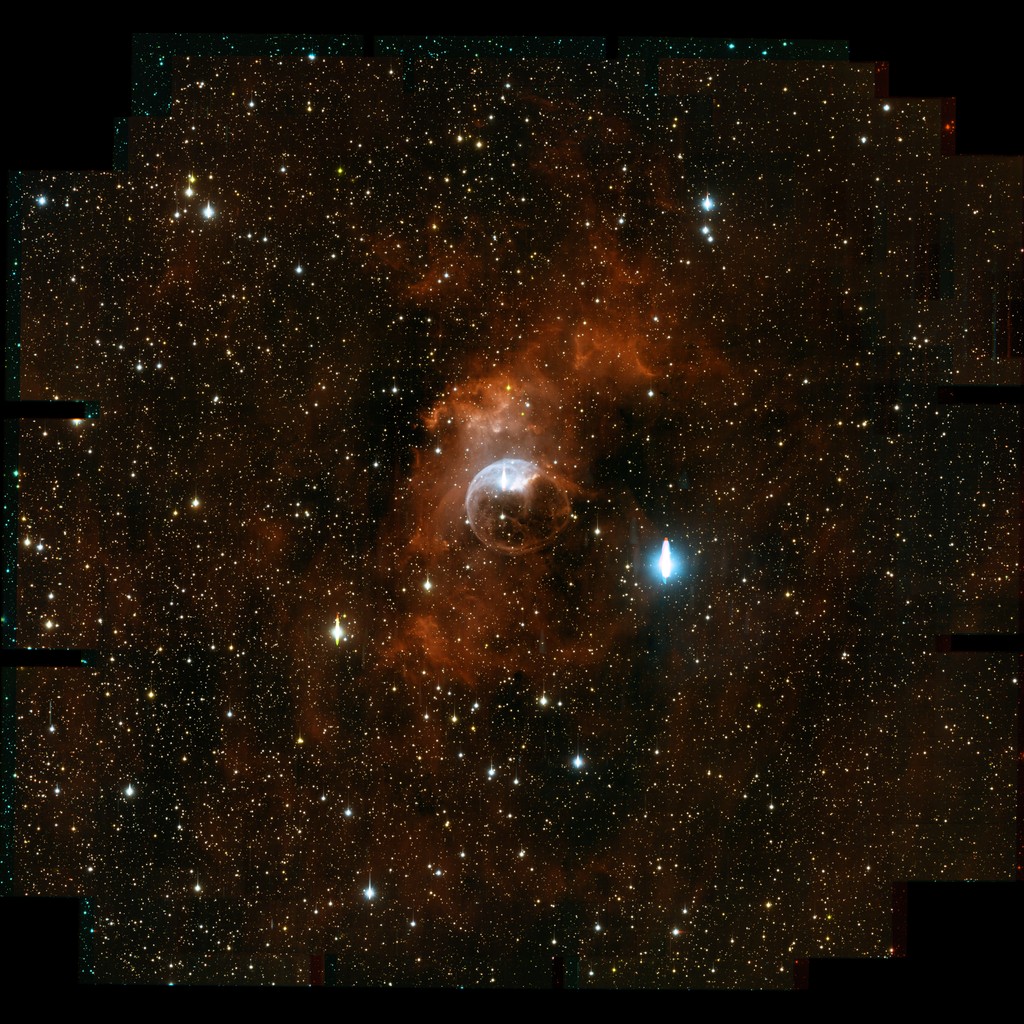
T.A. Rector (University of Alaska Anchorage), WIYN ODI team & WIYN/NOIRLab/NSF/AURA
| Type | Emission Nebula | Constellation | Cas |
|---|---|---|---|
| Magnitude | 10.0 | Size | 15.0′ |
| Distance | 7,100 light-years | Best Month | October |
| Visibility | Northern | Difficulty | Challenging (level 4/4) |
| Min. Aperture | 6in | RA / Dec | 23h 21m 46.8s · +61° 12' 00" |
| Discovered by | William Herschel, 1787 | ||
T.A. Rector (University of Alaska Anchorage), WIYN ODI team & WIYN/NOIRLab/NSF/AURA
Caldwell 11, widely known as the Bubble Nebula (NGC 7635), is a striking emission nebula located in the constellation Cassiopeia, approximately 7,100 to 11,000 light-years away. The nebula's iconic bubble shape is carved out of the surrounding interstellar gas by the intense stellar winds of a massive, hot central star (BD+60°2522), which is roughly 45 times more massive than our Sun. This wide-field view demonstrates the exquisite image quality of the One Degree Imager (ODI) camera on the WIYN 3.5-meter telescope at Kitt Peak, capturing the intricate nebulosity and dynamic shock fronts created by the star's radiation pressure. As an active star-forming region, it offers a dramatic example of how massive stars fundamentally reshape their immediate environments as they evolve.
The bubble itself is approximately six light-years in diameter. BD+60°2522 blasts material outward at speeds exceeding 100,000 kilometers per hour, and where this fast stellar wind plows into the denser surrounding molecular cloud, it creates a compressed shell of gas that glows brilliantly in hydrogen-alpha emission. Notably, the star sits offset toward one edge of the bubble rather than at the center — because the molecular cloud is not uniform in density, the shell expands more slowly where it encounters denser gas and races outward freely in the opposite direction. The open cluster M52 lies in the same wide-field view just beyond the frame's edge, making this a rich region of the autumn Cassiopeia sky.
For visual observers, the Bubble Nebula is a genuine challenge. The bubble itself is relatively faint and requires dark skies along with an OIII or hydrogen-alpha filter to detect the delicate arc of nebulosity. Long-exposure photographs reveal the spectacular full extent of the shock front and its surrounding molecular cloud, transforming this subtle visual object into one of the sky's most iconic images. Patrick Moore placed it as the eleventh entry in his Caldwell catalog for its combination of visual drama and accessibility to northern observers.
From Caph: From Caph, move 5° east-southeast; the Bubble sits adjacent to the open cluster M52.
| Star | Bayer | Mag | Spectral Type | Distance | Meaning |
|---|---|---|---|---|---|
| Cih | α Cas | 2.15 | B0 · Blue-white supergiant | 550 ly | Chinese name meaning 'The Whip' — the middle star of Cassiopeia's W, marking the queen's waist. A luminous blue variable. |
| Shedir | γ Cas | 2.24 | K0 · Orange giant | 229 ly | Arabic Al-Sadr, 'The Breast' — marks the heart of Cassiopeia the Queen on her throne. A slowly varying orange giant. |
| Caph | β Cas | 2.28 | F2 · White giant | 54 ly | Arabic Al-Kaff, 'The Hand' or 'The Palm' — marks the tip of the W-shape of Cassiopeia. A pulsating variable star. |
| Alderamin | α Cep | 2.45 | A7 · White subgiant | 49 ly | Arabic Al-Dhirā' al-Yamīn, 'The Right Arm' of Cepheus. Due to precession, it will become the North Star around 7500 CE. |
| Ruchbah | δ Cas | 2.66 | A5 · White giant binary | 99 ly | Arabic Al-Rukbah, 'The Knee' of Cassiopeia — one of the W-shaped stars of the queen, an eclipsing binary that dips in brightness periodically. |