KPNO/NOIRLab/NSF/AURA/Peter and Suzie Erickson/Adam Block
| Type | Open Cluster | Constellation | Cas |
|---|---|---|---|
| Magnitude | 7.1 | Size | 16.0′ |
| Distance | 6,850 light-years | Best Month | October |
| Visibility | Northern | Difficulty | Easy (level 2/4) |
| Min. Aperture | binoculars | RA / Dec | 01h 46m 12.0s · +61° 13' 48" |
| Discovered by | Giovanni Batista Hodierna, 1654 | ||
KPNO/NOIRLab/NSF/AURA/Peter and Suzie Erickson/Adam Block
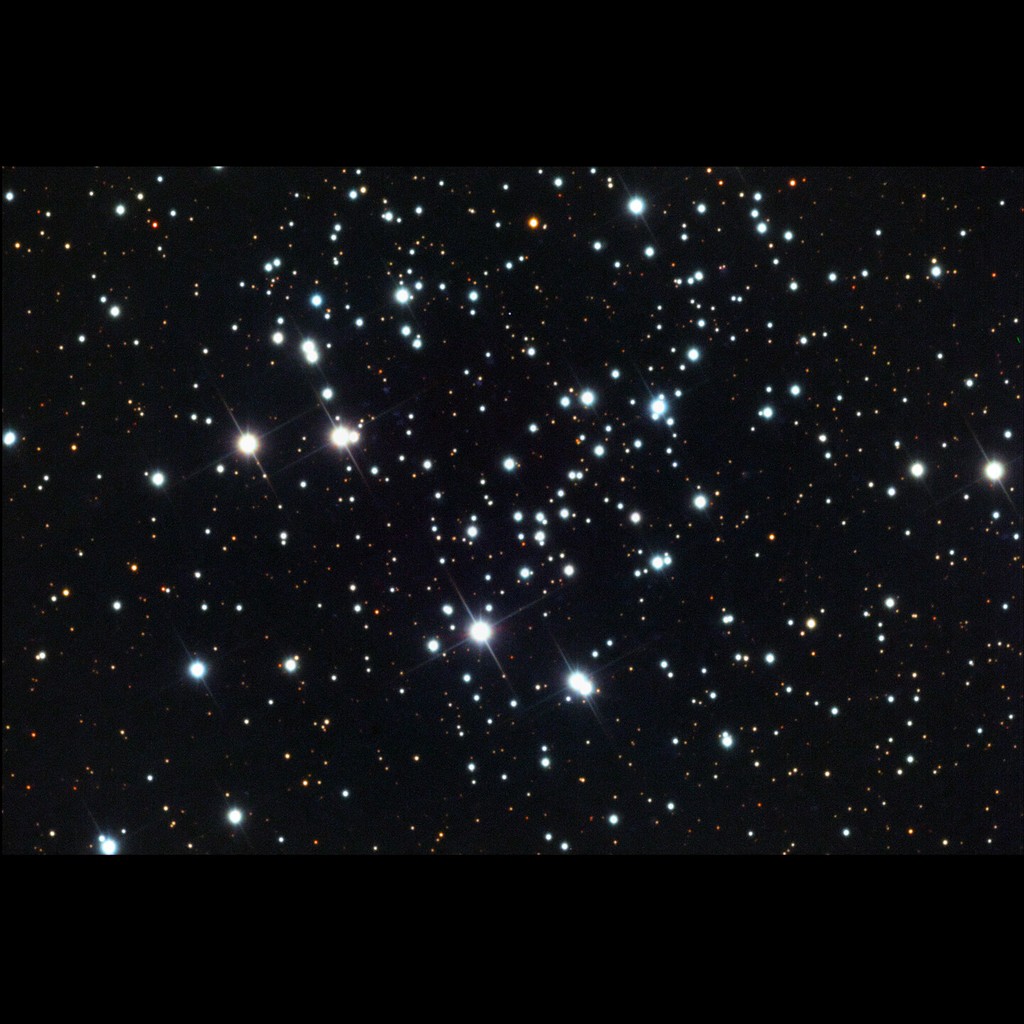
Caldwell 10, also known as NGC 663, is a prominent open cluster located in the constellation Cassiopeia. At a relatively young age of approximately 20 to 25 million years, this cluster provides a brilliant look at stellar youth, featuring a loose but striking grouping of stars that stand out clearly against the backdrop of the Milky Way. Its vibrant stellar population and clear structure make it an excellent reference for observers exploring the dynamic stellar neighborhoods within our own galaxy. This image was captured during the 2014 Advanced Observing Program at the Kitt Peak Visitor Center.
NGC 663 contains a notably high proportion of Be stars — rapidly rotating B-type stars surrounded by equatorial disks of ionized gas that emit strong spectral emission lines. This overabundance of Be stars compared to clusters of similar age has made NGC 663 a productive target for spectroscopic surveys studying the origins and evolution of stellar rotation. The cluster's integrated magnitude of approximately 7.1 makes it an easy binocular object, resolving into dozens of identifiable members in small telescopes. The richest section of the cluster presents a pleasing fan or arrowhead shape in the eyepiece.
Set against one of the densest stretches of the winter Milky Way in Cassiopeia, NGC 663 is often overlooked in favor of its more famous neighbor, the Double Cluster (Caldwell 14). But its own rich concentration of hot blue-white stars rewards exploration at low to moderate magnification, with intricate chains and groupings becoming apparent as the eye adjusts. At roughly 6,850 light-years from Earth, NGC 663 is one of the richer open clusters in this arm of the galaxy, containing an estimated 400 or more stellar members when faint stars are included.
From Ruchbah: From Ruchbah (Delta Cassiopeiae), move 3° northeast — the cluster is easily found in the same rich star field.
| Star | Bayer | Mag | Spectral Type | Distance | Meaning |
|---|---|---|---|---|---|
| Mirphak | ε Per | 1.79 | F5 · Yellow-white supergiant | 590 ly | Arabic Mirfaq al-Thurayya, 'Elbow near the Pleiades' — the brightest star in Perseus, embedded in a beautiful star cluster visible in binoculars. |
| Cih | α Cas | 2.15 | B0 · Blue-white supergiant | 550 ly | Chinese name meaning 'The Whip' — the middle star of Cassiopeia's W, marking the queen's waist. A luminous blue variable. |
| Shedir | γ Cas | 2.24 | K0 · Orange giant | 229 ly | Arabic Al-Sadr, 'The Breast' — marks the heart of Cassiopeia the Queen on her throne. A slowly varying orange giant. |
| Caph | β Cas | 2.28 | F2 · White giant | 54 ly | Arabic Al-Kaff, 'The Hand' or 'The Palm' — marks the tip of the W-shape of Cassiopeia. A pulsating variable star. |
| Ruchbah | δ Cas | 2.66 | A5 · White giant binary | 99 ly | Arabic Al-Rukbah, 'The Knee' of Cassiopeia — one of the W-shaped stars of the queen, an eclipsing binary that dips in brightness periodically. |