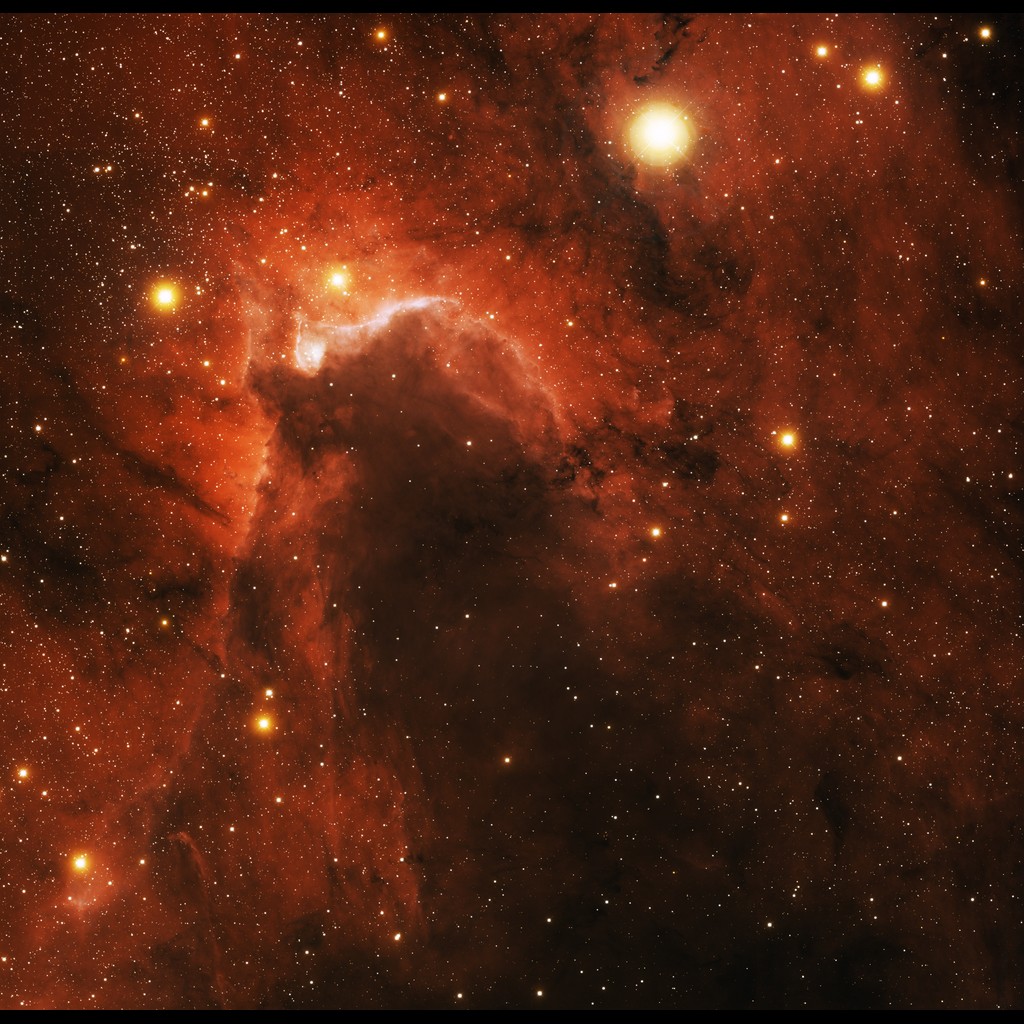
T.A. Rector (University of Alaska Anchorage) and H. Schweiker (WIYN and NOIRLab/NSF/AURA)
| Type | Emission Nebula | Constellation | Cep |
|---|---|---|---|
| Magnitude | 7.0 | Size | 50.0′ |
| Distance | 2,400 light-years | Best Month | September |
| Visibility | Northern | Difficulty | Moderate (level 3/4) |
| Min. Aperture | 3in | RA / Dec | 22h 58m 01.2s · +62° 30' 00" |
| Discovered by | William Herschel, 1787 | ||
T.A. Rector (University of Alaska Anchorage) and H. Schweiker (WIYN and NOIRLab/NSF/AURA)
Caldwell 9, known as the Cave Nebula (Sh2-155), is a captivating emission nebula located approximately 2,400 light-years away in the constellation Cepheus. Part of the Cepheus B molecular cloud complex, this active star-forming region features a dense, dark cloud of gas embedded within a giant emission nebula. The distinctive cave appearance is created by the dark dust lane that forms the back wall, while the top edge is illuminated by the intense radiation from hot, massive stars within the Cepheus OB3 association. This wide-field image was captured by the Mosaic camera on the Nicholas U. Mayall 4-meter telescope at Kitt Peak National Observatory, utilizing hydrogen-alpha (red), sulphur [S II] (blue), and I-band (orange) filters to reveal the complex gaseous structures. In this view, north is oriented to the left and east toward the bottom.
Star formation in the Sh2-155 region is actively driven by the Cepheus OB3 association, a group of young, hot O- and B-type stars whose ultraviolet radiation ionizes the surrounding gas and sculpts the cloud's cavern-like profile. Detailed studies have revealed multiple generations of star formation, with the triggering process propagating through the molecular cloud over millions of years as each generation of massive stars compresses adjacent clouds into new bursts of stellar birth. Embedded within the densest portions of the cloud are young stellar objects and protostars still too deeply shrouded in dust to be seen at visible wavelengths but readily detected in infrared surveys.
Despite its modest surface brightness, the Cave Nebula is a rewarding target for long-exposure narrowband imaging, where hydrogen-alpha emission traces the glowing walls of the nebular cavity and the dark molecular cloud forms the dramatic foreground. Visually, it requires a large aperture and very dark skies, appearing as a faint, irregular glow with a notable absence of stars marking the dark lane. Patrick Moore included it as the ninth entry in his Caldwell catalog, recognizing Sh2-155 as a compelling example of active star formation accessible from northern latitudes.
From Caph: From Caph (Beta Cassiopeiae), sweep 10° east along the Cassiopeia-Cepheus border.
| Star | Bayer | Mag | Spectral Type | Distance | Meaning |
|---|---|---|---|---|---|
| Cih | α Cas | 2.15 | B0 · Blue-white supergiant | 550 ly | Chinese name meaning 'The Whip' — the middle star of Cassiopeia's W, marking the queen's waist. A luminous blue variable. |
| Shedir | γ Cas | 2.24 | K0 · Orange giant | 229 ly | Arabic Al-Sadr, 'The Breast' — marks the heart of Cassiopeia the Queen on her throne. A slowly varying orange giant. |
| Caph | β Cas | 2.28 | F2 · White giant | 54 ly | Arabic Al-Kaff, 'The Hand' or 'The Palm' — marks the tip of the W-shape of Cassiopeia. A pulsating variable star. |
| Alderamin | α Cep | 2.45 | A7 · White subgiant | 49 ly | Arabic Al-Dhirā' al-Yamīn, 'The Right Arm' of Cepheus. Due to precession, it will become the North Star around 7500 CE. |
| Ruchbah | δ Cas | 2.66 | A5 · White giant binary | 99 ly | Arabic Al-Rukbah, 'The Knee' of Cassiopeia — one of the W-shaped stars of the queen, an eclipsing binary that dips in brightness periodically. |