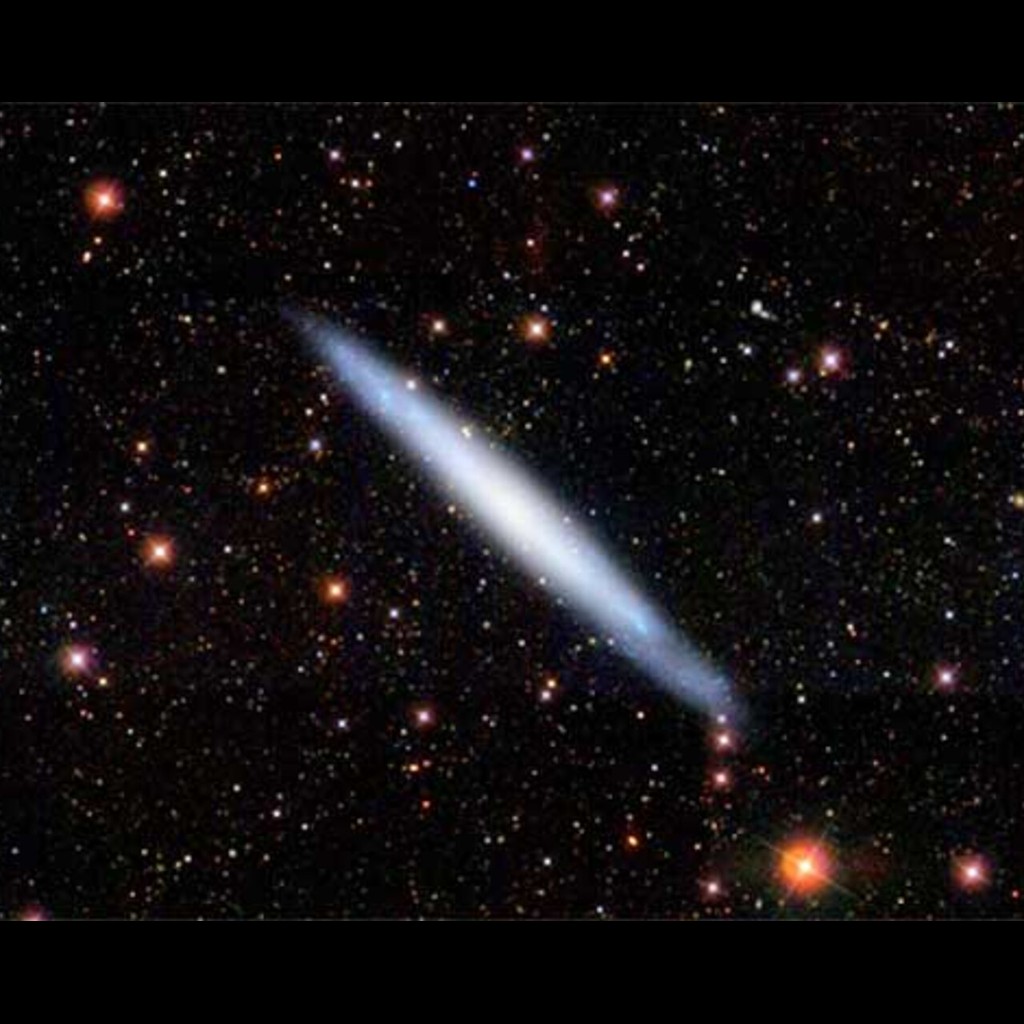
DSS2/STScI/NASA (public domain)
| Type | Galaxy | Constellation | CVn |
|---|---|---|---|
| Magnitude | 10.2 | Size | 16.2′ |
| Distance | 13.7 million light-years | Best Month | April |
| Visibility | Northern | Difficulty | Moderate (level 3/4) |
| Min. Aperture | 4-inch | RA / Dec | 12h 17m 30.1s · +37° 48' 25" |
| Discovered by | William Herschel, 1787 | ||
DSS2/STScI/NASA (public domain)
Caldwell 26, cataloged as NGC 4244, is a classic edge-on spiral galaxy located approximately 13.7 million light-years away in the constellation Canes Venatici. Discovered by William Herschel in 1787, it stretches over 16 arcminutes across the sky — one of the largest edge-on galaxies accessible to amateur instruments — and glows at a visual magnitude of about 10.2. Its profile is extraordinarily thin and uniform: a long silver needle of starlight with a modest central bulge and very little obvious dust absorption, characteristics of a late-type, low-mass spiral seen perfectly broadside.
In photographs, NGC 4244 invites comparison with the more celebrated edge-on systems NGC 891 (C23) and NGC 4565 (C38), but stands apart for its slender elegance. Unlike those galaxies, which display prominent dark dust lanes bisecting their disks, NGC 4244's disk is relatively dust-poor and its bulge far more modest, giving it a clean, spindle-like appearance that extends remarkably far from the center before fading into the background. Deep imaging also reveals a faint stellar halo — a low-surface-brightness cloud of older stars surrounding the visible disk — that is disproportionately large relative to the galaxy's disk mass, a puzzle still being studied.
NGC 4244 is a member of the Canes Venatici I Cloud of galaxies and is accompanied by a known dwarf companion. As one of the nearest large edge-on spirals, it has become a benchmark object for studies of stellar populations at different distances above and below the galactic plane, disk structure, and the relationship between a spiral galaxy's thin disk and its outer halo. A dark sky and at least a 4-inch aperture will reveal it as an elongated smear; larger instruments begin to show its inner brightness gradient and the subtle brightening at the nucleus.
| Star | Bayer | Mag | Spectral Type | Distance | Meaning |
|---|---|---|---|---|---|
| Cor Caroli | — | 2.89 | A0 · White main sequence | 110 ly | Latin for 'Heart of Charles' — named to honor King Charles II of England. The brightest star in Canes Venatici. |