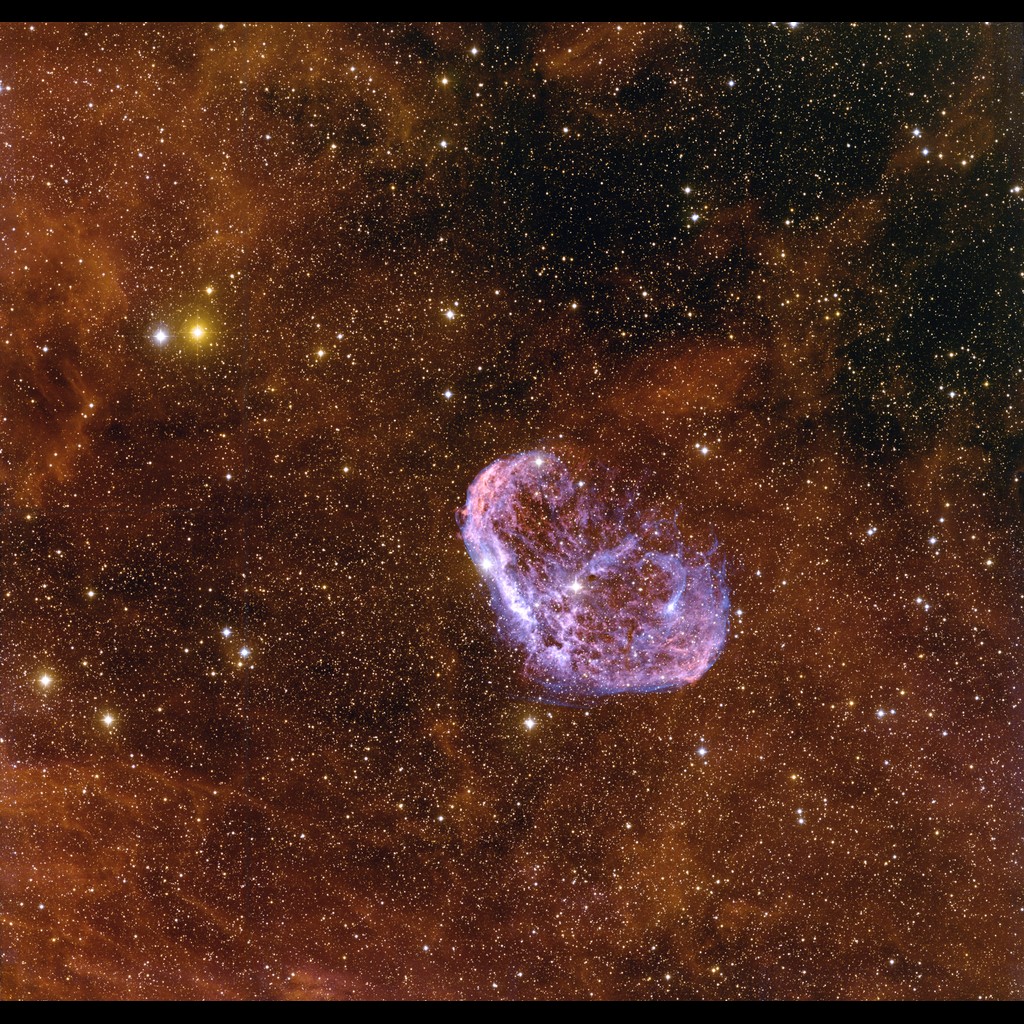
T.A. Rector (NRAO/AUI/NSF and NOIRLab/NSF/AURA)
| Type | Emission Nebula | Constellation | Cyg |
|---|---|---|---|
| Magnitude | 7.4 | Size | 18.0′ |
| Distance | 5,000 light-years | Best Month | August |
| Visibility | Northern | Difficulty | Challenging (level 4/4) |
| Min. Aperture | 6in | RA / Dec | 20h 12m 06.8s · +38° 21' 00" |
| Discovered by | Friedrich August Theodor Winnecke, 1877 | ||
T.A. Rector (NRAO/AUI/NSF and NOIRLab/NSF/AURA)
Caldwell 27, the Crescent Nebula (NGC 6888), is a brilliant emission nebula located in the constellation Cygnus, formed by the powerful stellar winds of the central Wolf-Rayet star WR 136. Wolf-Rayet stars are rare, extremely hot, and massive objects currently shedding their outer layers at high velocities, which collide with earlier ejected material to create the nebula's distinctive crescent-shaped shell. This wide-field composite image was captured using the National Science Foundation's 0.9-meter telescope at Kitt Peak, employing the NOAO Mosaic CCD camera. The image blends emission-line data with hydrogen-alpha mapped to red, oxygen [O III] to blue, and sulfur [S II] to yellow, providing a vivid look at the gas dynamics of this violent environment. In this orientation, north is down and east is to the right.
The central star, WR 136, is classified as a WN6 Wolf-Rayet star — so evolved and massive that it has blown away most of its hydrogen envelope, exposing the hotter helium-burning layers beneath. WR 136 drives a stellar wind with a terminal velocity exceeding 1,800 kilometers per second and a mass-loss rate tens of thousands of times greater than the Sun's. The Crescent Nebula marks the boundary where this fast wind collides with material ejected roughly 400,000 years ago when WR 136 was a red supergiant — compressing it into the bright arcing filaments visible today. The nebula spans approximately 25 by 18 arcminutes on the sky and lies roughly 5,000 light-years from Earth.
For visual observers, the Crescent Nebula is a moderately challenging target best detected with an OIII or hydrogen-alpha filter, which dramatically boosts the contrast of the glowing shell against the dark sky. Under good conditions with an 8-inch or larger telescope, the brightest arc of the crescent can be traced against the rich Cygnus star field. Long-exposure narrowband photographs transform the nebula into one of the most dramatic objects in the summer sky, revealing the full extent of the shell with vivid color-coding of the different emission regions and the complex filamentary structure within.
From Sadr: From Sadr (Gamma Cygni, the centre of the Northern Cross), move 2° southwest — the Crescent wraps around the Wolf-Rayet star nearby.
| Star | Bayer | Mag | Spectral Type | Distance | Meaning |
|---|---|---|---|---|---|
| Deneb | α Cyg | 1.25 | A2 · Blue-white supergiant | 2600 ly | Arabic Dhanab al-Dajājah, 'Tail of the Hen' — the tail of Cygnus the Swan and one of the three stars of the Summer Triangle. |
| Sadr | γ Cyg | 2.23 | F8 · Yellow-white supergiant | 1800 ly | Arabic Al-Sadr, 'The Breast' — marks the center of Cygnus the Swan, where the Northern Cross intersects. Surrounded by the North America Nebula. |
| Gienah | — | 2.48 | K0 · Blue-white giant | 1520 ly | Arabic Al-Janāh, 'The Wing' — marks the wing of Cygnus the Swan, one of several stars sharing this name across different constellations. |
| Albireo | β Cyg | 3.05 | K3 · Orange giant + blue companion | 430 ly | Origin uncertain, possibly corrupted Latin or Arabic. Famous as one of the most beautiful double stars in the sky — gold and blue. |
| Sheliak | γ Lyr | 3.52 | A8 · Blue-white eclipsing binary | 960 ly | Arabic Al-Sheliak, 'The Tortoise' or 'The Lyre' — an eclipsing binary in Lyra that was one of the first variable stars discovered, in 1784. |