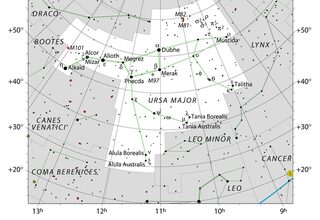
 IAU Chart
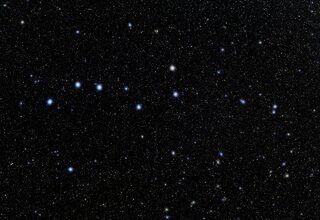 NOIRLab Images
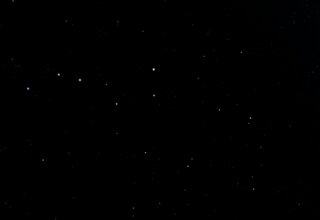 Stellarium Images
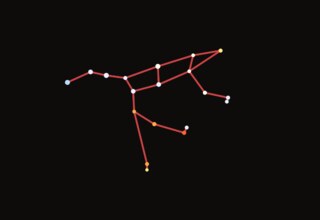 Stars and Sticks
| Abbreviation | UMa |
|---|---|
| Meaning | Great Bear |
| Pronunciation Guide is based on “Pronouncing Astronomical Names,” published in 1943 by the American Astronomical Society. | ER-suh MAY-jur |
| Genitive The genitive is the Latin possessive form used in star names. For example, Alpha Orionis means “the Alpha of Orion.” | UR-see muh-JOR-is |
| Best Month | April |
| Visibility | Northern |
| Origin | AncientThese figures are rooted in the classical Greek and Mesopotamian traditions cataloged by Ptolemy in the 2nd century AD. |
| Author | PtolemyPtolemy, a 2nd-century Greco-Egyptian astronomer, cataloged the 48 classical constellations in his landmark work, the Almagest. These form the core of the 88 modern constellations recognized today. |
| Type | constellation |
| Difficulty | Easiest |
| Description | The Great Bear is the third largest constellation and the most universally recognized in the northern hemisphere, home to the famous Big Dipper asterism — seven bright stars forming a distinctive ladle shape used for navigation for thousands of years. In myth the beautiful nymph Callisto was transformed into a bear by the jealous Hera and set among the stars by Zeus. The two stars forming the outer edge of the Big Dipper's bowl point almost directly to Polaris, the North Star. Mizar (Zeta Ursae Majoris), the middle star of the handle, was the first binary star to be identified through a telescope in 1617, and the first stellar object to be photographed, in 1857 — two firsts in the history of astronomy. |
| Asterism | Big Dipper: Seven bright stars forming a ladle shape; used to find the North Star. |
Click a thumbnail to view full-size. Plain and Annotated versions available on the image page.
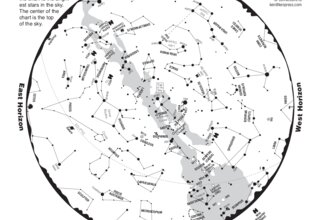
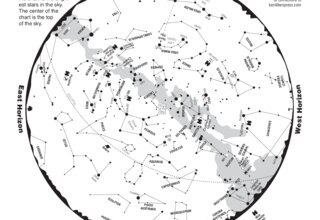
Monthly sky charts courtesy of What's Out Tonight? — Copyright ©2026 Ken Graun. Star charts are optimized for mid-latitudes of the Northern Hemisphere. Click a chart to view or download the PDF. For guidance on using the chart, or to purchase a planisphere and astronomy books, visit kenpress.com.
Images: NOIRLab/NSF/AURA/E. Slawik · IAU and Sky & Telescope · Stellarium — Full credits →