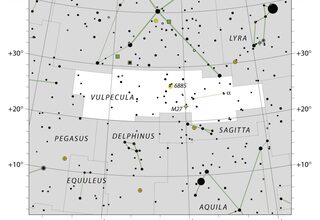
 IAU Chart
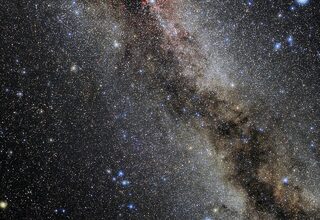 NOIRLab Images
 Stars and Sticks
| Abbreviation | Vul |
|---|---|
| Meaning | Fox |
| Pronunciation Guide is based on “Pronouncing Astronomical Names,” published in 1943 by the American Astronomical Society. | vul-PECK-yoo-luh |
| Genitive The genitive is the Latin possessive form used in star names. For example, Alpha Orionis means “the Alpha of Orion.” | vul-PEK-yuh-lee |
| Best Month | September |
| Visibility | Northern |
| Origin | ModernAdded between the 17th and 18th centuries by astronomers like Hevelius or Plancius to define faint star clusters ignored by the ancients. |
| Author | HeveliusA Polish astronomer known as the "founder of lunar topography" who added several "filler" constellations using high-precision instruments. |
| Type | constellation |
| Difficulty | Expert |
| Description | The Little Fox was introduced by Johannes Hevelius in 1687, originally depicted as a fox carrying a goose in its jaws — though the goose was later dropped. It sits in the heart of the Summer Triangle in a rich Milky Way field. The constellation contains the Dumbbell Nebula (M27) — the first planetary nebula ever discovered, found by Charles Messier in 1764 and named for its striking dumbbell shape; the puffed-out outer layers of a dead star about 1,360 light-years away, it is one of the brightest planetary nebulae and an easy target for small telescopes. The first pulsar ever discovered — PSR B1919+21 — was also detected in Vulpecula in 1967 by Jocelyn Bell Burnell, a landmark moment in astrophysics. |
Click a thumbnail to view full-size. Plain and Annotated versions available on the image page.
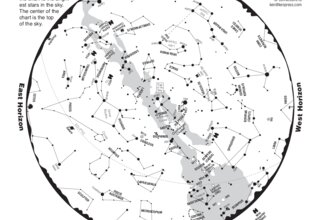
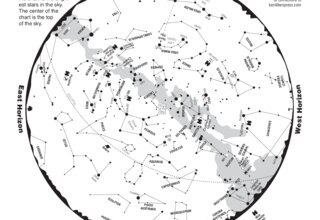
Monthly sky charts courtesy of What's Out Tonight? — Copyright ©2026 Ken Graun. Star charts are optimized for mid-latitudes of the Northern Hemisphere. Click a chart to view or download the PDF. For guidance on using the chart, or to purchase a planisphere and astronomy books, visit kenpress.com.
Images: NOIRLab/NSF/AURA/E. Slawik · IAU and Sky & Telescope · Stellarium — Full credits →