NOIRLab/NSF/AURA
| Type | Galaxy | Constellation | Boo |
|---|---|---|---|
| Magnitude | 10.2 | Size | 6.5′ |
| Distance | 59.0 million light-years | Best Month | May |
| Visibility | Global | Difficulty | Moderate (level 3/4) |
| Min. Aperture | 6-inch | RA / Dec | 13h 37m 32.2s · +08° 53' 10" |
| Discovered by | William Herschel, 1784 | ||
NOIRLab/NSF/AURA
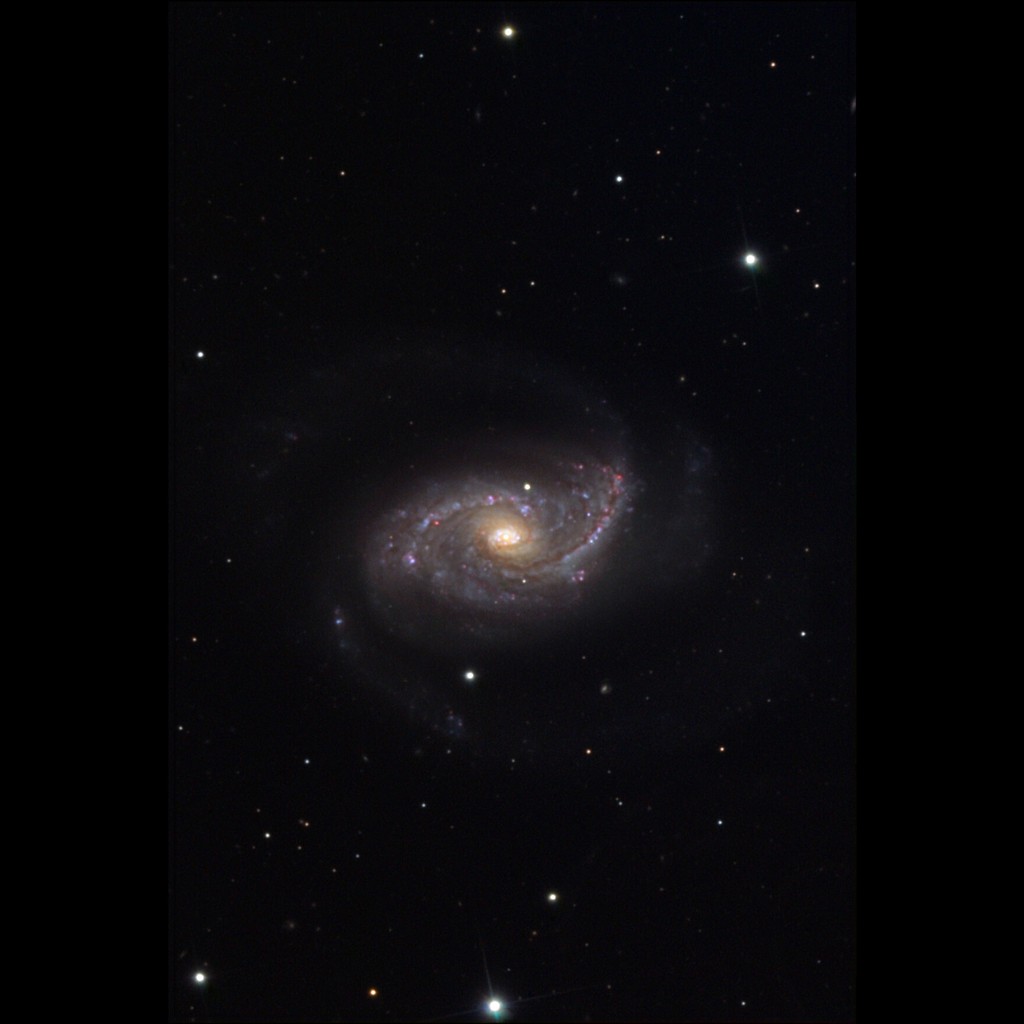
Caldwell 45, cataloged as NGC 5248, is an intermediate barred spiral galaxy located approximately 59 million light-years away in the constellation Boötes. Discovered by William Herschel in 1784, it glows at a visual magnitude of about 10.2 and spans roughly 6.5 arcminutes. Its face-on orientation presents a direct view of a well-organized spiral structure: two prominent inner arms tightly wrapped around a compact, active nucleus, set within a broader disk of older stars that fades gradually into the surrounding sky.
What sets NGC 5248 apart from many of its neighbors is the activity concentrated in its inner region. The nucleus is classified as a low-ionization nuclear emission-line region (LINER), and high-resolution imaging reveals a striking circumnuclear ring — a tightly wound pair of inner spiral arm segments traced by knots of intense star formation, essentially a miniature galaxy structure nested inside the larger one. Blue young star clusters and dust-threaded filaments wind through this nuclear ring, recording an ongoing cycle of stellar birth driven by gas funneled inward along the bar.
This image was captured using the Nicholas U. Mayall 4-meter telescope at Kitt Peak National Observatory as part of a survey program targeting nearby face-on spirals. The depth of the exposure reveals NGC 5248's multi-arm structure in detail, from the bright nuclear ring and inner bar at the center to the broader, more diffuse outer disk that extends well beyond the obvious spiral pattern. A 6-inch telescope under dark skies will show the galaxy as a roundish glow with a noticeably brighter core; larger apertures begin to hint at the inner spiral structure that makes this an important target for studies of galactic feedback and nuclear star formation.
| Star | Bayer | Mag | Spectral Type | Distance | Meaning |
|---|---|---|---|---|---|
| Arcturus | α Boo | -0.05 | K2 · Orange giant | 37 ly | Greek Arktouros, 'Guardian of the Bear' — it follows Ursa Major across the sky. The brightest star in the northern hemisphere. |
| Mufrid | β Boo | 2.68 | G0 · Yellow subgiant | 37 ly | Arabic Al-Mufrid, 'The Solitary Star of the Lancer' — close companion to brilliant Arcturus in the sky, though not physically related. |
| Porrima | — | 2.74 | F0 · Yellow-white binary | 38 ly | Named for Porrima, Roman goddess of prophecy. One of the finest equal double stars in the sky — twin yellow-white stars orbiting each other. |
| Vindemiatrix | — | 2.85 | G8 · Yellow giant | 102 ly | Latin for 'The Grape Gatherer' — its heliacal rising in ancient times signaled the grape harvest season in the Mediterranean. |