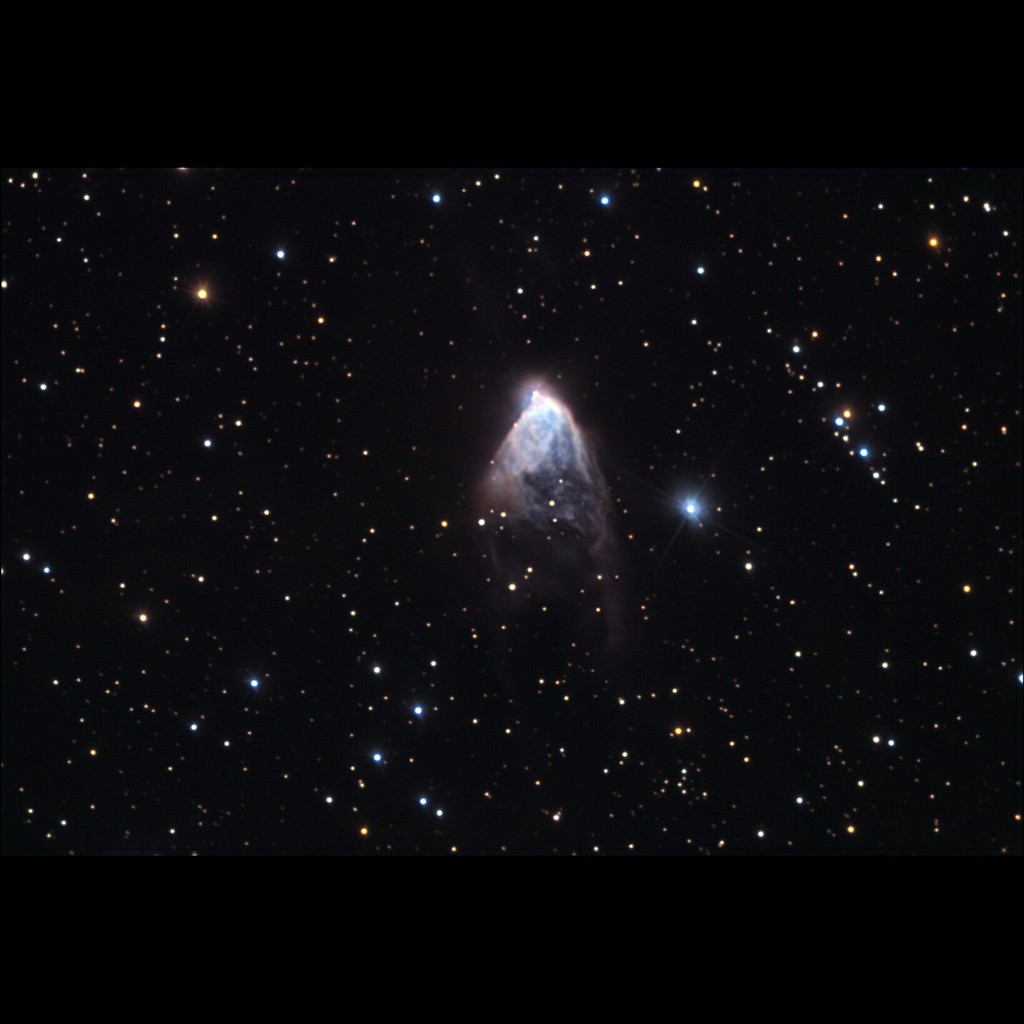
KPNO/NOIRLab/NSF/AURA/Carole Westphal/Adam Block
| Type | Reflection Nebula | Constellation | Mon |
|---|---|---|---|
| Magnitude | 9.0 | Size | 2.0′ |
| Distance | 2,500 light-years | Best Month | February |
| Visibility | Northern | Difficulty | Moderate (level 3/4) |
| Min. Aperture | 3in | RA / Dec | 06h 38m 49.2s · +08° 44' 24" |
| Discovered by | William Herschel, 1783 | ||
KPNO/NOIRLab/NSF/AURA/Carole Westphal/Adam Block
Caldwell 46, famously known as Hubble’s Variable Nebula, is a fan-shaped reflection nebula located approximately 2,500 light-years away in the constellation Monoceros. Though it looks remarkably like a comet, it is actually a cloud of gas and dust illuminated by the star R Monocerotis at its southern tip. Spanning about one light-year in length, the nebula is historically significant as the very first object ever photographed by the 200-inch Hale Telescope at Palomar Observatory in 1949.
What makes this nebula exceptional is that it "flickers" over weeks and months. Because the central star, R Mon, is a young variable star, its fluctuations cause the entire nebula to shift in brightness and structure. However, the mystery lies in the mechanism: astronomers believe the changes are actually caused by dense clouds of gas and dust orbiting very close to the star. These clouds act like shutters on a lantern, casting sweeping shadows across the foreground nebula and creating the illusion of a shifting, ghostly shape.
This detailed view was captured in 2014 as part of the Advanced Observing Program (AOP) at the Kitt Peak Visitor Center. It highlights the intricate textures of the dust that respond so dynamically to the hidden movements of the central star. For observers, Caldwell 46 remains one of the few deep-sky objects where one can witness noticeable changes in a celestial structure within a single human lifetime.
From Alhena: From Alhena (Gamma Geminorum), sweep 7° south into Monoceros.
| Star | Bayer | Mag | Spectral Type | Distance | Meaning |
|---|---|---|---|---|---|
| Procyon | β CMi | 0.40 | F5 · Yellow-white main sequence | 11 ly | Greek for 'Before the Dog' — it rises just before Sirius, the Dog Star. One of the three vertices of the Winter Triangle. |
| Betelgeuse | α Ori | 0.45 | M2 · Red supergiant | 700 ly | Arabic Ibt al-Jauzā, 'Armpit of the Central One' — the right shoulder of Orion, a red supergiant expected to explode as a supernova. |
| Alnilam | ε Ori | 1.69 | B0 · Blue-white supergiant | 2000 ly | Arabic Al-Nilam, 'String of Pearls' — the central and brightest of Orion's three belt stars, one of the most luminous stars known. |
| Alnitak | β Tau | 1.74 | O9 · Blue supergiant | 1260 ly | Arabic Al-Nitāq, 'The Girdle' — the easternmost of Orion's three belt stars, near the famous Horsehead Nebula. |
| Alhena | — | 1.93 | A0 · White giant | 109 ly | Arabic Al-Han'ah, 'The Brand' or 'The Mark on a camel's neck.' Marks the foot of Pollux in the Gemini twins. |
| Mintaka | — | 2.25 | O9 · Blue-white giant | 900 ly | Arabic Al-Mintaqa, 'The Belt' or 'The Girdle' — the westernmost of Orion's three belt stars, almost exactly on the celestial equator. |
| Gomeisa | α CMi | 2.89 | B8 · Blue-white main sequence | 170 ly | Arabic Al-Ghumaysā', 'The Weeping One' — in Arabic legend, one of two sisters mourning the death of a great star. The fainter companion to Procyon. |