Sloan Digital Sky Survey - CCBY
| Type | Globular Cluster | Constellation | Del |
|---|---|---|---|
| Magnitude | 8.9 | Size | 5.9′ |
| Distance | 50,000 light-years | Best Month | August |
| Visibility | Northern | Difficulty | Moderate (level 3/4) |
| Min. Aperture | 3in | RA / Dec | 20h 34m 04.8s · +07° 24' 00" |
| Discovered by | William Herschel, 1785 | ||
Sloan Digital Sky Survey - CCBY
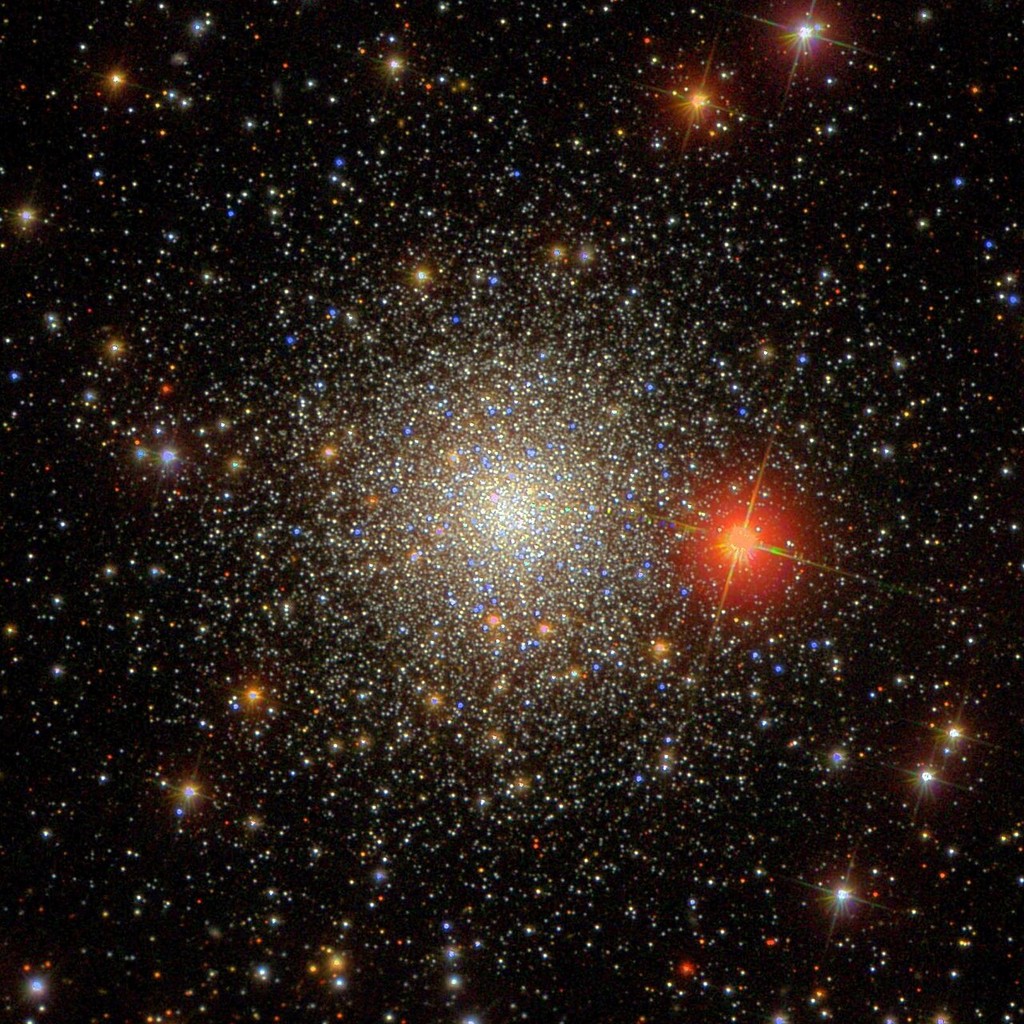
Caldwell 47, or NGC 6934, is a large and relatively bright globular cluster located roughly 50,000 light-years away in the small constellation of Delphinus. Discovered by William Herschel in 1785, it is a dense, spherical collection of hundreds of thousands of ancient stars held together by mutual gravity. While it is quite distant compared to some of its more famous cousins like M13, it remains a favorite for amateur astronomers because it is easily visible as a "fuzzy star" in small telescopes and resolves into a shimmering grain of sand in larger apertures.
This cluster is particularly notable for its high concentration of RR Lyrae variable stars. These stars are "standard candles"—astronomical tools that allow scientists to measure precise distances across the cosmos because their intrinsic brightness is well understood. By studying the pulsing light of these stars within NGC 6934, astronomers can better map the size and scale of our own Milky Way’s galactic halo, the vast outer shell where this cluster resides.
Visually, Caldwell 47 is classified as a Type IV cluster, meaning it has an intermediate-to-high concentration of stars at its core. In a dark-sky environment, long-exposure images reveal a stunning contrast between the golden-hued, aging stars at the center and the brilliant, scattered blue stars on the periphery. Its location in a relatively "empty" part of the sky makes it an excellent target for testing the resolving power of your optics and the clarity of the night air.
From Enif: From Enif (Epsilon Pegasi), sweep 5° east-northeast into Delphinus.
| Star | Bayer | Mag | Spectral Type | Distance | Meaning |
|---|---|---|---|---|---|
| Altair | α Aql | 0.76 | A7 · White main sequence | 17 ly | Arabic Al-Nasr al-Tā'ir, 'The Flying Eagle.' One of the three stars of the Summer Triangle, it spins so fast it is noticeably flattened at the poles. |
| Enif | — | 2.38 | K2 · Orange supergiant | 690 ly | Arabic Al-Anf, 'The Nose' of the horse — marks the muzzle of Pegasus. A supergiant that varies irregularly in brightness. |
| Tarazed | γ Aql | 2.72 | K3 · Orange giant | 460 ly | Persian Tarāzad, possibly 'The Beam of the Scales' — flanks Altair in Aquila, the bright orange counterpart to the white eagle star. |
| Alshain | θ Aql | 3.71 | G8 · Yellow subgiant | 45 ly | Persian Shahīn, 'The Peregrine Falcon' — flanks Altair in Aquila, part of the trio of stars that make the eagle's body. |