REU Program/NOIRLab/ NSF /AURA
| Type | Globular Cluster | Constellation | Oph |
|---|---|---|---|
| Magnitude | 6.7 | Size | 14.5′ |
| Distance | 15,700 light-years | Best Month | July |
| Visibility | Global | Difficulty | Easy (level 2/4) |
| Min. Aperture | binoculars | RA / Dec | 16h 47m 13.2s · -01° 57' 00" |
| Discovered by | Charles Messier, 1764 | ||
REU Program/NOIRLab/ NSF /AURA
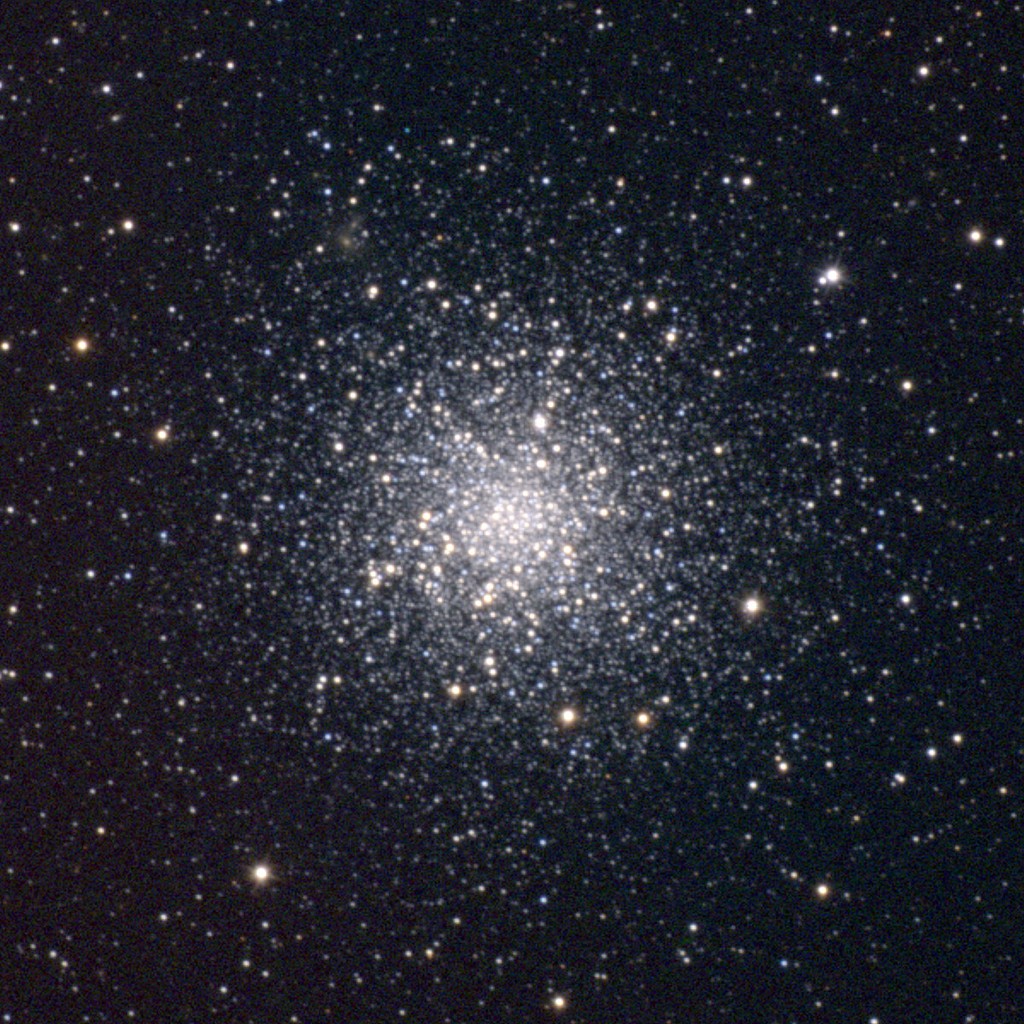
Messier 12 (NGC 6218) is a globular cluster in the constellation Ophiuchus, approximately 15,000 light-years from Earth and roughly 70 light-years across. Charles Messier discovered it on May 30, 1764, the same night he found the nearby M10. The two clusters lie less than three degrees apart in the sky and are easily compared in a single binocular sweep, yet they present a striking contrast: where M10 has a moderately concentrated core, NGC 6218 is one of the more loosely structured of Messier's globulars, with a gradual density gradient from center to edge and no sharply defined core.
NGC 6218 contains somewhere between 150,000 and 200,000 stars at an estimated age of around 12 billion years. Its loose concentration class — intermediate between the extremes — means stars are distributed more evenly than in a dense, post-core-collapse globular. Astronomers have found that M12 has shed an unusually large proportion of its low-mass stars into the Milky Way halo over its lifetime, leaving it relatively depleted in the faintest members compared with globulars of similar size. A few dozen variable stars, including RR Lyrae pulsators, have been identified within the cluster.
A 60–80 mm telescope shows M12 as a large, softly glowing sphere; apertures of 150 mm begin to sprinkle individual stars across the face of the cluster, especially at the edges. This approximately true-color image was assembled from BVR exposures taken in June 1995 at the Burrell Schmidt telescope of Case Western Reserve University's Warner and Swasey Observatory on Kitt Peak, as part of the Research Experiences for Undergraduates (REU) program supported by the National Science Foundation.
Navigate from Arcturus toward Ophiuchus. In Ophiuchus — 3° northwest of M10, both visible in the same binocular field.
| Star | Bayer | Mag | Spectral Type | Distance | Meaning |
|---|---|---|---|---|---|
| Unukalhai | α Ser | 2.63 | K2 · Orange giant | 74 ly | Arabic 'Unuq al-Hayyah, 'Neck of the Snake' — the brightest star in Serpens, marking where the serpent is held by Ophiuchus. |
| Cebalrai | γ Oph | 2.76 | K2 · Orange giant | 82 ly | Arabic Kalb al-Rā'ī, 'Heart of the Shepherd' — a quiet orange star marking the body of Ophiuchus the Serpent Bearer. |