N.A.Sharp, REU program/NOIRLab/ NSF /AURA
| Type | Open Cluster | Constellation | Sct |
|---|---|---|---|
| Magnitude | 5.8 | Size | 14.0′ |
| Distance | 6,200 light-years | Best Month | August |
| Visibility | Global | Difficulty | Easiest (level 1/4) |
| Min. Aperture | naked eye | RA / Dec | 18h 51m 07.2s · -06° 16' 12" |
| Discovered by | Gottfried Kirch, 1681 | ||
N.A.Sharp, REU program/NOIRLab/ NSF /AURA
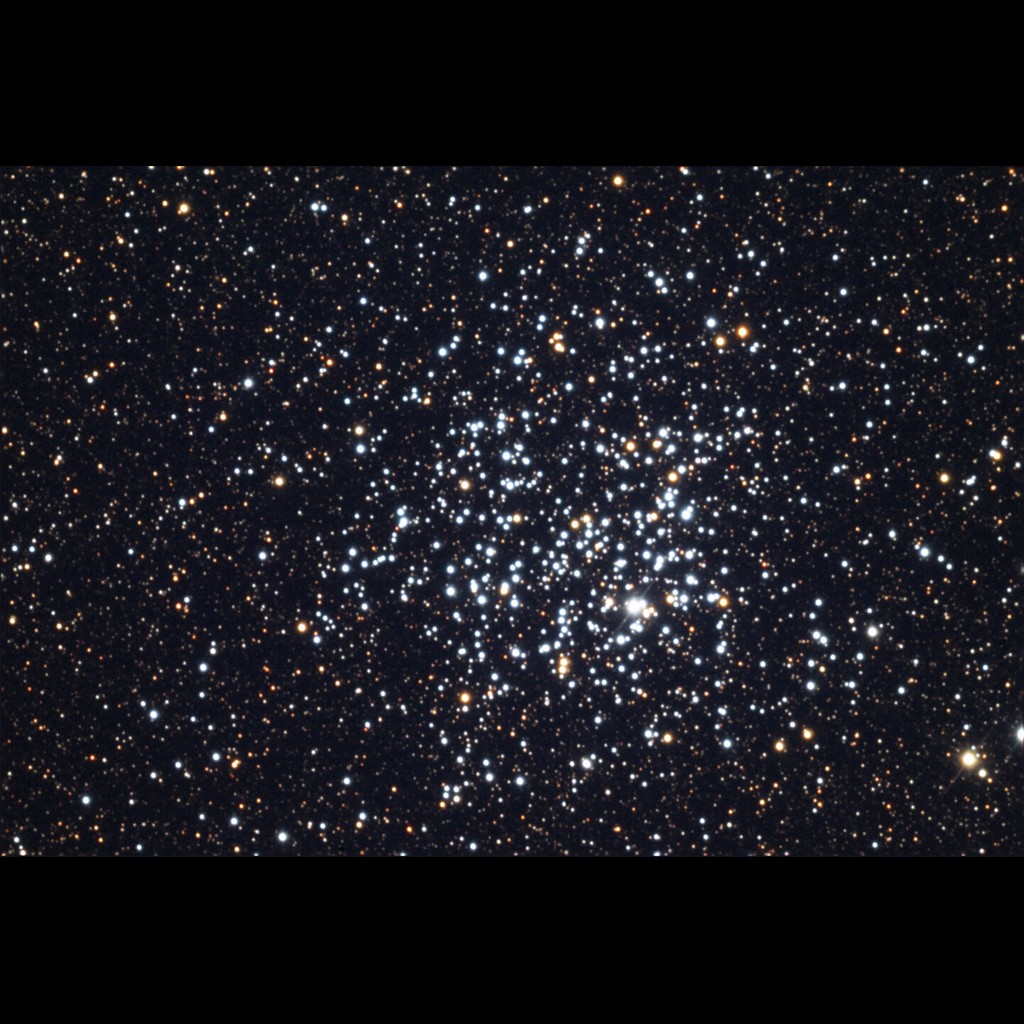
Messier 11 (NGC 6705), the Wild Duck Cluster, is one of the richest and most compact open star clusters known, containing nearly 3,000 stars compressed into a span of roughly 20 light-years. It lies approximately 6,200 light-years away in the small but star-rich constellation Scutum. The cluster was first recorded by Gottfried Kirch in 1681 and later described by William Derham in 1733 as resembling a flight of wild ducks in a V-formation — giving it a name that has endured. Charles Messier catalogued it in 1764. Through any telescope it is a stunning sight: so richly populated that it resembles a loose globular cluster rather than the open clusters typical of the Milky Way disk.
NGC 6705 is estimated to be between 220 and 250 million years old — old enough that its most massive stars have long since evolved away, but young enough that it retains hundreds of blue-white stars and a bright foreground giant near the cluster's apparent center. The cluster is gravitationally bound and remarkably concentrated, with a central density that rivals some globular clusters. Set against the dense star fields of the Scutum Star Cloud — one of the brightest patches of the summer Milky Way — M11 sits in one of the most spectacular regions of the night sky for wide-field observing.
Through binoculars M11 appears as a glowing knot of light brighter than the surrounding Milky Way; a small telescope resolves dozens of stars against a glittering background haze. This color composite was assembled from CCD images taken in July 1995 at the Burrell Schmidt telescope of Case Western Reserve University's Warner and Swasey Observatory on Kitt Peak, as part of the Research Experiences for Undergraduates (REU) program supported by the National Science Foundation.
Navigate from Vega toward Scutum. In Scutum, in the rich Milky Way star cloud — look for a compressed haze just south of the Eagle Nebula region.
| Star | Bayer | Mag | Spectral Type | Distance | Meaning |
|---|---|---|---|---|---|
| Cebalrai | γ Oph | 2.76 | K2 · Orange giant | 82 ly | Arabic Kalb al-Rā'ī, 'Heart of the Shepherd' — a quiet orange star marking the body of Ophiuchus the Serpent Bearer. |