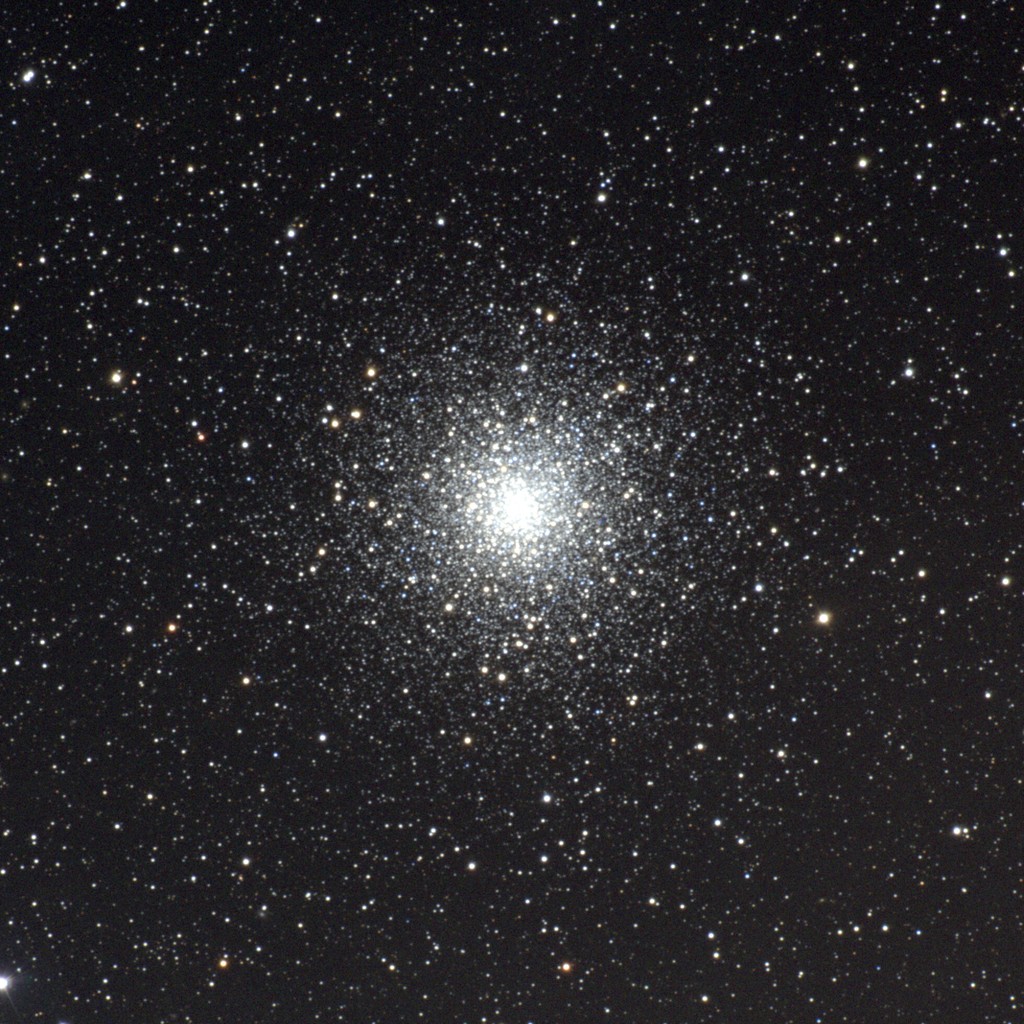
N.A.Sharp, Vanessa Harvey/REU program/NOIRLab/ NSF /AURA
| Type | Globular Cluster | Constellation | Oph |
|---|---|---|---|
| Magnitude | 6.6 | Size | 15.1′ |
| Distance | 14,300 light-years | Best Month | July |
| Visibility | Global | Difficulty | Easy (level 2/4) |
| Min. Aperture | binoculars | RA / Dec | 16h 57m 07.2s · -04° 05' 60" |
| Discovered by | Charles Messier, 1764 | ||
N.A.Sharp, Vanessa Harvey/REU program/NOIRLab/ NSF /AURA
Messier 10 (NGC 6254) is a seventh-magnitude globular cluster in the constellation Ophiuchus, located approximately 16,000 light-years from Earth. It was discovered by Charles Messier on May 29, 1764, who described it as a "nebula without stars, fine and round." William Herschel later resolved NGC 6254 into stars. M10 spans roughly 70 light-years and covers an area of sky about half the diameter of the full Moon — making it one of the more prominent globulars in Ophiuchus. Its near-twin, M12, lies less than three degrees to the northwest, and the two clusters make a compelling comparison pair through a wide-field eyepiece.
NGC 6254 is a moderately concentrated globular with a comparatively loose core — notably less centrally packed than many other Messier globulars. It contains somewhere between 100,000 and 200,000 stars, many of them ancient red giants that give the cluster a warm overall tint in color images. The cluster is moving toward us at roughly 70 kilometers per second, gradually approaching over cosmic timescales. A handful of variable stars, including RR Lyrae pulsators, have been detected within M10 and used to refine its distance.
A small telescope reveals M10 as a large, softly glowing ball with a brighter core; 150 mm aperture begins to resolve stars at the edges. This image was assembled from CCD exposures taken in June 1996 at the Burrell Schmidt telescope of Case Western Reserve University's Warner and Swasey Observatory on Kitt Peak, as part of the Research Experiences for Undergraduates (REU) program supported by the National Science Foundation.
Navigate from Arcturus toward Ophiuchus. In Ophiuchus — forms a pair with M12 about 3° to the northwest.
| Star | Bayer | Mag | Spectral Type | Distance | Meaning |
|---|---|---|---|---|---|
| Cebalrai | γ Oph | 2.76 | K2 · Orange giant | 82 ly | Arabic Kalb al-Rā'ī, 'Heart of the Shepherd' — a quiet orange star marking the body of Ophiuchus the Serpent Bearer. |