NOIRLab/ NSF /AURA
| Type | Globular Cluster | Constellation | Oph |
|---|---|---|---|
| Magnitude | 7.9 | Size | 9.3′ |
| Distance | 25,800 light-years | Best Month | July |
| Visibility | Global | Difficulty | Moderate (level 3/4) |
| Min. Aperture | 3in | RA / Dec | 17h 19m 12.0s · -18° 31' 12" |
| Discovered by | Charles Messier, 1764 | ||
NOIRLab/ NSF /AURA
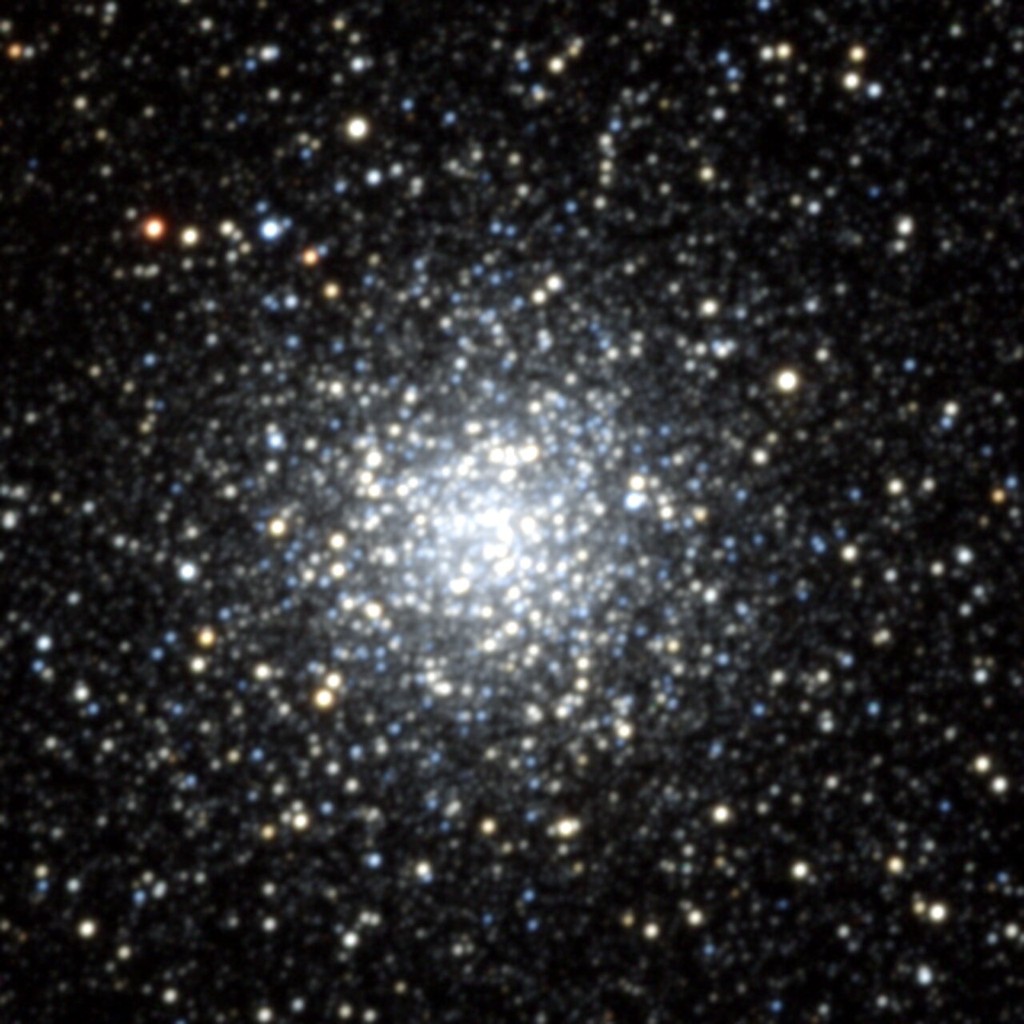
Messier 9 (NGC 6333) is a globular cluster in the constellation Ophiuchus, nestled relatively close to the galactic center — approximately 26,000 light-years from Earth and only about 5,500 light-years from the Milky Way's core. It was discovered by Charles Messier on May 28, 1764, who described it as a "nebula without stars." Though NGC 6333 appears small on the sky compared to globulars farther from the galactic plane, it is a substantial object: roughly 70 light-years across and densely packed with hundreds of thousands of ancient stars.
NGC 6333 sits in a region rich in interstellar dust, and the effect is immediately visible in images: the cluster's outline is noticeably oval rather than round, the result of dust in the north-west direction absorbing and scattering starlight selectively. This same dust dims M9 significantly, making it fainter than its actual luminosity would suggest. The cluster has a strong central concentration, with stars crowding tightly toward the core. Relatively few variable stars — only about a dozen — have been identified within NGC 6333, modest compared with richer or more accessible globular clusters.
In a small telescope M9 appears as a compact, slightly oval haze with a brighter center; resolving its individual stars requires apertures of 200 mm or more. It is best located by sweeping east from the star Eta Ophiuchi. This image was taken in April 1995 at the Kitt Peak National Observatory 0.9-meter telescope.
Navigate from Vega toward Ophiuchus. In Ophiuchus, near the star Eta Ophiuchi.
| Star | Bayer | Mag | Spectral Type | Distance | Meaning |
|---|---|---|---|---|---|
| Antares | α Sco | 1.06 | M1 · Red supergiant | 550 ly | Greek Antares, 'Rival of Mars' — its fiery red color rivals the planet Mars. The blazing heart of Scorpius and one of the largest stars known. |
| Graffias | — | 2.56 | B0 · Blue-white binary | 530 ly | Greek origin meaning 'Claws' — one of several names for the head of Scorpius. A fine double star in small telescopes. |
| Kaus Meridionalis | δ Sgr | 2.72 | K3 · Orange giant | 306 ly | Hybrid Arabic-Latin, 'Middle of the Bow' — the central bow star of Sagittarius, part of the famous Teapot asterism. |
| Kaus Borealis | — | 2.82 | K1 · Orange giant | 78 ly | Hybrid Arabic-Latin, 'Northern Bow' — marks the top of the Archer's bow in Sagittarius. Part of the Teapot asterism. |
| Nash | — | 2.98 | K0 · Orange giant | 97 ly | Arabic Al-Nasl, 'The Arrowhead' or 'The Point' — marks the tip of the Archer's arrow aimed at the heart of Scorpius. |