NOIRLab/NSF/AURA
| Type | Emission Nebula | Constellation | Sgr |
|---|---|---|---|
| Magnitude | 6.0 | Size | 90.0′ |
| Distance | 4,100 light-years | Best Month | August |
| Visibility | Global | Difficulty | Easiest (level 1/4) |
| Min. Aperture | naked eye | RA / Dec | 18h 03m 46.8s · -24° 22' 48" |
| Discovered by | Giovanni Batista Hodierna, 1654 | ||
NOIRLab/NSF/AURA
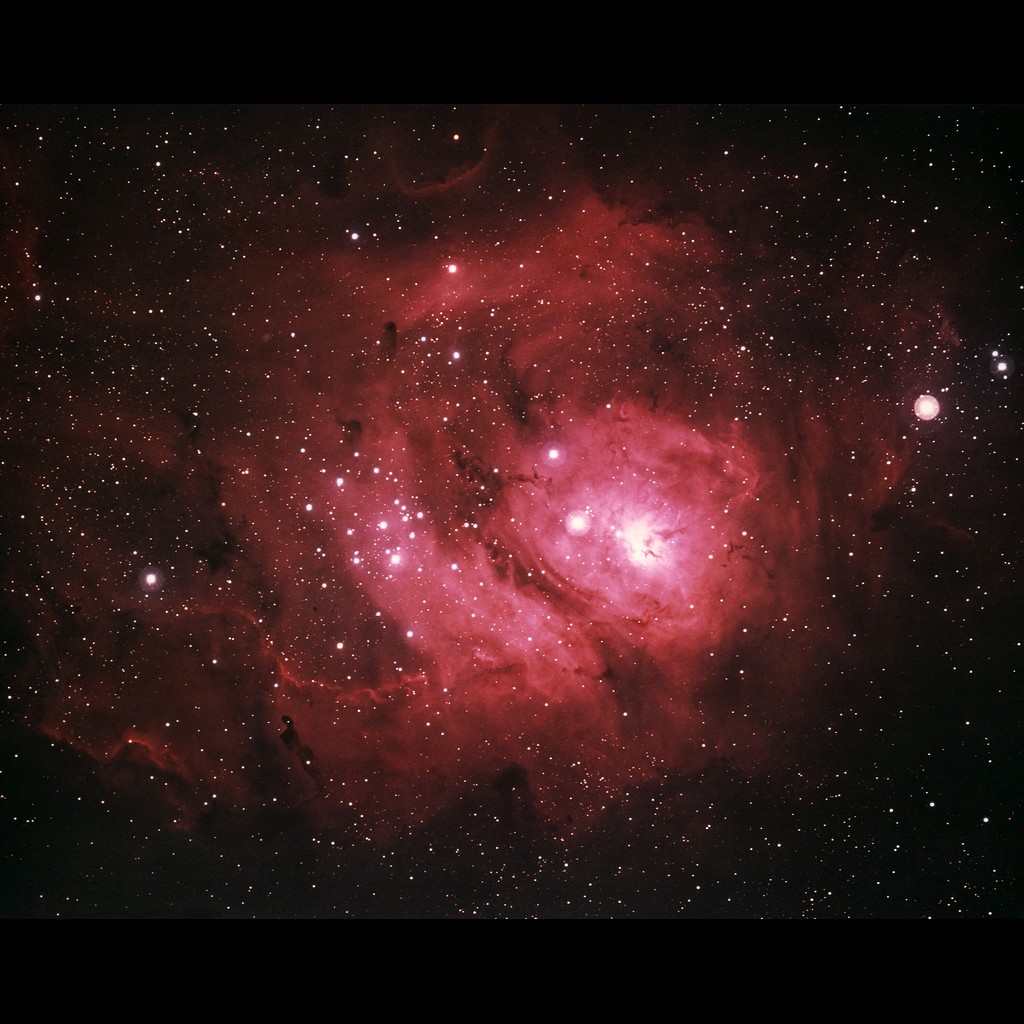
Messier 8 (NGC 6523), the Lagoon Nebula, is a sweeping emission nebula and star-forming region in the constellation Sagittarius, lying approximately 6,500 light-years from Earth and spanning about 60 light-years across. It was first recorded by Giovanni Battista Hodierna before 1654, and Guillaume Le Gentil independently observed it in 1747; Charles Messier catalogued it in 1764. The Lagoon's distinctive structure — a glowing cloud bisected by a dark dust lane that early observers likened to a lagoon or tidal inlet — is visible to the naked eye from a dark site as a fuzzy patch in the Milky Way, and becomes a spectacular sight in binoculars or a telescope.
NGC 6523 glows with the characteristic red light of hydrogen energized by ultraviolet radiation from a handful of intensely hot, young stars buried within its center. Deep inside the brightest knot of the nebula, known as the Hourglass Region, powerful stellar winds sculpt dark filaments and pillars of dust that emit strongly in the infrared — sites where new stars may be condensing even now. Several peculiar variable stars within the nebula occasionally flare to roughly 25 times their normal brightness, and the embedded open cluster NGC 6530 contains dozens of hot blue stars that formed from this cloud within the past few million years.
The Lagoon is one of only two star-forming nebulae visible to the unaided eye from northern latitudes (the other is the Orion Nebula), and it rewards any aperture. This image was captured at the Kitt Peak National Observatory 4-meter Mayall telescope in 1973, with north at the top.
Navigate from Vega toward Sagittarius. In Sagittarius — follow the spout of the Teapot asterism upward; M8 is the first bright nebula above it.
| Star | Bayer | Mag | Spectral Type | Distance | Meaning |
|---|---|---|---|---|---|
| Kaus Australis | ε Sgr | 1.79 | B9 · Blue-white giant | 143 ly | Hybrid Arabic-Latin, 'Southern Bow' — the brightest star in Sagittarius, at the base of the Archer's bow. Part of the Teapot asterism. |
| Nunki | ζ Sgr | 2.05 | B2 · Blue-white main sequence | 228 ly | Babylonian origin — one of the oldest known star names, from the Babylonian star catalogue. Associated with the sacred city of Eridu. |
| Kaus Meridionalis | δ Sgr | 2.72 | K3 · Orange giant | 306 ly | Hybrid Arabic-Latin, 'Middle of the Bow' — the central bow star of Sagittarius, part of the famous Teapot asterism. |
| Kaus Borealis | — | 2.82 | K1 · Orange giant | 78 ly | Hybrid Arabic-Latin, 'Northern Bow' — marks the top of the Archer's bow in Sagittarius. Part of the Teapot asterism. |
| Nash | — | 2.98 | K0 · Orange giant | 97 ly | Arabic Al-Nasl, 'The Arrowhead' or 'The Point' — marks the tip of the Archer's arrow aimed at the heart of Scorpius. |