N.A.Sharp, REU program/NOIRLab/ NSF /AURA
| Type | Open Cluster | Constellation | Sco |
|---|---|---|---|
| Magnitude | 3.3 | Size | 80.0′ |
| Distance | 800 light-years | Best Month | July |
| Visibility | Global | Difficulty | Easiest (level 1/4) |
| Min. Aperture | naked eye | RA / Dec | 17h 53m 52.8s · -34° 49' 12" |
| Discovered by | Claudius Ptolemy, 130 | ||
N.A.Sharp, REU program/NOIRLab/ NSF /AURA
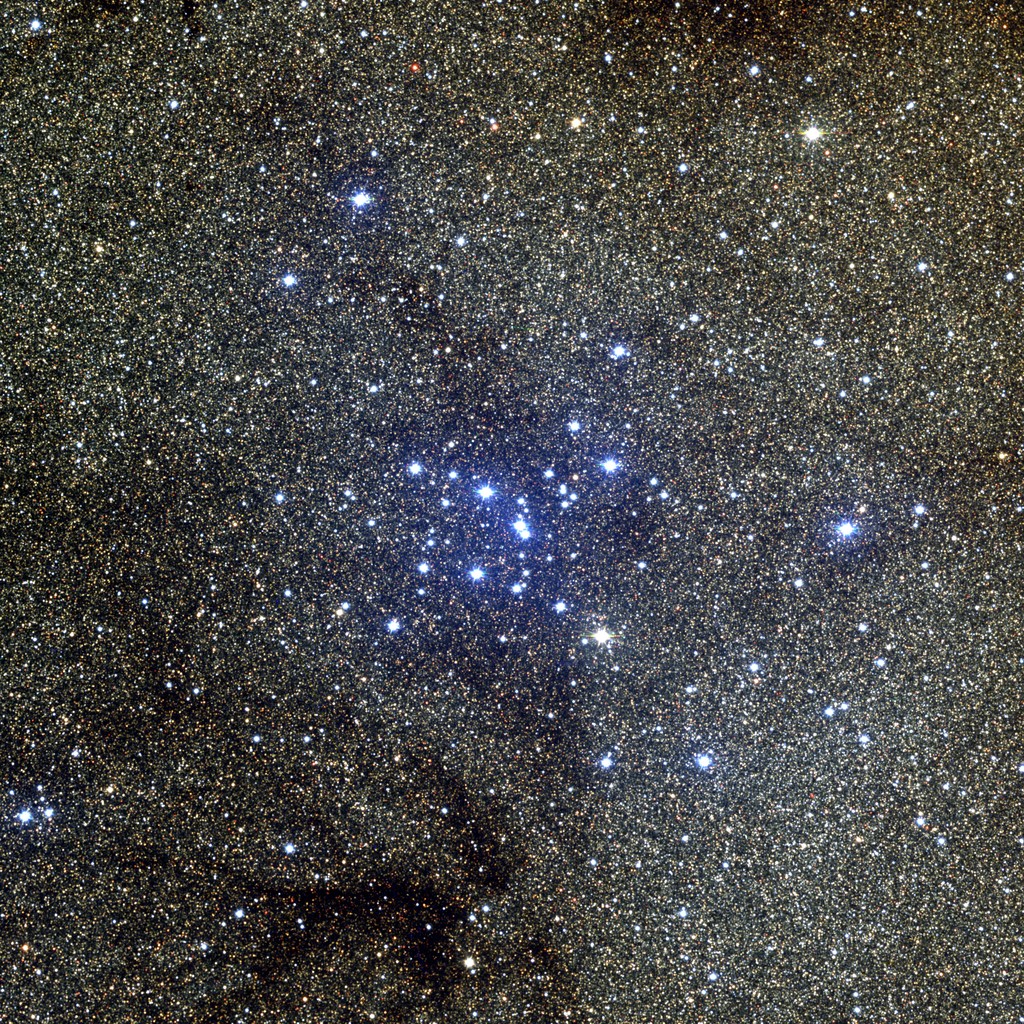
Messier 7 (NGC 6475), sometimes called Ptolemy's Cluster, is one of the most ancient recorded deep-sky objects in the sky. The Greek-Egyptian astronomer Claudius Ptolemy noted it in 130 AD as "a nebula following the sting of Scorpius," making it one of the earliest catalogued celestial objects outside of stars and planets. Charles Messier added it to his list in 1764. The cluster lies in the constellation Scorpius, projected against a dense backdrop of Milky Way starfields that makes for one of the most photogenic open cluster views in the sky — a sparkling foreground swarm set against a glittering river of background stars.
NGC 6475 contains around 80 stars spread across roughly 20–25 light-years; its distance is estimated at 800–1,000 light-years. The stars are estimated to be in excess of 200 million years old, considerably more evolved than its neighbor M6, and several bright yellow and orange giants among the membership signal that the cluster is gradually losing its hottest, most massive stars to age. Compared with the tighter Butterfly Cluster nearby, M7 is loose and sprawling — best appreciated through binoculars or a rich-field telescope rather than a high-power eyepiece.
M7 is visible to the naked eye as a broad misty patch low in the southern sky; binoculars immediately resolve it into dozens of stars scattered across a field wider than the full Moon. This color composite was assembled from CCD images taken in June and July 1995 at the Burrell Schmidt telescope of Warner and Swasey Observatory on Kitt Peak, as part of the Research Experiences for Undergraduates (REU) program supported by the National Science Foundation.
Navigate from Rigel toward Scorpius. The tail of Scorpius — M7 is the large naked-eye glow just east of the Scorpion's stinger.
| Star | Bayer | Mag | Spectral Type | Distance | Meaning |
|---|---|---|---|---|---|
| Shaula | — | 1.62 | B1 · Blue-white subgiant | 700 ly | Arabic Al-Shawlā', 'The Raised Tail' — the stinger of Scorpius, one of the brightest stars in the southern sky and a navigation star. |
| Kaus Australis | ε Sgr | 1.79 | B9 · Blue-white giant | 143 ly | Hybrid Arabic-Latin, 'Southern Bow' — the brightest star in Sagittarius, at the base of the Archer's bow. Part of the Teapot asterism. |
| Sargas | η Sco | 1.86 | F1 · White supergiant | 272 ly | Sumerian origin of uncertain meaning — one of the oldest star names. Marks the upper tail of Scorpius, a rare white supergiant. |
| Nunki | ζ Sgr | 2.05 | B2 · Blue-white main sequence | 228 ly | Babylonian origin — one of the oldest known star names, from the Babylonian star catalogue. Associated with the sacred city of Eridu. |
| Kaus Meridionalis | δ Sgr | 2.72 | K3 · Orange giant | 306 ly | Hybrid Arabic-Latin, 'Middle of the Bow' — the central bow star of Sagittarius, part of the famous Teapot asterism. |
| Kaus Borealis | — | 2.82 | K1 · Orange giant | 78 ly | Hybrid Arabic-Latin, 'Northern Bow' — marks the top of the Archer's bow in Sagittarius. Part of the Teapot asterism. |
| Nash | — | 2.98 | K0 · Orange giant | 97 ly | Arabic Al-Nasl, 'The Arrowhead' or 'The Point' — marks the tip of the Archer's arrow aimed at the heart of Scorpius. |