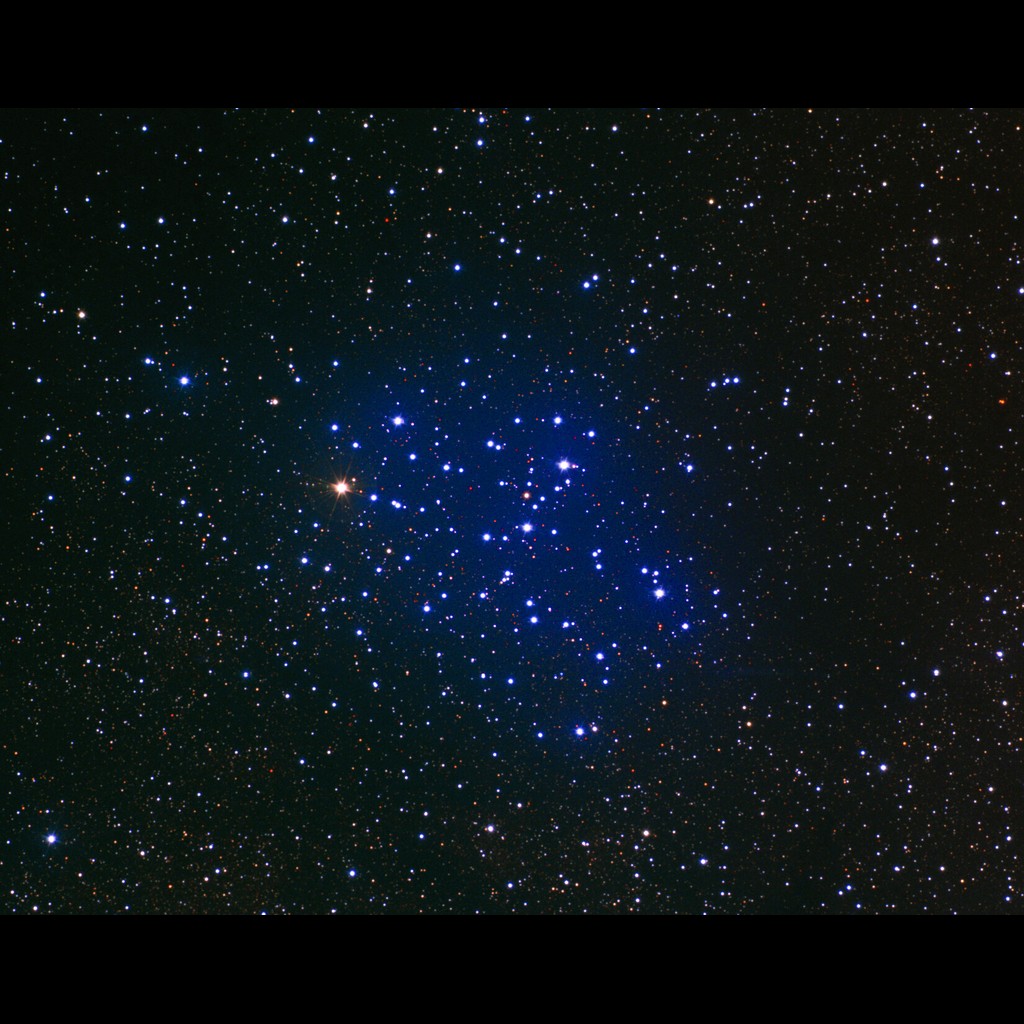
N.A.Sharp, Mark Hanna, REU program/NOIRLab/NSF/AURA
| Type | Open Cluster | Constellation | Sco |
|---|---|---|---|
| Magnitude | 4.2 | Size | 25.0′ |
| Distance | 1,600 light-years | Best Month | July |
| Visibility | Global | Difficulty | Easiest (level 1/4) |
| Min. Aperture | naked eye | RA / Dec | 17h 40m 04.8s · -32° 15' 00" |
| Discovered by | Giovanni Batista Hodierna, 1654 | ||
N.A.Sharp, Mark Hanna, REU program/NOIRLab/NSF/AURA
Messier 6 (NGC 6405), popularly known as the Butterfly Cluster, is a bright open star cluster in the constellation Scorpius, visible to the naked eye on dark, transparent nights. It may have been observed by Giovanni Battista Hodierna before 1654; Charles Messier catalogued it in 1764. The "butterfly" name comes from the way the brightest members trace the outline of a butterfly with wings outstretched — a pattern that stands out clearly in binoculars or a wide-field telescope. The cluster lies approximately 1,600 light-years away and is estimated to be between 50 and 100 million years old, a youngster by astronomical standards.
NGC 6405 contains roughly 80 stars spread across about 12 light-years. The most visually prominent member is BM Scorpii, a bright orange-red star and slow semiregular variable that serves as a striking color counterpoint to the cluster's many hot blue-white stars — a beautiful pairing that illustrates the range of stellar temperatures present even in a young cluster. The Butterfly Cluster sits near the richer cluster M7 along the same stretch of Scorpius Milky Way, and the two make a rewarding low-power binocular pair.
From a dark site, M6 is an easy naked-eye object; binoculars reveal the butterfly shape immediately, and a small telescope shows individual stars cascading across the field. This image was taken in June 1995 at the Burrell Schmidt telescope of Case Western Reserve University's Warner and Swasey Observatory on Kitt Peak, as part of the Research Experiences for Undergraduates (REU) program supported by the National Science Foundation.
Navigate from Rigel toward Scorpius. M6 and M7 lie in the tail of Scorpius — M6 is the northern of the two, about 5° north of M7.
| Star | Bayer | Mag | Spectral Type | Distance | Meaning |
|---|---|---|---|---|---|
| Antares | α Sco | 1.06 | M1 · Red supergiant | 550 ly | Greek Antares, 'Rival of Mars' — its fiery red color rivals the planet Mars. The blazing heart of Scorpius and one of the largest stars known. |
| Shaula | — | 1.62 | B1 · Blue-white subgiant | 700 ly | Arabic Al-Shawlā', 'The Raised Tail' — the stinger of Scorpius, one of the brightest stars in the southern sky and a navigation star. |
| Kaus Australis | ε Sgr | 1.79 | B9 · Blue-white giant | 143 ly | Hybrid Arabic-Latin, 'Southern Bow' — the brightest star in Sagittarius, at the base of the Archer's bow. Part of the Teapot asterism. |
| Sargas | η Sco | 1.86 | F1 · White supergiant | 272 ly | Sumerian origin of uncertain meaning — one of the oldest star names. Marks the upper tail of Scorpius, a rare white supergiant. |
| Nunki | ζ Sgr | 2.05 | B2 · Blue-white main sequence | 228 ly | Babylonian origin — one of the oldest known star names, from the Babylonian star catalogue. Associated with the sacred city of Eridu. |
| Kaus Meridionalis | δ Sgr | 2.72 | K3 · Orange giant | 306 ly | Hybrid Arabic-Latin, 'Middle of the Bow' — the central bow star of Sagittarius, part of the famous Teapot asterism. |
| Kaus Borealis | — | 2.82 | K1 · Orange giant | 78 ly | Hybrid Arabic-Latin, 'Northern Bow' — marks the top of the Archer's bow in Sagittarius. Part of the Teapot asterism. |
| Nash | — | 2.98 | K0 · Orange giant | 97 ly | Arabic Al-Nasl, 'The Arrowhead' or 'The Point' — marks the tip of the Archer's arrow aimed at the heart of Scorpius. |