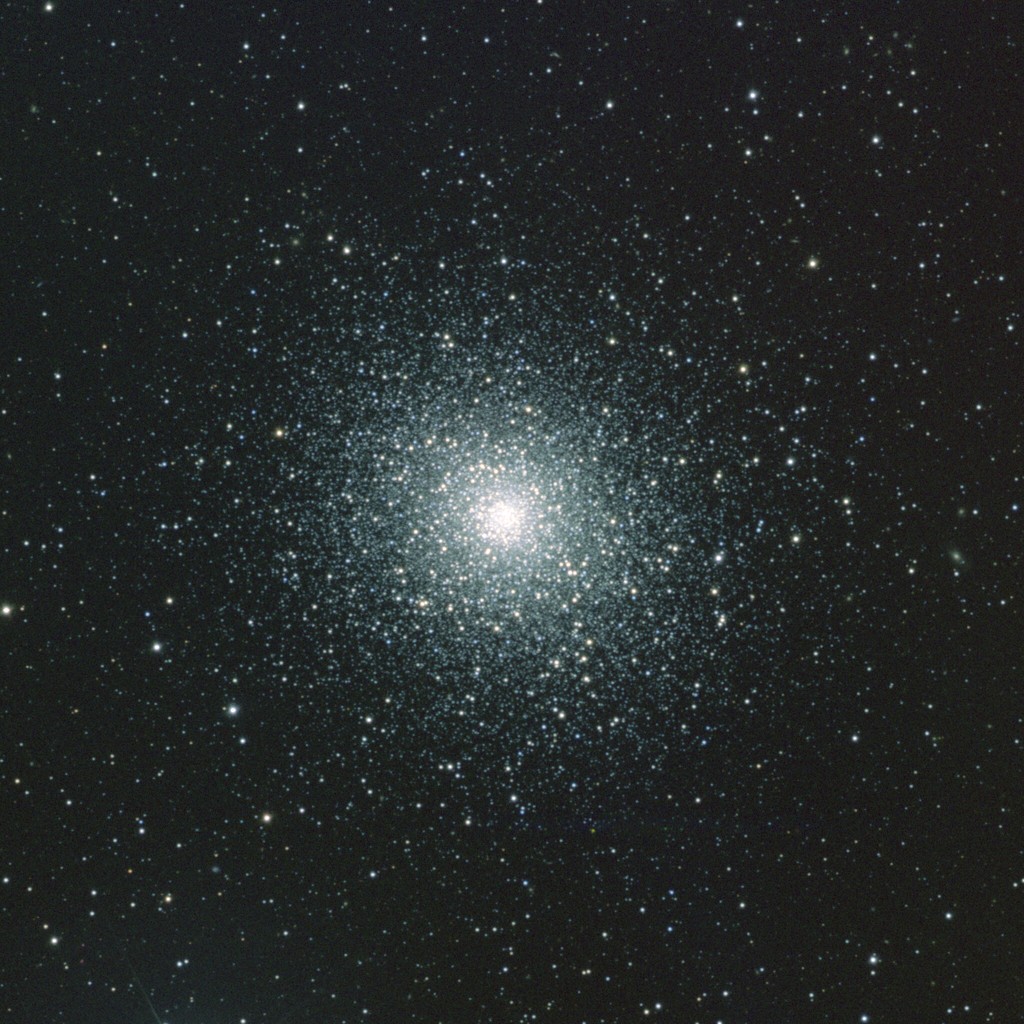
Hillary Mathis, REU Program/NOIRLab/ NSF /AURA
| Type | Globular Cluster | Constellation | Ser |
|---|---|---|---|
| Magnitude | 6.7 | Size | 17.4′ |
| Distance | 24,500 light-years | Best Month | June |
| Visibility | Global | Difficulty | Easy (level 2/4) |
| Min. Aperture | binoculars | RA / Dec | 15h 18m 32.4s · +02° 04' 48" |
| Discovered by | Gottfried Kirch, 1702 | ||
Hillary Mathis, REU Program/NOIRLab/ NSF /AURA
Messier 5 (NGC 5904) is one of the oldest, largest, and most spectacular globular clusters visible from the northern hemisphere, located approximately 25,000 light-years away in the constellation Serpens. It was discovered on May 5, 1702, by German astronomers Gottfried and Maria Margaretha Kirch, who logged it as a "nebulous star." Charles Messier catalogued it independently in 1764, and William Herschel resolved NGC 5904 into stars in 1791. On exceptionally clear, dark nights the cluster is just visible to the unaided eye — a fuzzy pinprick of light that binoculars immediately resolve into a glowing sphere.
NGC 5904 contains around 500,000 stars spread across roughly 165 light-years, with an age estimated at 12–13 billion years. It is slightly elliptical — more elongated than most globulars — and its concentrated, brilliant core gives way to a richly populated outer halo. The cluster hosts more than 100 known variable stars, including RR Lyrae variables that helped establish early distance scales for the Milky Way. M5 is moving toward the Sun at about 50 kilometers per second; over the aeons it has lost an enormous envelope of stars to tidal stripping, leaving a faint stream of escaping members trailing behind it through the halo.
A small telescope reveals M5 as a glowing orb with a noticeably brighter core; apertures of 150 mm or more begin to resolve a cascade of individual stars across the face of the cluster. This approximately true-color image was assembled from fourteen BVR exposures taken in June and July 1997 at the Burrell Schmidt telescope of Case Western Reserve University's Warner and Swasey Observatory on Kitt Peak, as part of the Research Experiences for Undergraduates (REU) program supported by the National Science Foundation.
From Arcturus: From Arcturus, sweep 16° south into Serpens Caput, near the star 5 Serpentis.
| Star | Bayer | Mag | Spectral Type | Distance | Meaning |
|---|---|---|---|---|---|
| Arcturus | α Boo | -0.05 | K2 · Orange giant | 37 ly | Greek Arktouros, 'Guardian of the Bear' — it follows Ursa Major across the sky. The brightest star in the northern hemisphere. |
| Zubeneschemali | β Lib | 2.61 | B8 · Blue-white main sequence | 160 ly | Arabic Al-Zubānā al-Shamālī, 'The Northern Claw' — the only bright star in the sky with a distinctly greenish tint to the naked eye. |
| Unukalhai | α Ser | 2.63 | K2 · Orange giant | 74 ly | Arabic 'Unuq al-Hayyah, 'Neck of the Snake' — the brightest star in Serpens, marking where the serpent is held by Ophiuchus. |
| Zubenelgenubi | α Lib | 2.75 | A3 · White binary | 77 ly | Arabic Al-Zubānā al-Janūbī, 'The Southern Claw' — Libra was once the claws of Scorpius in Greek astronomy before becoming the Scales. |