NOIRLab/ NSF /AURA
| Type | Globular Cluster | Constellation | Sco |
|---|---|---|---|
| Magnitude | 5.9 | Size | 26.3′ |
| Distance | 7,200 light-years | Best Month | July |
| Visibility | Global | Difficulty | Easiest (level 1/4) |
| Min. Aperture | naked eye | RA / Dec | 16h 23m 34.8s · -26° 31' 48" |
| Discovered by | Philippe Loys de Chéseaux, 1746 | ||
NOIRLab/ NSF /AURA
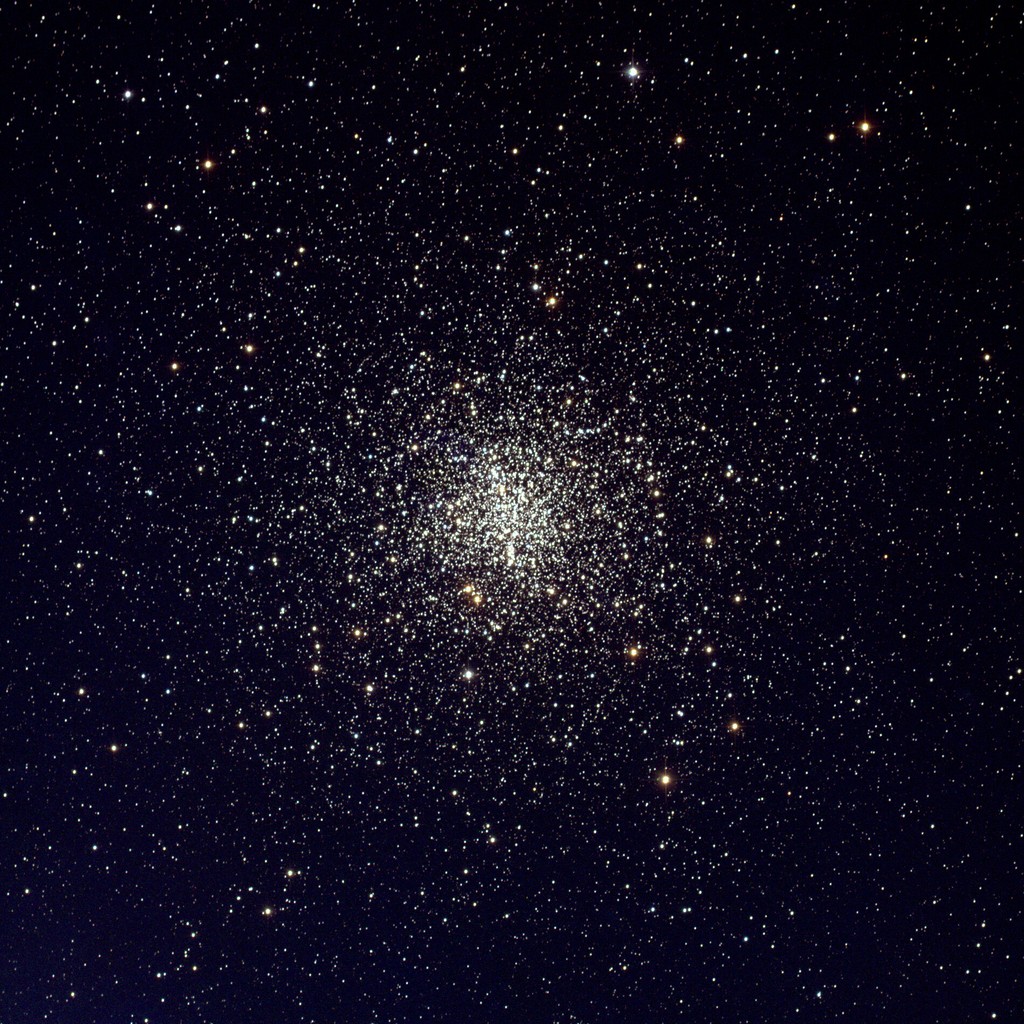
Messier 4 (NGC 6121) is the closest globular cluster to Earth, lying roughly 7,000 light-years away in the constellation Scorpius — so near that its outer stars can be resolved with a modest backyard telescope. It was first noted by Philippe Loys de Chéseaux in 1746, and Charles Messier observed it in 1764, becoming the first astronomer to resolve it into individual stars. Despite its proximity, NGC 6121 never rises particularly high in the sky for northern observers, and a thick curtain of intervening interstellar dust dims it considerably and imparts a slightly warm, brownish cast to its light.
NGC 6121 contains roughly 100,000 stars and is estimated to be about 12 billion years old — among the older members of the Milky Way's globular cluster system. One of its most distinctive features is an unusual central bar structure, a linear concentration of brighter stars running across the core that is rare among globular clusters. In 1995, astronomers using the Hubble Space Telescope discovered white dwarf stars within M4 that carry isotopic signatures of heavy elements forged in an earlier generation of stars, offering direct evidence of the cluster's ancient stellar history. A millisecond pulsar, PSR B1620−26, also resides in M4 and is orbited by one of the oldest known exoplanets, estimated at about 13 billion years old.
Through binoculars M4 is a large, loosely resolved haze just a degree west of the bright star Antares; even small telescopes reveal individual stars across the face of the cluster. This image was made with the T2KA CCD camera at the Kitt Peak National Observatory 0.9-meter telescope in March 1995.
Navigate from Rigel toward Scorpius. M4 lies just 1.3° west of the brilliant red star Antares in Scorpius — the easiest globular to find in the sky.
| Star | Bayer | Mag | Spectral Type | Distance | Meaning |
|---|---|---|---|---|---|
| Antares | α Sco | 1.06 | M1 · Red supergiant | 550 ly | Greek Antares, 'Rival of Mars' — its fiery red color rivals the planet Mars. The blazing heart of Scorpius and one of the largest stars known. |
| Shaula | — | 1.62 | B1 · Blue-white subgiant | 700 ly | Arabic Al-Shawlā', 'The Raised Tail' — the stinger of Scorpius, one of the brightest stars in the southern sky and a navigation star. |
| Dschubba | λ Sco | 2.29 | B0 · Blue subgiant | 400 ly | Arabic Al-Jabhah, 'The Forehead' — marks the head of Scorpius. A rapidly rotating blue star that has shed a disk of material. |
| Graffias | — | 2.56 | B0 · Blue-white binary | 530 ly | Greek origin meaning 'Claws' — one of several names for the head of Scorpius. A fine double star in small telescopes. |